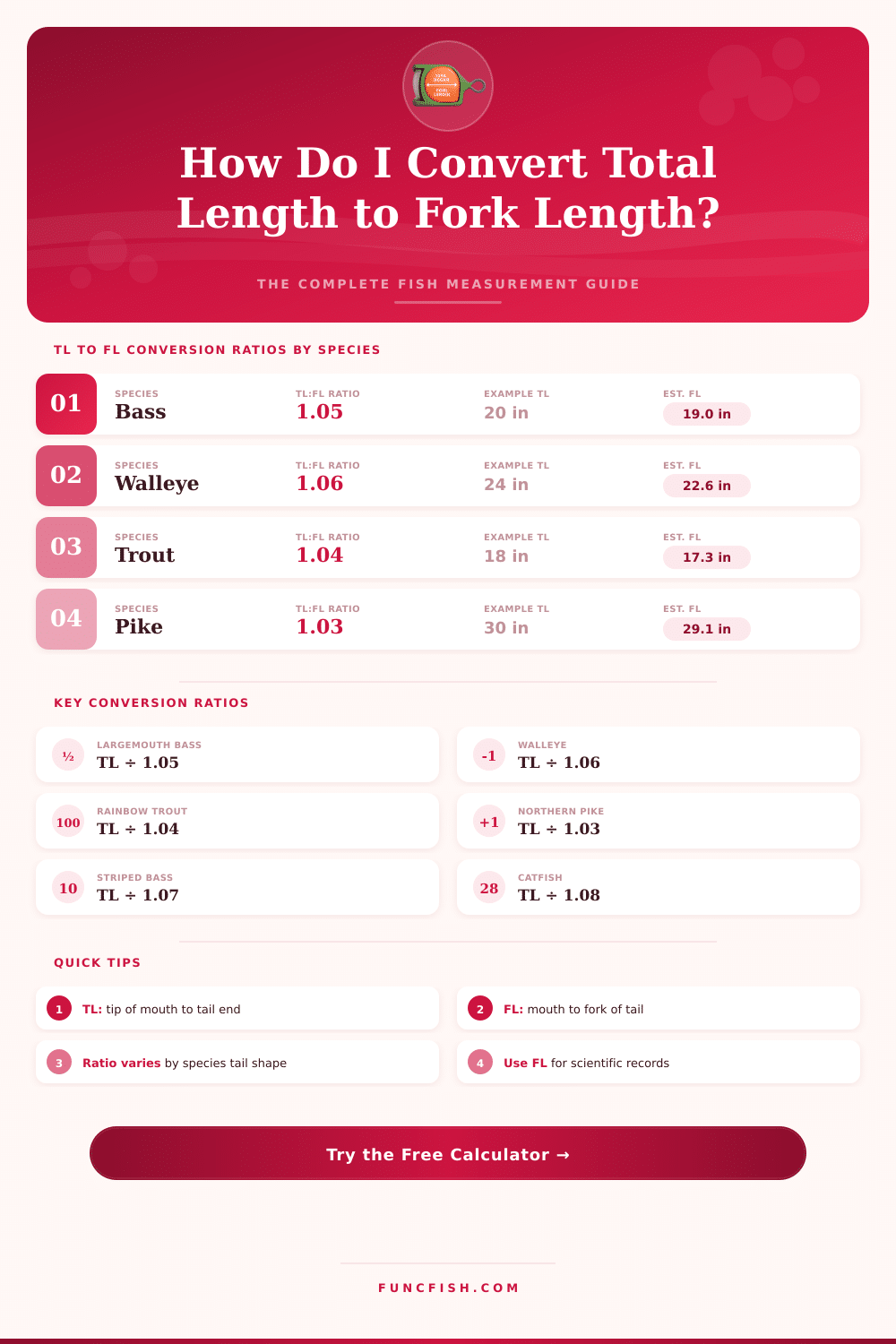
🐟 Fish Total Length to Fork Length Converter
Convert between total length (TL) and fork length (FL) for any species using real scientific ratios
| Species | TL:FL Ratio | Typical TL Range | Typical FL Range | Tail Type |
|---|---|---|---|---|
| Largemouth Bass | 1.050 | 8–26 in (20–66 cm) | 7.6–24.8 in (19–63 cm) | Notched |
| Smallmouth Bass | 1.050 | 7–22 in (18–56 cm) | 6.7–21 in (17–53 cm) | Notched |
| Walleye | 1.060 | 12–30 in (30–76 cm) | 11.3–28.3 in (29–72 cm) | Forked |
| Rainbow Trout | 1.040 | 8–30 in (20–76 cm) | 7.7–28.8 in (20–73 cm) | Slightly Forked |
| Brown Trout | 1.040 | 8–32 in (20–81 cm) | 7.7–30.8 in (20–78 cm) | Slightly Forked |
| Northern Pike | 1.030 | 16–46 in (41–117 cm) | 15.5–44.7 in (39–114 cm) | Forked |
| Muskellunge | 1.030 | 24–60 in (61–152 cm) | 23.3–58.3 in (59–148 cm) | Forked |
| Striped Bass | 1.070 | 14–48 in (36–122 cm) | 13.1–44.9 in (33–114 cm) | Deeply Forked |
| Channel Catfish | 1.080 | 10–36 in (25–91 cm) | 9.3–33.3 in (24–85 cm) | Deeply Forked |
| Crappie | 1.055 | 5–17 in (13–43 cm) | 4.7–16.1 in (12–41 cm) | Notched |
| Redfish (Red Drum) | 1.065 | 14–45 in (36–114 cm) | 13.1–42.3 in (33–107 cm) | Slightly Forked |
| Bluegill / Sunfish | 1.055 | 4–12 in (10–30 cm) | 3.8–11.4 in (10–29 cm) | Notched |
| Common Carp | 1.035 | 12–36 in (30–91 cm) | 11.6–34.8 in (29–88 cm) | Slightly Forked |
| Atlantic Salmon | 1.045 | 18–48 in (46–122 cm) | 17.2–45.9 in (44–117 cm) | Slightly Forked |
| Method | Accuracy | Error Range | Best For |
|---|---|---|---|
| Measuring Board (Standard) | ★★★★★ Excellent | ± 0.1 in (2mm) | Official records, scientific sampling |
| Flexible Tape Measure | ★★★★ Very Good | ± 0.25 in (6mm) | Catch-and-release, field surveys |
| Rigid Ruler | ★★★ Good | ± 0.5 in (12mm) | Smaller fish, panfish |
| Visual Estimate | ★★ Fair | ± 2% or more | Quick reference only |
| Total Length (in) | Bass FL (in) | Walleye FL (in) | Trout FL (in) | Pike FL (in) | Catfish FL (in) |
|---|---|---|---|---|---|
| 10" | 9.5" | 9.4" | 9.6" | 9.7" | 9.3" |
| 14" | 13.3" | 13.2" | 13.5" | 13.6" | 13.0" |
| 18" | 17.1" | 17.0" | 17.3" | 17.5" | 16.7" |
| 22" | 21.0" | 20.8" | 21.2" | 21.4" | 20.4" |
| 26" | 24.8" | 24.5" | 25.0" | 25.2" | 24.1" |
| 30" | 28.6" | 28.3" | 28.8" | 29.1" | 27.8" |
| 36" | 34.3" | 34.0" | 34.6" | 35.0" | 33.3" |
| 40" | 38.1" | 37.7" | 38.5" | 38.8" | 37.0" |
| 48" | 45.7" | 45.3" | 46.2" | 46.6" | 44.4" |
Fish length conversion helps to estimate its weight or change one type of measure to another. Most weights of game fish can be well counted only from their length usually the “fork length” that goes from the nose until the deepest part of the V-shaped tail So it is possible to enjoy catching, exactly estimate the weight and later restore the fish safely in the sea for new life.
Two mainstream modes for estimate length of fish are Standard Length and Total Length. Standard length goes from the nose until base of the tail without the fins. Conversions between them present as total length to standard, or total to fork, based on body data from issued studies or from fishbase.com.
How to Estimate Fish Weight from Length
Exists even a table with relations for more than 2 000 species, for change one length type in another.
For estimate weight of fish available several modes. Some use length together with girth. Fat fish weighs more than average for its length, while slim less.
Girth induce everything. For instance, fish long 38 inches with 20.25-inch girth weighed only a bit more than 20 pounds. Alike fish without that thickness weighed much less.
When do not give girth, some calculators take default of 0.58 times the length. Species-particular biological formulas from fishing studies strengthen many tools. Some calculators allow to choose from more than 30 confirmed species and switch between imperial and metric units.
Conversion factors do not depend on units, so you can use feet, inches or centimetres. All conversions base on standard proportions. Weights appear in grams or pounds.
Each conversion formula is only imprecise guide, no precise weight. Length-weight change never will be 100% accurate. For real assurance weigh the fish your self.
The mainstream target of all those conversions are urge measure and release alive, for conservation. For most folks one alone measure embraces the task.
Practical effect for field measures are before estimate bodyparts. Measure from fingertip to knuckle, later to wrist, ultimately to elbow. Like this you have some imprecise ratings, usable when no scale is nearby.