🤿 Freediving Weight Calculator
Calculate your ideal weight belt load for any wetsuit, water type, and body weight
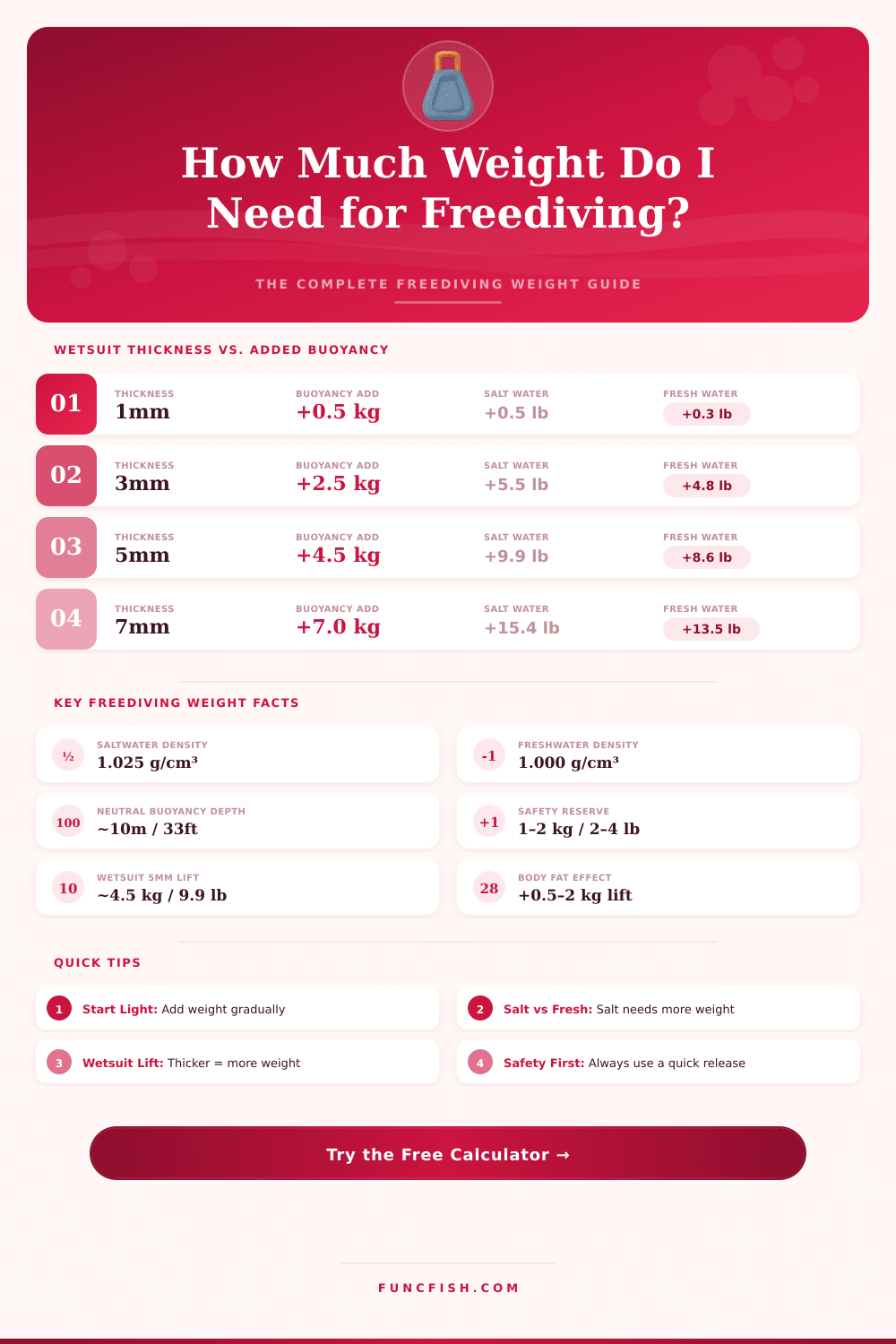
| Wetsuit | Buoyancy Added (Salt) | Buoyancy Added (Fresh) | Typical Extra Weight | Best For |
|---|---|---|---|---|
| No Wetsuit | 0 kg / 0 lb | 0 kg / 0 lb | 0 kg / 0 lb | Warm tropical waters 28°C+ |
| 1mm Skin Suit | +0.5 kg / +1.1 lb | +0.3 kg / +0.7 lb | +0.5–1 kg / +1–2 lb | 26–30°C water |
| 2mm Shorty | +1.5 kg / +3.3 lb | +1.1 kg / +2.4 lb | +1–2 kg / +2–4 lb | 24–28°C water |
| 3mm Full Suit | +2.5 kg / +5.5 lb | +1.9 kg / +4.2 lb | +2–3 kg / +4–7 lb | 20–26°C water |
| 5mm Full Suit | +4.5 kg / +9.9 lb | +3.5 kg / +7.7 lb | +4–5 kg / +9–11 lb | 15–22°C water |
| 5mm Two-Piece | +6.0 kg / +13.2 lb | +4.7 kg / +10.4 lb | +5–7 kg / +11–15 lb | 12–18°C water |
| 7mm Full Suit | +7.0 kg / +15.4 lb | +5.5 kg / +12.1 lb | +6–8 kg / +13–18 lb | 10–16°C water |
| 7mm Two-Piece | +9.5 kg / +20.9 lb | +7.5 kg / +16.5 lb | +8–11 kg / +18–24 lb | Below 12°C water |
| Body Fat % | Buoyancy Type | Extra Weight Needed | Typical Diver Profile |
|---|---|---|---|
| 5–10% | Slightly Negative | Reduce weight by 1–2 kg | Elite athlete / competition |
| 10–15% | Near Neutral | Standard baseline | Fit recreational diver |
| 15–20% | Slightly Positive | Add +0.5–1 kg | Average recreational diver |
| 20–25% | Positive | Add +1–2 kg | Average adult diver |
| 25–30% | Notably Positive | Add +2–3 kg | Higher body fat diver |
| 30%+ | Very Positive | Add +3–5 kg | Significant extra weight needed |
| Water Type | Density (g/cm³) | vs. Fresh Water | Typical Locations |
|---|---|---|---|
| Fresh Water | 1.000 | Baseline | Lakes, rivers, quarries |
| Brackish Water | 1.005–1.015 | +5–15% | Estuaries, Baltic Sea |
| Tropical Ocean | 1.022–1.024 | +22–24% | Caribbean, Indo-Pacific |
| Atlantic / Pacific | 1.024–1.025 | +24–25% | Most ocean diving |
| Mediterranean | 1.027–1.029 | +27–29% | Mediterranean Sea |
| Red Sea | 1.040 | +40% | Red Sea, Dead Sea adjacent |
| Discipline | Starting % of Body Weight | Target Buoyancy at 10m | Notes |
|---|---|---|---|
| Recreational Freediving | 2–3% | Slightly negative | Safety-focused, easier equalization |
| Spearfishing | 2.5–4% | Neutral to slightly negative | Need to hold position at depth |
| Competition CWT | 1.5–2% | Neutral at target depth | Minimize drag, fine-tune per depth |
| Pool / Static Apnea | 1–2% | Neutral at surface | Horizontal position, less weight |
| Underwater Photography | 3–4% | Slightly negative | Stability for shots at depth |
| Training (depth record) | 1–1.5% | Neutral at planned depth | Highly individual, pool test required |
Finding the right weight for freediving is hard. Because each person is different, the amount of weight changes a lot. Some maybe need 1 kg with 3mm wetsuit, while another needs 4 kg with 1mm wetsuit.
Because bodies are unique, there is no solution for all
How to Find the Right Weight for Freediving
A freediving weight calculator helps estimate the best amount of weight, so the diver has good buoyancy. It thinks of the weight of the diver, the thickness of the wetsuit, if the water is salt or fresh and the target depth. Even so, every result of such calculator you must check in the water.
The most usual way to weight yourself is to use a rubber belt with weights, that gives neutral buoyancy. Overweighting expands the effort to stay at the surface between dives and during rise. New snorkelers and freedivers commonly too burden themselves.
To check buoyancy simply, do a passive exhale. If after passive exhale you sink, you have too much weight. If you float or sink slowly, go to surface, change the weight until you are neutrally buoyant at the target depth.
For freediving you commonly intend to be neutrally buoyant in 10 metres. For spearfishing it works well to be neutrally buoyant in 5 metres above the target depth. If the target depth is less than 10 metres, you need more weight.
Being positively buoyant more up than 30 feet can bring the diver to surface during shallow water blackout. Weighting for be negative at surface can cause drowning.
Common rule says, that for every millimeter of full body neoprene wetsuit you must add a kilo of weight. More small weights help to exactly set the buoyancye. Weights of 0.5 to 1 kg or 1 to 2 lb are best.
That also spreads the weight equally around the body and makes the dive more streamlined. Pair of 2 lb and 3 lb weights, well balanced at the belt, feel much better underwater than big weights, that make you lean.
A freediving neck weight is commonly used by competitive divers, that go along lines or in a pool. It means precise change of weight and puts it where it acts as a rudder, pulling instead of pushing the diver. Salt water weighs more than fresh, so for salt diving you need a bit more weight.
Diving without weights is harder, because you spend more energy and oxygen to reach the target depth. You can also reduce the weight by means of bigger musclemass.