🐟 Fish Dressed Weight Calculator
Estimate dressed weight, fillet yield, and edible portions from any whole fish catch
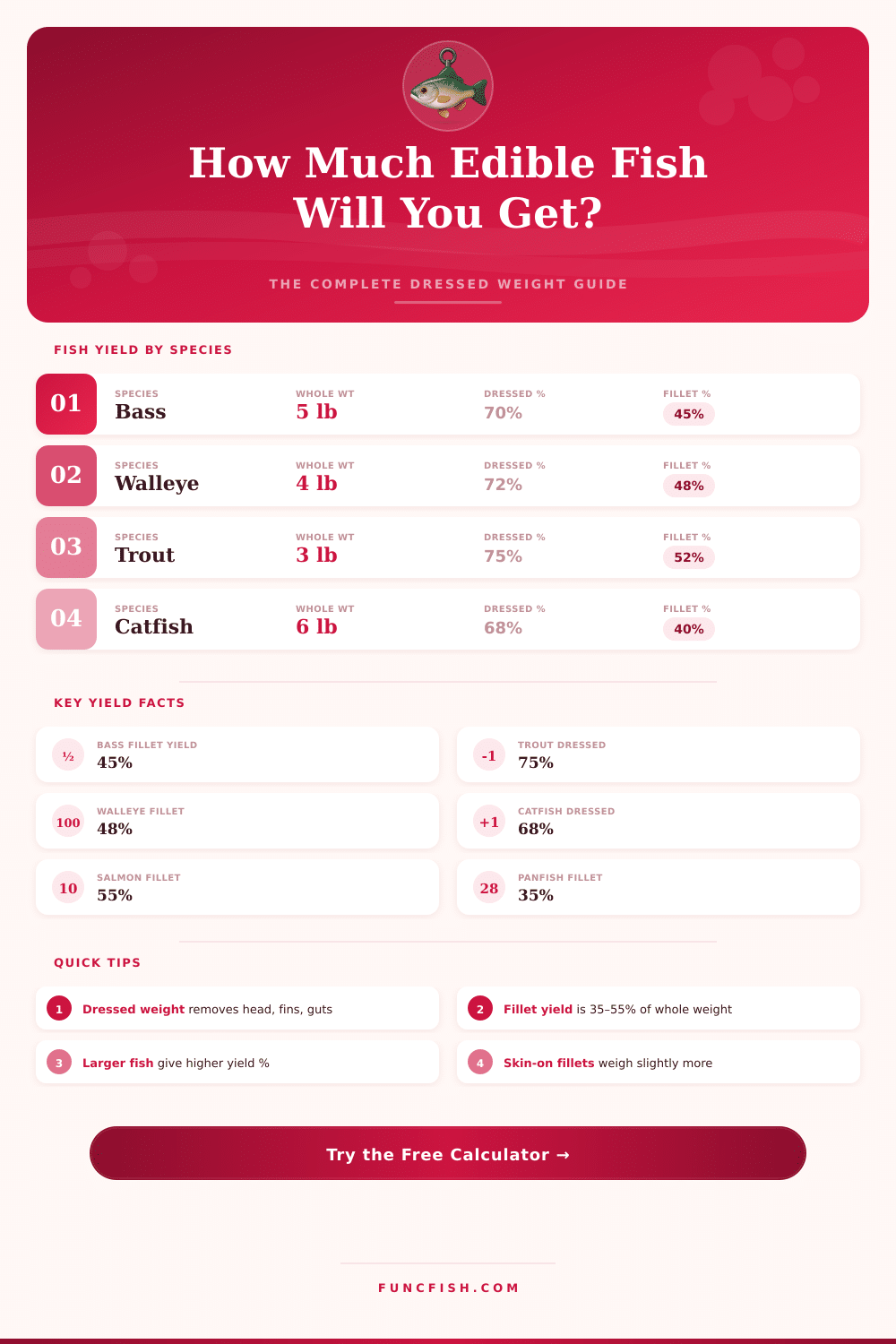
| Species | Dressed % | H&G % | Fillet % (skin on) | Fillet % (skinless) | Typical Range |
|---|---|---|---|---|---|
| Largemouth Bass | 70% | 65% | 45% | 40% | 1–10 lb |
| Smallmouth Bass | 71% | 66% | 46% | 41% | 0.5–5 lb |
| Walleye | 72% | 67% | 48% | 44% | 1–10 lb |
| Rainbow Trout | 75% | 68% | 52% | 47% | 0.5–8 lb |
| Brown Trout | 74% | 67% | 50% | 45% | 0.5–10 lb |
| Channel Catfish | 68% | 62% | 40% | 36% | 1–15 lb |
| Flathead Catfish | 67% | 61% | 39% | 35% | 2–30 lb |
| Bluegill / Sunfish | 65% | 60% | 35% | 30% | 0.1–1 lb |
| Crappie | 67% | 62% | 37% | 32% | 0.25–2 lb |
| Yellow Perch | 66% | 60% | 36% | 31% | 0.1–1 lb |
| Northern Pike | 69% | 63% | 43% | 38% | 2–20 lb |
| Muskellunge | 68% | 62% | 42% | 37% | 5–40 lb |
| Atlantic Salmon | 76% | 70% | 55% | 50% | 3–20 lb |
| Chinook Salmon | 77% | 71% | 57% | 52% | 5–50 lb |
| Striped Bass | 71% | 65% | 47% | 42% | 2–40 lb |
| Red Drum | 70% | 64% | 44% | 39% | 2–30 lb |
| Flounder | 73% | 66% | 49% | 44% | 0.5–8 lb |
| Cobia | 74% | 68% | 53% | 48% | 5–50 lb |
| Processing Method | Parts Removed | Avg. Yield % | Best For |
|---|---|---|---|
| Dressed / Pan-Dressed | Scales, fins, guts (head on) | 65–75% | Pan frying, baking whole |
| Headed & Gutted (H&G) | Head, scales, guts, fins | 60–70% | Smoking, poaching |
| Filleted (skin on) | All bones, head, skeleton | 35–57% | Pan frying, grilling |
| Filleted & Skinless | Skin, bones, head, skeleton | 30–52% | Baking, chowder |
| Skinned & Gutted | Skin, guts (head on, bone in) | 55–68% | Catfish, buffalo fish |
| Steaked | Head, tail, guts | 55–65% | Grilling, salmon, tuna |
| Servings Needed | Fillet Needed (lb) | Fillet Needed (kg) | Whole Fish Needed (avg 45% yield) |
|---|---|---|---|
| 1 person | 0.33 lb (5–6 oz) | 0.15 kg | ~0.75 lb / 0.34 kg whole |
| 2 people | 0.67 lb (10–11 oz) | 0.30 kg | ~1.5 lb / 0.68 kg whole |
| 4 people | 1.33 lb (21–22 oz) | 0.60 kg | ~3 lb / 1.36 kg whole |
| 6 people | 2.0 lb (32 oz) | 0.91 kg | ~4.5 lb / 2.04 kg whole |
| 8 people | 2.67 lb (42–43 oz) | 1.21 kg | ~6 lb / 2.72 kg whole |
| 10 people | 3.33 lb (53–54 oz) | 1.51 kg | ~7.5 lb / 3.40 kg whole |
Fish dressed weight is one of those words that often confuses at first. It shows the total weight of fish in pounds after removing the entrails only. So it is about the weight of the cleaned and scaled fish.
When you say that fish is “dressed” that means you removed its entrails and cleaned it
Dressed Weight and Live Weight of Fish
Help to understand the difference between live weight and dressed weight. Live weight is the weight of the whole fish with body and everything, before filleting. Dressed weight relates only to fillets.
Other way to think about it: “dressed” means gutted, scaled, with tail and fins removed. It can be head-on or head-off according to the situaton.
Between those two weights is a big difference. If you describe fish as “dressed above thousand pounds”, that implies that it is huge, because you lost weight during dressing by removal of organs, and it still surpasses 1000 pounds. That helps to imagine how much mass you lose in the process.
Actual amounts of products range according to many factors like size of the fish, season, sex and skill of the fishmonger. Bigger fish usually give better output. Fillet yield in percentages is calculated dividing weight of fillets by whole fish weight and multiplying by 100.
At bigger fish the percentages are higher, because thickness of fillets compared to bones are bigger.
For tuna specifically, the kilos of marketable meat that farmer receives from animal depend on dressing percentage and body cutting outputs. Scientists researched the tie between live weight (also called round weight) and product of gutted and gilled fishes. You analyzed all of 165 fishes from two farming places and four different cages just after slaughtering.
Some anglers try to estimate live weight from dressed weight. One method is to multiply the dressed weight by 1.35 or use a chart. According to reports of stores, the gross catch is around 25 to 30 percent.
For instance, adding approximately 90 pounds for head, bellies and tail helps to estimate the alive weight of fish.
The notion of dressed weight counts also for other animals. You can express it as percentage of live weight, called killing out percentage. The final dressed weight can range a lot between animals of same species according to how much fat you remove during dressing, as lean the animal is during butchering and whether it ate shortly before slaughtering.
When you buy whole fish, choose the kind and enter the weight in pounds of the whole bought fish for count fillet output. Knowing of dressed weight simplifies planning of meals and buying of fish alot.