🚛 Trailer Ramp Length Calculator
Calculate the exact ramp length needed for any trailer height, load type, and safe loading angle
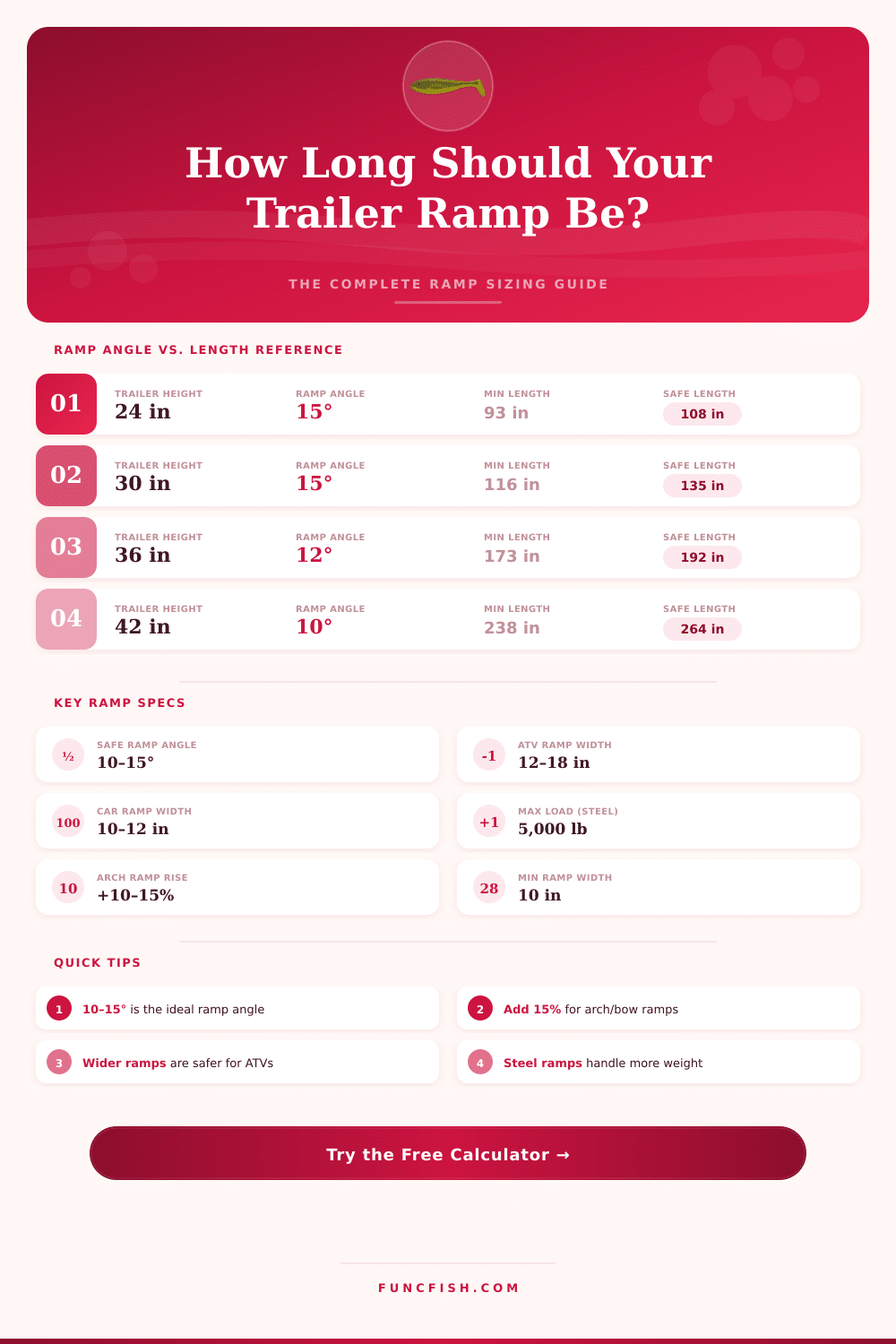
| Trailer Height | Ramp Angle | Min Length (in) | Min Length (cm) | Safe Length (in) |
|---|---|---|---|---|
| 18 in (46 cm) | 15° | 69 | 175 | 83 |
| 24 in (61 cm) | 15° | 93 | 236 | 112 |
| 24 in (61 cm) | 12° | 116 | 295 | 139 |
| 30 in (76 cm) | 15° | 116 | 295 | 139 |
| 30 in (76 cm) | 12° | 145 | 368 | 174 |
| 36 in (91 cm) | 12° | 173 | 439 | 208 |
| 36 in (91 cm) | 10° | 207 | 526 | 249 |
| 42 in (107 cm) | 10° | 238 | 605 | 286 |
| 48 in (122 cm) | 8° | 345 | 876 | 414 |
| Load Type | Typical Weight | Max Safe Angle | Min Ramp Width | Recommended Material |
|---|---|---|---|---|
| ATV / UTV | 600–1,800 lb | 15° | 12 in | Aluminium |
| Car / Sedan | 2,500–4,000 lb | 10° | 10 in per side | Steel |
| Motorcycle | 300–900 lb | 20° | 8 in | Aluminium |
| Riding Mower | 400–900 lb | 12° | 16 in | Steel / Wood |
| Pickup Truck | 4,000–7,000 lb | 8° | 10 in per side | Steel |
| Boat / Watercraft | 500–3,000 lb | 12° | 18 in | Aluminium |
| Wheelchair | 200–400 lb | 6° | 36 in | Aluminium / HDPE |
| Golf Cart | 500–1,200 lb | 12° | 18 in | Aluminium |
| Snowmobile | 400–700 lb | 15° | 12 in | Mesh Aluminium |
| Heavy Equipment | 5,000–20,000 lb | 8° | 24 in | Steel |
| Material | Max Load | Weight (per ft) | Traction | Best Use |
|---|---|---|---|---|
| Aluminium | 3,000 lb | ~3 lb | Good | ATV, Motorcycle, Boat |
| Steel | 5,000+ lb | ~6 lb | Very Good | Cars, Trucks, Mowers |
| HDPE Plastic | 1,500 lb | ~2 lb | Moderate | Wheelchair, Light Loads |
| Treated Wood | 2,000 lb | ~4 lb | Good (dry) | DIY, Mowers |
| Fibreglass Composite | 2,500 lb | ~3.5 lb | Good | Marine, ATV |
| Folding Steel | 4,000 lb | ~5.5 lb | Very Good | Cars, Trucks |
| Mesh Aluminium | 2,800 lb | ~2.5 lb | Excellent | Snowmobile, ATV |
| Rubber Traction Mat | 800 lb | ~1.5 lb | Excellent | Light/Temporary |
Trailer ramp lengths can range from 45 to 130 inches but the trailer door measurements and the angle of access decide which ramp works for a particular vehicle. That range is quite wide, so picking the right one is genuinely important.
A safety system can be added so that ramps stay fixed to the trailer during use. It stops a ramp from popping up when the ground is soft or uneven. Charts show the maximum weight for every wheel of a loaded vehicle.
How to Choose a Trailer Ramp
For instance, a 6000 lb car with 4 wheels has around 1500 pounds per wheel, if the weight is relatively equally spread. Charts also mention the maximum length of ramps, whether from steel or aluminum.
Some ramps come in precise sizes. A 60-inch slide-in ramp from high-strength steel, resistant against corrosion, works for most PJ trailer models, including CC and B5. There are aluminum ramps 72 inches long and 14 inches wide, with 6000 lb capacity. Other aluminum car trailer ramps are around 237 inches long for loading cars, trucks and other gear.
Ramps are available up to 10 feet long. They are light and strog. Because of the current prices of steel, custom ramps would cost more than double only for the materials, not counting the work for a new set.
Commonly on 7000 GVW trailers you use 4 or 5 foot ramps. One solution is a pair of 2x12x8 foot red oak boards on a trailer 20 inches high, that works well with heavy gear. A set of 7-inch high trailer ramps makes loading race cars, sports cars or other low vehicles onto a tilt trailer easy, without scratches, whether on track, at a show or during a long trip.
For builders you can use a plan 6.5 feet wide and 5 feet long, framed with rectangular tubes with cross poles every 15 inches on center. Ramps without transitions are 150 cm long, with the bottom transition welded and the upper one bound to the trailer deck by 6 M10 grade 8.8 bolts.
A 5×9 utility ramp trailer holds 1600 pounds. Seven foot ramps work to load bikes in a pickup, and straight and folding sets are available, usually in pairs. A 7-foot ramp will suit a riding mower, with around 20 inches of free spacebelow.