🎣 Fish Leader Strength Calculator
Find the ideal leader lb test for your target species, technique, and water conditions — in both lb and kg.
| Species | Typical Weight | Rec. Leader (lb) | Rec. Leader (kg) | Best Material | Notes |
|---|---|---|---|---|---|
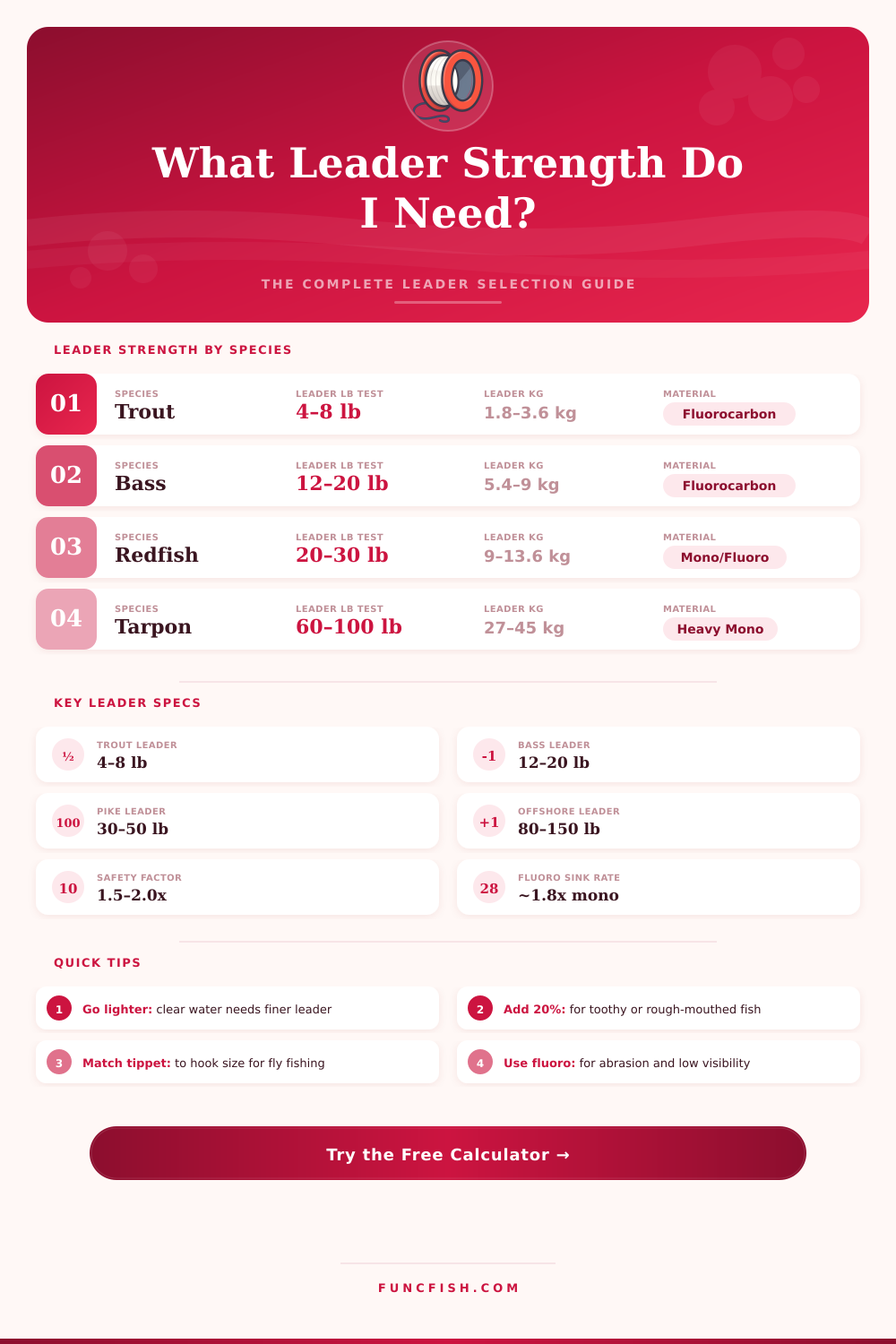
| Panfish (Bluegill, Crappie) | 0.25–1 lb (0.1–0.45 kg) | 2–4 lb | 0.9–1.8 kg | Fluorocarbon | Ultralight; clear water |
| Trout (Stream) | 0.5–3 lb (0.23–1.4 kg) | 4–8 lb | 1.8–3.6 kg | Fluorocarbon | Stealth critical |
| Largemouth Bass | 2–8 lb (0.9–3.6 kg) | 12–20 lb | 5.4–9 kg | Fluorocarbon | Heavier in heavy cover |
| Walleye | 2–10 lb (0.9–4.5 kg) | 8–15 lb | 3.6–6.8 kg | Fluorocarbon/Mono | Fluorocarbon preferred |
| Pike / Muskie | 5–40 lb (2.3–18 kg) | 30–80 lb wire | 13.6–36 kg | Wire / Cable | Toothy; always use wire |
| Redfish / Red Drum | 5–30 lb (2.3–13.6 kg) | 20–30 lb | 9–13.6 kg | Fluorocarbon | Abrasion-resistant |
| Striped Bass | 5–50 lb (2.3–22.7 kg) | 30–50 lb | 13.6–22.7 kg | Heavy Mono/Fluoro | Structure fishing — heavy |
| Snook | 5–30 lb (2.3–13.6 kg) | 20–40 lb | 9–18 kg | Fluorocarbon | Gill plate abrasion |
| Tarpon | 50–150 lb (22.7–68 kg) | 60–100 lb | 27–45 kg | Heavy Mono | IGFA class rules apply |
| Mahi-Mahi | 5–50 lb (2.3–22.7 kg) | 40–80 lb | 18–36 kg | Heavy Mono/Fluoro | Offshore; fast fish |
| Yellowfin Tuna | 20–200 lb (9–91 kg) | 60–150 lb | 27–68 kg | Heavy Mono | Extremely powerful runs |
| Catfish | 5–80 lb (2.3–36 kg) | 20–60 lb | 9–27 kg | Heavy Mono | Abrasion from bottom |
| X-Size | Diameter (in) | Diameter (mm) | Test (lb) | Test (kg) | Typical Hook Sizes |
|---|---|---|---|---|---|
| 0X | 0.011" | 0.279 mm | 15.5 lb | 7.0 kg | #2 – #6 |
| 1X | 0.010" | 0.254 mm | 13.5 lb | 6.1 kg | #4 – #8 |
| 2X | 0.009" | 0.228 mm | 11.5 lb | 5.2 kg | #6 – #10 |
| 3X | 0.008" | 0.203 mm | 8.5 lb | 3.9 kg | #10 – #14 |
| 4X | 0.007" | 0.178 mm | 6.0 lb | 2.7 kg | #12 – #16 |
| 5X | 0.006" | 0.152 mm | 4.0 lb | 1.8 kg | #14 – #18 |
| 6X | 0.005" | 0.127 mm | 3.0 lb | 1.4 kg | #16 – #22 |
| 7X | 0.004" | 0.102 mm | 2.0 lb | 0.9 kg | #18 – #26 |
| Material | Stretch | Visibility | Abrasion Resist. | Sink Rate | Best Use |
|---|---|---|---|---|---|
| Monofilament | 15–30% | Moderate | Good | Slow Sink | General freshwater/inshore |
| Fluorocarbon | 5–10% | Near Invisible | Excellent | Fast Sink | Clear water, subsurface |
| Single-Strand Wire | None | High | Excellent | Fast Sink | Toothy fish (Pike, Wahoo) |
| Coated Wire Cable | Minimal | Moderate | Excellent | Medium Sink | Shark, Muskie, offshore |
| Heavy Mono (Shock) | 10–20% | Moderate | Very Good | Slow Sink | Surf, tarpon, big game |
| Braid Leader | <1% | High | Moderate | Neutral | Specialty deepwater |
| Nylon Tippet | 20–30% | Low–Moderate | Good | Floats/Slow | Dry/wet fly fishing |
| Fluoro Tippet | 5–8% | Very Low | Very Good | Fast Sink | Nymphing, streamer fly |
The choice of the apt leading force depends on what you fish to catch. For fishing in sweet water use 6-12 pound test line for general use. For bass 8 or 10 pounds work well.
At toothy fishes as pike or musky, choose fluorocarbon or monofilament in 20 pounds or more. For walleye a 10-pound fluorocarbon leader is useful kaze that toothy fish could attack. If toothy fish are not around, 6-8 pounds fluorocarbon work surprisingly.
How to Choose the Right Fishing Leader
In spring during high rivers necesas commonly 20 pounds or more, but summer little flies help a lot.
In salt water the cause adjusts. Because snook and redfish populate beside docks, oyster bars, grass flats and mangroves, undoubted size of leader you favour. Leader light enough for do not excite the fish, but heavy for regularly big snook and redfish, that is the best force.
Especially for snook, 40 pounds fluorocarbon work well, because their lips and gills can abrade or stretch the line. Fluorocarbon is more resista and flatly keep at such strong struggles. In clear flats 10 pounds fluorocarbon suffice well.
But at docks, oysters, stumps or topwater lures 20 pounds monofilament are safer.
Because of bottom seafishing commonly you use 30-50 pounds braid for the mainline with 20-pound leader. That helps, if some snag happen, you can simply break the leader without losing lot of braid. Closely of underwater rocks, pilings or logs 40 pounds leaders are usefull, because braid easily rub at froto.
Some use 100 pounds Suffix or Dacron for leaders against sharp objects. On pure sandy beaches 60 pounds extensively suffice, but 80 pounds more well serve somewhere with rocks, stones or garbage. For enormous trevally require directly heavy bit leading material.
Those leaders have permanent diameter without taperings, because you want to preserve the diameter and escape weakening by means of knots. Any tippet-class use because of the fighting manner of that fish.
Leading force usually base on the pound test of the mainline. With monofilament as mainline choose equal or stronger test for leaders. At braid lower the force, so that the leader break first when you snag.
More lightweight leader than the mainline allow you lose hooks, but preserve the mainline. That system also allows that bait and leader freely float, during the weight stay on the bottom. That improves the presentation and give fishes time run before feel the line.