🐟 Fish Livewell Size Calculator
Calculate the ideal livewell capacity to keep your catch alive and healthy
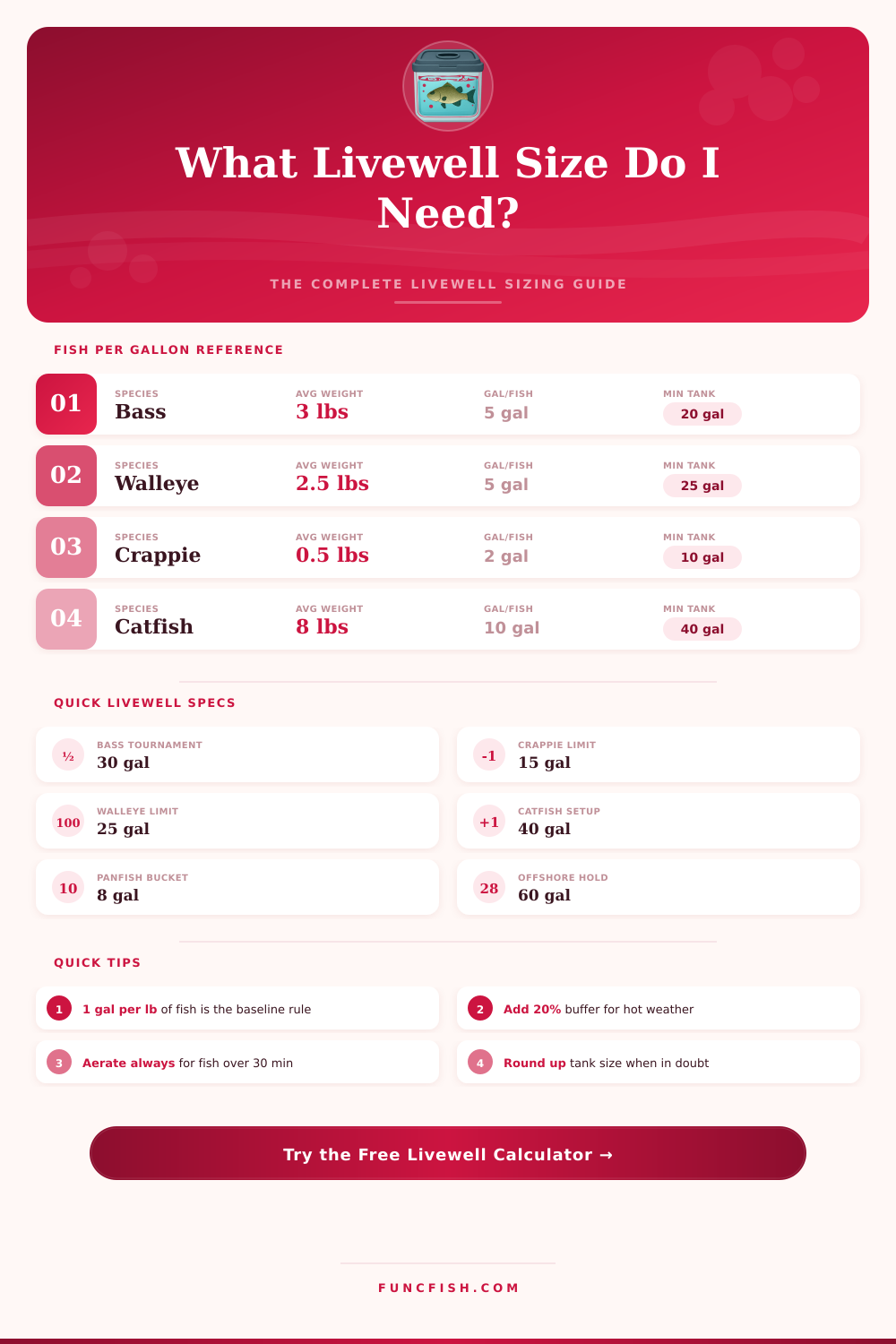
| Species | Avg Weight | Gal per Fish | Min Tank Size | Max Density | Temp Sensitivity |
|---|---|---|---|---|---|
| Largemouth Bass | 2–5 lb | 5 gal | 20 gal | 0.5 lb/gal | High |
| Smallmouth Bass | 1–4 lb | 4 gal | 16 gal | 0.6 lb/gal | Very High |
| Walleye | 1.5–4 lb | 5 gal | 25 gal | 0.5 lb/gal | High |
| Crappie | 0.3–1 lb | 2 gal | 10 gal | 1.0 lb/gal | Medium |
| Catfish | 3–15 lb | 10 gal | 30 gal | 0.4 lb/gal | Low |
| Rainbow Trout | 0.5–3 lb | 4 gal | 15 gal | 0.7 lb/gal | Very High |
| Striped Bass | 5–20 lb | 12 gal | 40 gal | 0.4 lb/gal | High |
| Northern Pike | 3–10 lb | 8 gal | 30 gal | 0.45 lb/gal | High |
| Panfish / Perch | 0.1–0.5 lb | 1.5 gal | 8 gal | 1.2 lb/gal | Low |
| Offshore Tuna | 20–60 lb | 20 gal | 60 gal | 0.3 lb/gal | High |
| Tank Size (L x W x D in) | Volume (cu in) | Gallons (US) | Liters | Suitable For |
|---|---|---|---|---|
| 18 x 12 x 10 | 2,160 | 9.4 gal | 35.4 L | Panfish, small crappie |
| 24 x 14 x 12 | 4,032 | 17.5 gal | 66.1 L | Crappie, small bass |
| 30 x 16 x 12 | 5,760 | 24.9 gal | 94.2 L | Bass (5 fish avg) |
| 36 x 18 x 14 | 9,072 | 39.3 gal | 148.6 L | Bass tournament limit |
| 42 x 20 x 16 | 13,440 | 58.2 gal | 220.1 L | Striper, catfish, walleye |
| 48 x 24 x 18 | 20,736 | 89.7 gal | 339.5 L | Large catfish, offshore |
| Water Temp | O2 Level | Fish Stress | Capacity Adjust | Aeration Need |
|---|---|---|---|---|
| Below 60°F / 15°C | High O2 | Low | No change | Basic bubbler |
| 60–70°F / 15–21°C | Good O2 | Low–Med | +0% | Recirculating pump |
| 70–80°F / 21–27°C | Moderate O2 | Medium | +15% | Recirculating + timer |
| 80–85°F / 27–29°C | Low O2 | High | +25% | Pure O2 recommended |
| Above 85°F / 29°C | Very Low O2 | Critical | +35% | Pure O2 + ice required |
Determine the right size of livewell are important for keep the catch alive. Every inch of the length of fish requires one gallon of water so that it stay alive long time. For typical species plan at least one gallon of capacity for every pound of live fish.
When fishes weigh between 2 and 8 pounds minimal livewell of 20 gallons is needed. Ideally use oval or round well of 25 gallons or more that will do the fishes most happy. Bigger commonly works more as in special ships with two 60-gallon livewells.
Choose the Right Livewell Size
Expand the water volume helps in several ways. Big water spreads the waste substances that the fishes produce. It increases the oxygen because more water can store thus grow the capacity.
Sufficient space will inhibit stress what depresses tension and wounds between the fishes. Best livewells give fishes possibility stay upright and move freely. During tournaments for tuna fishing tank of 40 until 50 gallons probably is needed.
Portable livewells commonly have foldable waterproof forms and breathable mesh coverings. Some even integrate aerators for freshen the oxygen in the bait. Narrow models easily sit on ships of all sizes and do not take place when not use.
Exist also mesh fish bags that fold as 6- or 10-gallon live bags. They can have thick transparent closings and aeration holes.
For remove small fishes from a livewell the width matters. Well of 30 inches of diameter is needed for trout reds or sheepshead while you release the more little legal while catch bigger. If space suffices separate the most little fish in own section that eases identification and change.
Color coded labels with little clips on the lip help mark the fishes according to size. At bass larger fishes stress more in livewell so think about their keeping. Many favour stringer either livewell until moment fillet and bleed them.