🎣 Fishing Rod Weight Rating Calculator
Match your lure weight, line strength & rod power for any species or technique
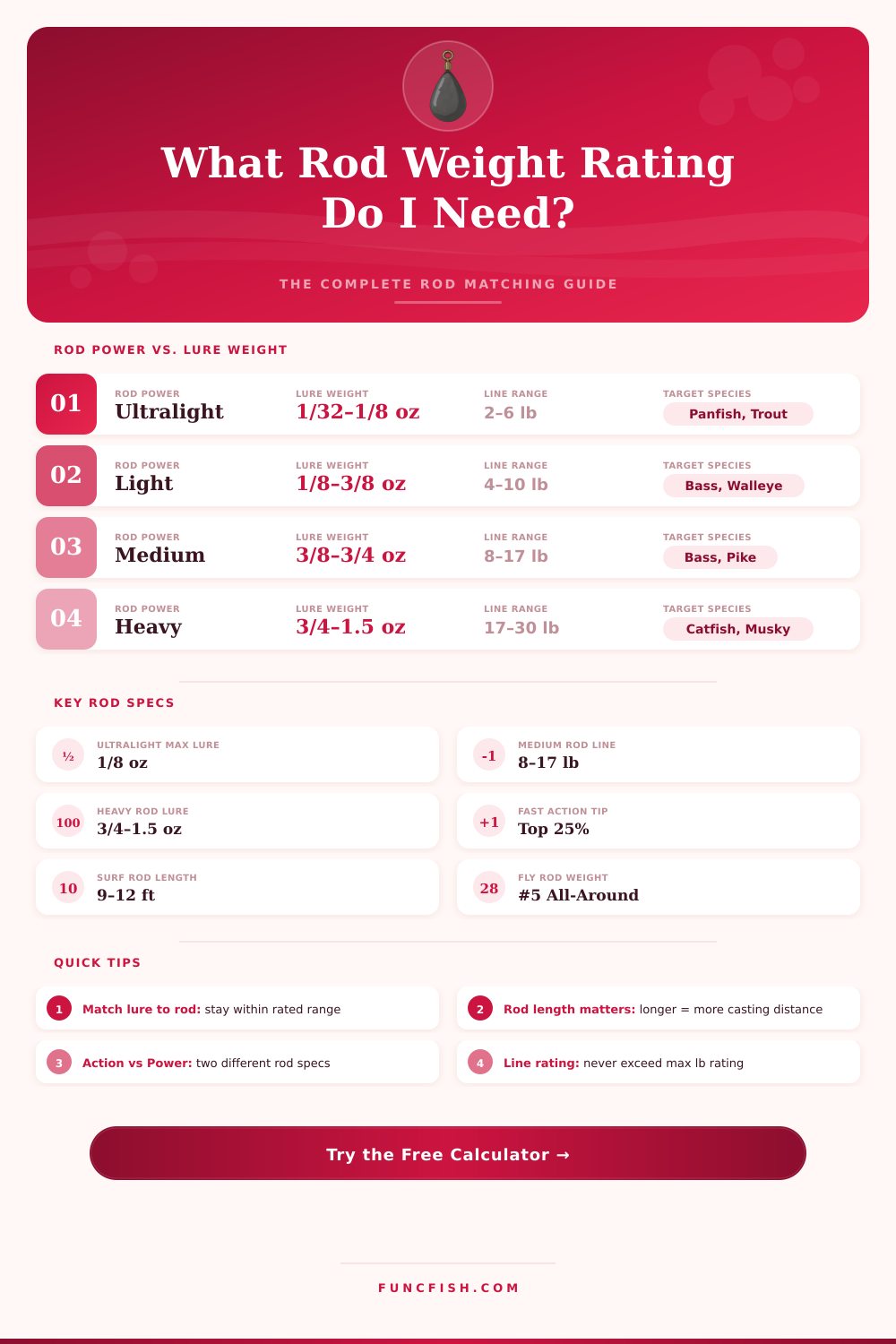
| Rod Power | Lure Wt (oz) | Lure Wt (g) | Line (lb) | Line (kg) | Best Use |
|---|---|---|---|---|---|
| Ultralight | 1/32 – 1/8 | 0.9 – 3.5 | 2 – 6 | 0.9 – 2.7 | Panfish, Small Trout |
| Light | 1/8 – 3/8 | 3.5 – 10.6 | 4 – 10 | 1.8 – 4.5 | Trout, Bass, Walleye |
| Medium Light | 3/16 – 1/2 | 5.3 – 14.2 | 6 – 12 | 2.7 – 5.4 | Bass, Walleye, Crappie |
| Medium | 3/8 – 3/4 | 10.6 – 21.3 | 8 – 17 | 3.6 – 7.7 | Bass, Pike, Redfish |
| Medium Heavy | 1/2 – 1.5 | 14.2 – 42.5 | 12 – 25 | 5.4 – 11.3 | Bass, Catfish, Snook |
| Heavy | 3/4 – 3 | 21.3 – 85 | 17 – 40 | 7.7 – 18.1 | Catfish, Musky, Salmon |
| Extra Heavy | 2 – 8+ | 56.7 – 227+ | 25 – 80+ | 11.3 – 36+ | Surf, Offshore, Big Game |
| Species | Avg Weight | Rod Power | Lure Wt (oz) | Line (lb) | Rod Length |
|---|---|---|---|---|---|
| Bluegill / Sunfish | 0.25–1 lb | Ultralight | 1/32–1/8 | 2–6 | 5–6.5 ft |
| Rainbow Trout | 0.5–3 lb | Ultralight–Light | 1/16–1/4 | 4–8 | 6–7 ft |
| Largemouth Bass | 2–8 lb | Medium–Med Heavy | 3/8–1.5 | 10–20 | 6.5–7.5 ft |
| Walleye | 1–5 lb | Light–Medium | 1/8–1/2 | 6–14 | 6.5–7 ft |
| Northern Pike | 3–15 lb | Medium Heavy–Heavy | 3/4–3 | 17–30 | 7–8 ft |
| Channel Catfish | 2–20 lb | Heavy | 1–4 | 17–40 | 7–9 ft |
| Striped Bass | 5–30 lb | Heavy–Extra Heavy | 1.5–4 | 20–50 | 8–11 ft |
| Redfish / Red Drum | 5–25 lb | Medium Heavy | 1/2–2 | 12–30 | 7–7.5 ft |
| Mahi Mahi | 5–30 lb | Heavy | 2–6 | 20–50 | 6–7 ft |
| Yellowfin Tuna | 20–100 lb | Extra Heavy | 4–12 | 50–130 | 5.5–7 ft |
| Action | Flex Zone | Sensitivity | Casting Distance | Best Technique |
|---|---|---|---|---|
| Extra Fast | Top 10% | Excellent | Medium | Flipping, Pitching |
| Fast | Top 25% | Very Good | Good | Jigs, Worms, Swimbaits |
| Moderate Fast | Top 35% | Good | Very Good | Crankbaits, Spinnerbaits |
| Moderate | Top 50% | Moderate | Excellent | Crankbaits, Treble Hooks |
| Slow / Parabolic | Entire Blank | Low | Very Good | Live Bait, Fly Casting |
Fishing rod has a limit about the weight that it can lift and cast well. You call that the power of the rod. For choose the right rod, it does not suffice to simply think about the weight according to the size of the fish.
You must match line weight with lure weight and reel size. Recommendations about lure weight and line test helps to tell the power of the fishing rod. The rating of line and lure weight on rod show its power.
Match Rod Power with Line and Lure Weight
For instance, extra heavy power is 25 to 40 lb with 2 to 4 oz, while heavy power is 20 to 30 lb with 1/2 to 2 oz.
If rod says 8-12 lb, you will be able to fight fish well without break it. Line weight does not always match the weight of the caught fish, because that depends on the strength of the fish and the current. If rod is rated for a maximum of 12 lb line, try not use bigger force.
Rod maybe can lift fish from water that weighs more than 12 lb, if the weight spreads across the whole slim part. But do not use 50 lb mainline with 30 lb leader on 8-12 lb rod. Line under 15 lb risks to break during hookset.
Line above 30 lb can break the rod, especially if your hookset is not good and the fish strongly resists.
In fly fishing, 2-weight rod is much more slim than 8-weight. Five-weights are the most used for usual trout fishing. 8-weight works for cast big flies to bigger fish as salmon or redfish.
6-weight rod works well for trout and panfish, but also can handle bass, pike or light saltwater. Many think that 4 to 7 weights are all-purpose fly rods. They work for fish of little trout and panfish to big trout and bass.
9-weight is good for steelhead. The weight of fly line is like that of the rod. 1-weight line is the lightest, while 16-weight is the strongest and durable.
For beach fishing, 7- or 8-weight rod usually is suggested.