⚓ Boat Speed: Knots to MPH Calculator
Convert marine speed between knots, mph, and km/h — with boat type presets & reference tables
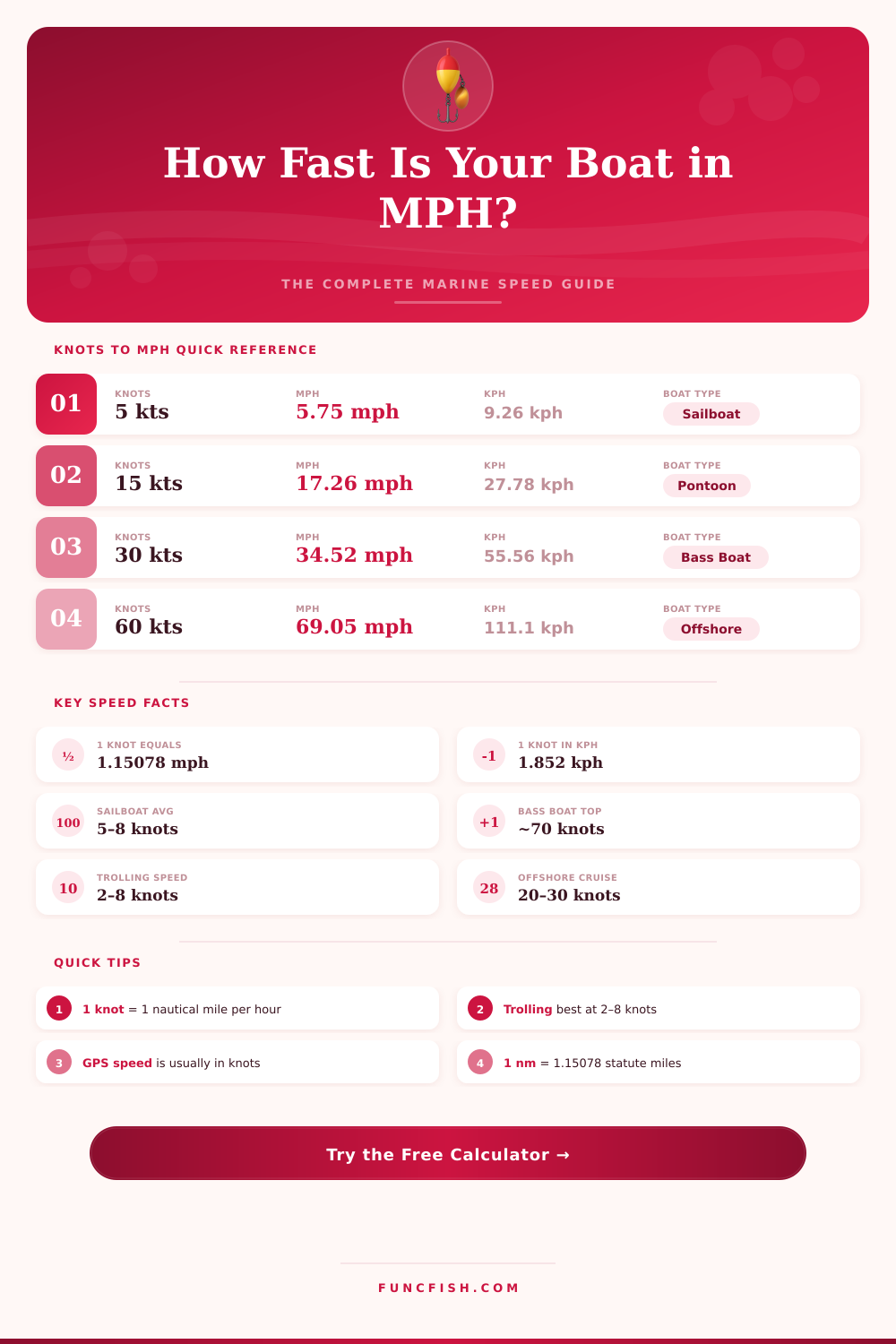
| Knots | MPH | KPH | Feet/Sec | M/Sec | Beaufort Scale |
|---|---|---|---|---|---|
| 1 | 1.15 | 1.85 | 1.69 | 0.51 | 1 – Light Air |
| 3 | 3.45 | 5.56 | 5.06 | 1.54 | 2 – Light Breeze |
| 5 | 5.75 | 9.26 | 8.44 | 2.57 | 3 – Gentle Breeze |
| 8 | 9.21 | 14.82 | 13.50 | 4.12 | 4 – Moderate |
| 10 | 11.51 | 18.52 | 16.88 | 5.14 | 5 – Fresh Breeze |
| 15 | 17.26 | 27.78 | 25.32 | 7.72 | 6 – Strong Breeze |
| 20 | 23.02 | 37.04 | 33.76 | 10.29 | 7 – High Wind |
| 25 | 28.77 | 46.30 | 42.20 | 12.86 | 8 – Gale |
| 30 | 34.52 | 55.56 | 50.64 | 15.43 | 9 – Strong Gale |
| 35 | 40.28 | 64.82 | 59.08 | 18.01 | 10 – Storm |
| 40 | 46.03 | 74.08 | 67.52 | 20.58 | 11 – Violent Storm |
| 50 | 57.54 | 92.60 | 84.40 | 25.72 | 12 – Hurricane |
| 60 | 69.05 | 111.12 | 101.27 | 30.87 | 12+ – Hurricane |
| Target Species | Troll Speed (knots) | Troll Speed (mph) | Troll Speed (kph) | Lure / Bait Style |
|---|---|---|---|---|
| Walleye | 1.5 – 2.5 | 1.7 – 2.9 | 2.8 – 4.6 | Crawler harness, crankbait |
| Striped Bass | 3 – 5 | 3.5 – 5.75 | 5.6 – 9.3 | Umbrella rig, soft plastic |
| Salmon / Trout | 2 – 3.5 | 2.3 – 4.0 | 3.7 – 6.5 | Spoon, flasher fly |
| Mahi-Mahi | 7 – 9 | 8.1 – 10.4 | 13.0 – 16.7 | Skirted lure, ballyhoo |
| Yellowfin Tuna | 6 – 9 | 6.9 – 10.4 | 11.1 – 16.7 | Cedar plug, daisy chain |
| Wahoo | 10 – 14 | 11.5 – 16.1 | 18.5 – 25.9 | High-speed lure, wire rig |
| Marlin / Sailfish | 7 – 10 | 8.1 – 11.5 | 13.0 – 18.5 | Skirted lure, live bait |
| Lake Trout | 1.5 – 3 | 1.7 – 3.5 | 2.8 – 5.6 | Spoon, tube jig |
| Kingfish | 5 – 8 | 5.75 – 9.2 | 9.3 – 14.8 | Spoon, live bait |
| Muskie / Pike | 3 – 5 | 3.5 – 5.75 | 5.6 – 9.3 | Large crankbait, bucktail |
| Distance (nm) | At 5 knots | At 10 knots | At 20 knots | At 30 knots | At 50 knots |
|---|---|---|---|---|---|
| 5 nm | 1h 0m | 30m | 15m | 10m | 6m |
| 10 nm | 2h 0m | 1h 0m | 30m | 20m | 12m |
| 25 nm | 5h 0m | 2h 30m | 1h 15m | 50m | 30m |
| 50 nm | 10h 0m | 5h 0m | 2h 30m | 1h 40m | 1h 0m |
| 100 nm | 20h 0m | 10h 0m | 5h 0m | 3h 20m | 2h 0m |
Knot is unit of speed, that equals exactly to one nautical mile in hour. You can express it also around 1,151 miles in hour or 0,514 metres in second. In sea travel one uses knot for estimate speed.
Here is the reason: during miles in hour works for simple sailing, where exactness does not matter, knots work for real travel. One knot matches around 1,15078 miles in hour. The usual symbol is kn, although kt also often appear.
What is a knot in sea travel
Some even write NPH, but knot stays favoured because of its logic.
The history of that word goes back until the 17th century. Sailors measured the ship speed by means of device called common string. It was made up of string with knots tied in regular spaces, attached to wooden bit in form of a slice.
They cast it of the back, with dragging short string behind the ship. The knots stood in equal distances. For estimate speed, you numbered, how many knots went out in 28 seconds.
That gave knots. Like this sailors knew, as far quickly they moved.
Knots are useful for ocean travel, because nautical mile equals to one minute of length at the equator. They well work with nautical system, so you commonly use them. Nautical mile equals also to one minute of latitude.
So on charts with grades, minutes and seconds it easy measures. One nautical mile has 6076 feet. If you knows his speed and time, you can well estimate distance.
Naval speeds range according to the type. Little planing motorboat with outside engine reaches 20 until 40 knots. High-performance sportboat with stepped hulls, good propellers, can go 40 until 80 knots.
Speed over the ground adjust because of water. Against flow the ground speed sinks. For instance, in 10 knots with 3 knot upstream flow it falls to 7 knots.
With the current it inreases.