⛵ Hull Speed Calculator
Calculate the theoretical maximum speed of your displacement hull boat using waterline length
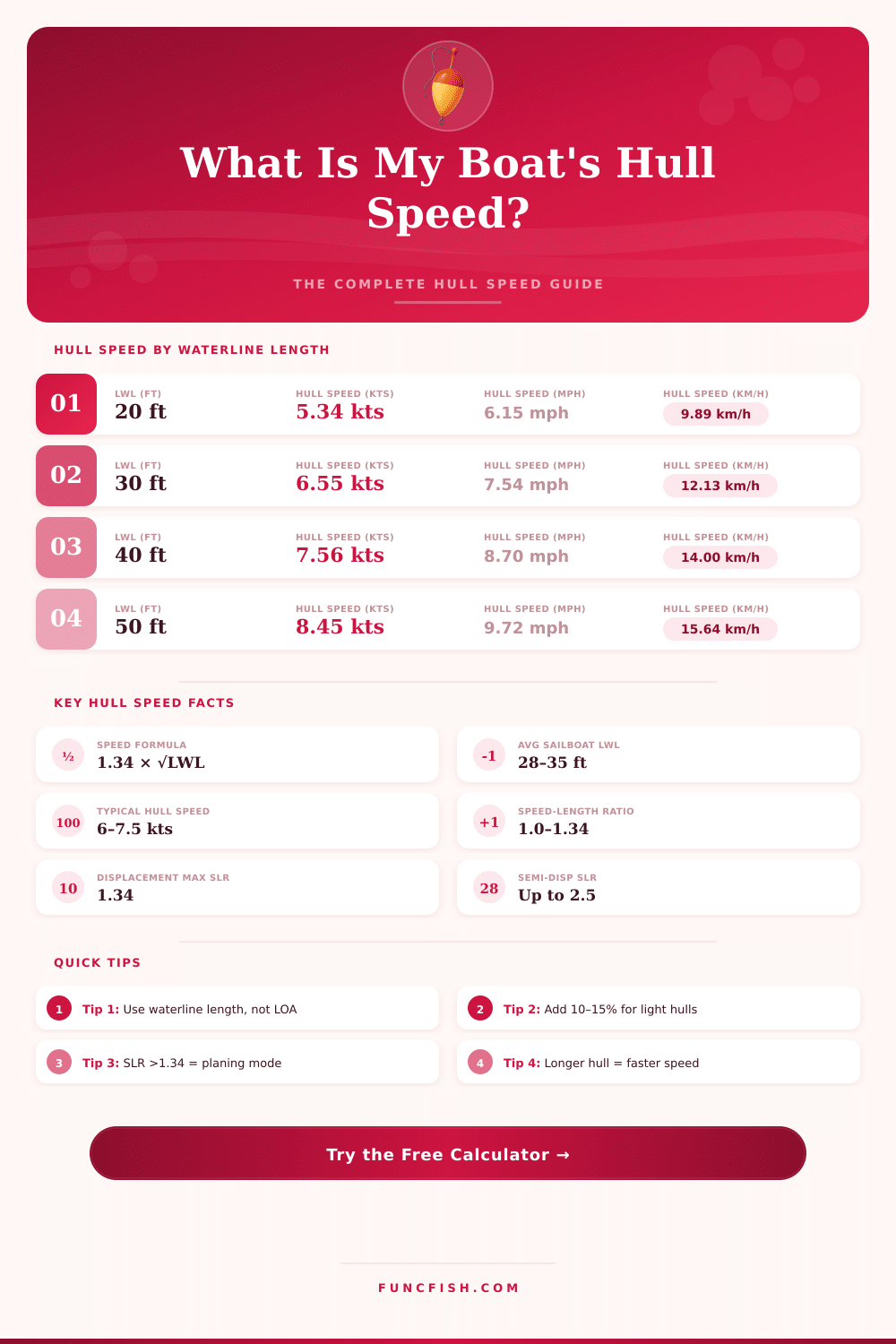
| LWL (ft) | LWL (m) | Hull Speed (kts) | Hull Speed (mph) | Hull Speed (km/h) | Typical Use |
|---|---|---|---|---|---|
| 15 ft | 4.57 m | 5.19 kts | 5.97 mph | 9.61 km/h | Small Dinghy |
| 20 ft | 6.10 m | 5.99 kts | 6.89 mph | 11.09 km/h | Day Sailer |
| 25 ft | 7.62 m | 6.70 kts | 7.71 mph | 12.41 km/h | Weekender |
| 30 ft | 9.14 m | 7.34 kts | 8.45 mph | 13.60 km/h | Coastal Cruiser |
| 35 ft | 10.67 m | 7.93 kts | 9.13 mph | 14.69 km/h | Bluewater Cruiser |
| 40 ft | 12.19 m | 8.47 kts | 9.74 mph | 15.68 km/h | Offshore Sailer |
| 45 ft | 13.72 m | 8.98 kts | 10.34 mph | 16.64 km/h | Performance Cruiser |
| 50 ft | 15.24 m | 9.47 kts | 10.90 mph | 17.55 km/h | Long Range Cruiser |
| 60 ft | 18.29 m | 10.37 kts | 11.93 mph | 19.21 km/h | Liveaboard / Ketch |
| 70 ft | 21.34 m | 11.21 kts | 12.90 mph | 20.76 km/h | Superyacht / Charter |
| Vessel Type | Typical LWL | Hull Mode | Max SLR | Typical Hull Speed | Notes |
|---|---|---|---|---|---|
| Dinghy / Skiff | 10–18 ft | Displacement / Planing | 1.34–3.0 | 4.2–6.4 kts | Can plane in strong wind |
| Day Sailer | 18–25 ft | Displacement | 1.34 | 5.7–6.7 kts | Keelboat, light displacement |
| Coastal Cruiser | 25–35 ft | Displacement | 1.34 | 6.7–7.9 kts | Moderate to heavy displacement |
| Bluewater Cruiser | 35–45 ft | Displacement | 1.34 | 7.9–9.0 kts | Heavy, stiff hull for offshore |
| Catamaran | 25–50 ft | Displacement | 1.4–1.6 | 7.5–11 kts | Lighter displacement per hull |
| Trawler / Passagemaker | 30–60 ft | Semi-Displacement | 1.5–1.8 | 8–12 kts | Fuel-efficient at displacement |
| Power Cruiser | 20–40 ft | Semi-Disp / Planing | 2.0–3.0+ | 15–30+ kts | High power-to-weight ratio |
| Canoe / Kayak | 12–18 ft | Displacement | 1.0–1.2 | 3.4–5.1 kts | Narrow beam, low resistance |
| SLR Value | Hull Mode | Description | Typical Vessel | Fuel Efficiency |
|---|---|---|---|---|
| 0.8 – 1.0 | Displacement | Economy / Motoring speed | Trawlers, cruisers under power | Very High |
| 1.0 – 1.2 | Displacement | Comfortable passage speed | Sailboats, trawlers | High |
| 1.2 – 1.34 | Displacement | Hull speed approach | Racing sailboats, light cruisers | Moderate |
| 1.34 | Displacement Max | Theoretical hull speed limit | All displacement hulls | Low — max effort |
| 1.34 – 2.0 | Semi-Displacement | Bow wave partially climbed | Semi-disp powerboats | Poor |
| 2.0 – 3.0 | Semi-Displacement | Transitioning to planing | Fast powerboats, RIBs | Very Poor |
| 3.0+ | Planing | Hull rises above bow wave | Speedboats, sportfishers | N/A — planing physics |
Hull speed, or displacement speed, is the moment when the wave of the bow has wavelength equal to the length of the waterline of the ship. During the boat boost from stop, that wave stretches and her height grows together with it Delokiĝa hull move through the water self, rather than planing hull that slips above the surface.
Here is the formula for this theoretical speed: take 1.34 and multiply it by the square root of the waterline length in feet. Boat with 25 feet waterline, or actually, 18-foot waterline, reach around 5.5 knots. The calculation bases on wavelength of peak to peak.
What Is Hull Speed?
Beneteau First 30, with 8.15 metres waterline, reach hull speed close to 7 knots. Swan 54 with longer waterline surpass that.
The basic formula is 1.34 times the square root of the waterline length, but here is the key, you can corect it. According to the form of the hull, the multiplier can be 1.2 or even 1.42. Consider boat with 49 feet waterline.
According to whether it is thick or slim, heavy or pointy, the speed ranges from around 8.4 until almost 10 knots.
Hull speed is not strict bar, not as the speed of light. It simply shows that most of boats can not always surpass that threshold. The power for go more quickly cost astronomical amounts of energy.
When displacement hull tries to boost, it starts to dig in. That generates big bow wave and more drag, what requires more force only to stay hear.
Most displacement monohulls run into troubles in speed-to-length ratio of 1.1 until 1.2. At that level, almost half of the wind energy goes only to create waves. Heavier boats submerge more deeply and move more water aside.
Both bow and stern waves play when the hull cut through them. The more quickly, the bigger and longer those waves become. Ultimately, bow and stern waves sync and resistance bursts.
Hull speed you can consider as the maximum spot where the ship boosts without big power losses. Here the hull slip with minimal drag, commonly the most comfortable haste without excessive noise, unless it already plans. Modern displacement hulls can surpass hull speed without planning, even without extra power.
Old designs? Here hull speed is the ceiling, unless the boat becomes plane. If it is planing hull, it simply rises on the bow wave and slipaway.