
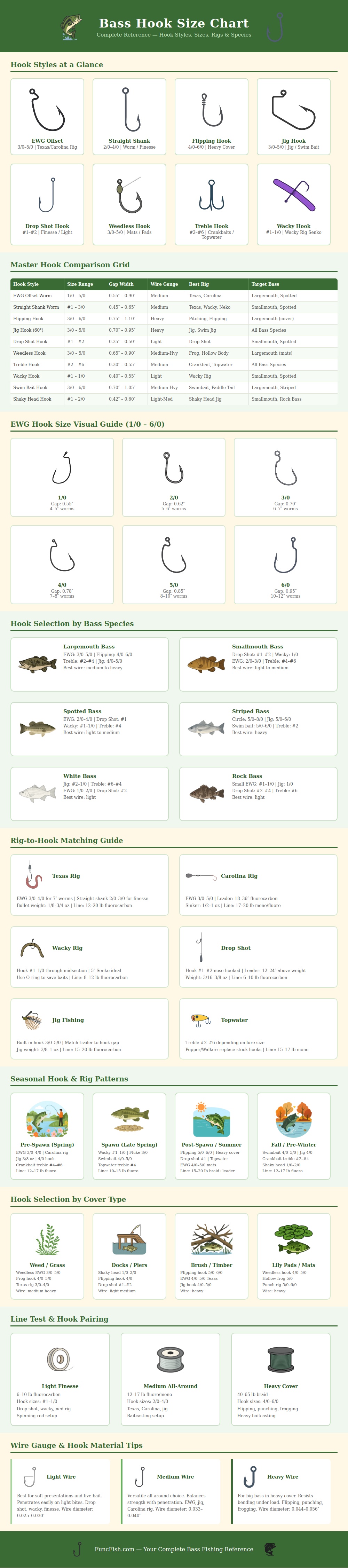
When selecting the hook size for your fishing setup, it is necessary to ensure that the hook size match the bait, the fish species you are after, and the fishing environment. If the hook is too small for the bait, the hook may not be able to penetrate the flesh of the fish. However, if the hook is too large for the fish species you are fishing for, the fish may reject the hook altogether.
In such a case, it is essential to select a hook that is appropriate for the specific fishing situation. There are several different type of fishing hooks, each of which feature specific design elements to serve a particular purpose. For example, extra wide-gap offset worm hooks are useful for Texas rigs and Carolina rigs due to the bent shank of the hook that allows the soft plastic bait to slide down the shank.
How to Choose the Right Fishing Hook
Straight shank hooks is useful for finesse fishing techniques and for employing wacky rigs as the straight shank of the hook allow the bait to fall natural through the water. Additionally, flipping hooks have a feature of thicker wire than other types of hooks, and thus, they are helpful when pitching the bait into thick brush as the thick wire can better withstand the pressure of a large fish. Lastly, jig hooks have a 60-degree bend in the hook that allow them to be useful for fishing bait as the bend keeps the trailers (of the bait) secure during use.
Another critical element of the hook is the gap width of the hook. This has to match the profile of the bait to the jaw of the fish. If the gap of the hook is too narrow, the hook will not be able to rotate into the lip of the fishs mouth when the fish bites.
If the gap of the hook is too wide, smallmouth bass may spit the hook out of their mouths. Other important measurement of the hook are the wire gauge of the hook. This is an important measurement for those who fish in thick cover or who pursue fish species with strong bites as the wire gauge will determine the hooks ability to withstand such forces.
If the wire of the hook is light, it will easily penetrate the bony mouth of the fish but may bend under heavy pressure. However, if the wire is heavy, it will resist being straightened out in thick vegetation but may be more difficult for the fish to take into its mouth. It is also important to ensure that the size of the hook matches the length of the plastic bait.
For example, an extra wide gap hook in size 1/0 is appropriate for a 5-inch worm but would be inappropriate for a size 5/0 hook for a very large worm. The rule of thumb for hook size and plastic worm length is to make sure the hook gap is roughly half the length of the worm. Thus, using a 3/0 hook with a 0.70-inch gap will work best with a 6-inch or 7-inch straight tail worm.
Using larger hooks for large swimbaits but using smaller hooks for wacky rigs such as a size #1 hook. The species of fish you are fishing for will also dictate what type of hook you need. For example, largemouth bass require much heavier hooks such as a 4/0 flipping hook as they fight strong against cover.
Smallmouth bass require much lighter hooks such as a size #1 hook for drop shotting as they are easily spooked. Spotted bass require a hook in the middle range such as a 2/0 extra wide gap hook for Carolina rigs. Thus, many anglers has multiple types of hooks to match the species of fish they are fishing for.
The fishing rig you use will also determine the type of hook you should use. Texas rigs require 3/0 or 4/0 extra wide gap hooks with bullet weights. For Carolina rigs, the hooks has larger gaps to account for the structure on the bottom of the fishing area.
Drop shot rigs use smaller hooks such as a size #1 hook to allow the bait to remain above the weight of the rig. For jigs, the hooks are 4/0 to be embedded under the skirt of the jig. Topwater lures use treble hooks in sizes #4 to #6 to prevent the lure from rolling unnatrually in the water.
Finally, the fishing season and the type of cover in the fishing area will also affect the type of hook you use when you go fishing. During the pre-spawn fishing season, when largemouth bass are deep in the water, using a 3/0 hook on a Carolina rig will be beneficial. During the spawn season, when largemouth bass are close to the surface, using a #1 hook for wacky rigs will be more effective.
In the summer, when largemouth bass are in thick brush, using a 5/0 flipping hook will catch more fish. In the fall, when largemouth bass are more aggressive when feeding, using a 4/0 hook for swimbaits will work best. In terms of cover, anglers use weedless hooks for grassy areas while heavy hooks are used for timber areas.
The line used for fishing also must match the hook and the fishing rig. For finesse fishing techniques such as drop shot rigs, using a 6 to 10 pound fluorocarbon fishing line is best as the fluorocarbon line will not spook the fish. For Texas rigs, using a 12 to 17 pound fishing line is sufficient.
For areas with mats and roots on the bottom of the fish habitat, using 40 to 65 pound fishing line braid will help punch through the mats as the braid has zero stretch. Finally, light wire hooks will penetrate the mouths of the fish better then heavy wire hooks but will be less able to fight strong fish against thick cover. Thus, a balance must be found between the weight of the fishing wire and the size of the hook gap to ultimately ensure that the fish are hooked successful.