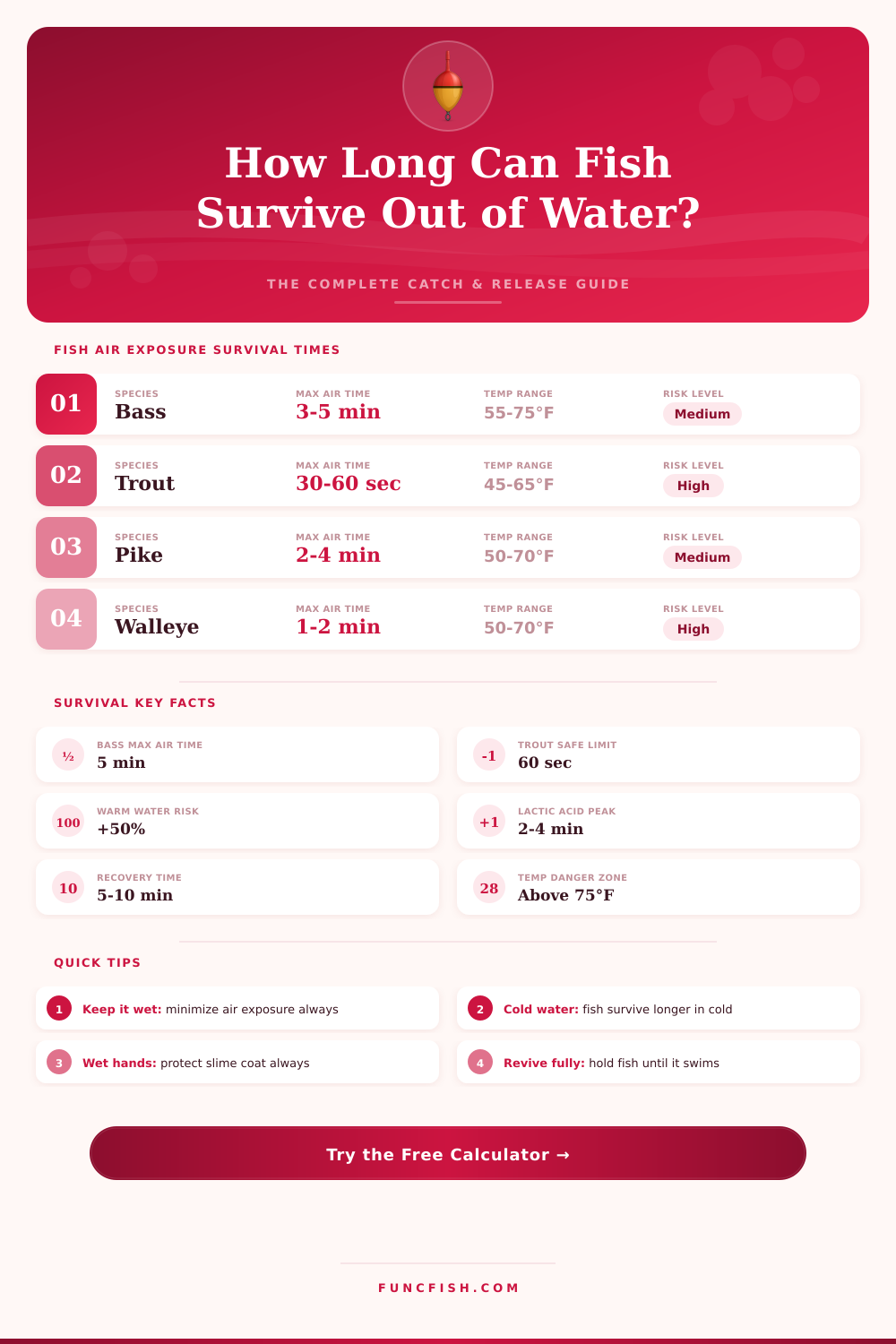
🐟 Fish Out-of-Water Survival Time Calculator
Estimate how long a fish can safely survive out of water based on species, temperature & conditions
| Water Temp (°F) | Water Temp (°C) | Oxygen Level | Survival Multiplier | Risk Level |
|---|---|---|---|---|
| Below 45°F | Below 7°C | Very High | 1.5x (longer) | Low |
| 45–55°F | 7–13°C | High | 1.25x | Low |
| 55–65°F | 13–18°C | Moderate-High | 1.0x (baseline) | Moderate |
| 65–72°F | 18–22°C | Moderate | 0.8x (shorter) | Moderate-High |
| 72–80°F | 22–27°C | Low-Moderate | 0.6x | High |
| Above 80°F | Above 27°C | Low | 0.4x (critical) | Critical |
| Species | Typical Weight | Baseline Max Air (sec) | Optimal Water Temp | Oxygen Sensitivity | Recovery Time |
|---|---|---|---|---|---|
| Largemouth Bass | 1–8 lb (0.5–3.6 kg) | 300 sec | 65–75°F (18–24°C) | Medium | 2–5 min |
| Smallmouth Bass | 0.5–5 lb (0.2–2.3 kg) | 240 sec | 60–70°F (15–21°C) | Medium-High | 3–6 min |
| Rainbow Trout | 0.5–10 lb (0.2–4.5 kg) | 45 sec | 50–60°F (10–16°C) | Very High | 5–10 min |
| Brown Trout | 0.5–15 lb (0.2–6.8 kg) | 60 sec | 52–64°F (11–18°C) | Very High | 5–10 min |
| Brook Trout | 0.25–5 lb (0.1–2.3 kg) | 40 sec | 45–60°F (7–16°C) | Extreme | 8–15 min |
| Northern Pike | 2–20 lb (0.9–9 kg) | 180 sec | 55–65°F (13–18°C) | Medium | 3–7 min |
| Walleye | 1–10 lb (0.5–4.5 kg) | 90 sec | 55–68°F (13–20°C) | High | 4–8 min |
| Bluegill | 0.1–2 lb (0.05–0.9 kg) | 360 sec | 65–75°F (18–24°C) | Low-Medium | 1–3 min |
| Channel Catfish | 1–30 lb (0.5–13.6 kg) | 480 sec | 70–80°F (21–27°C) | Low | 2–4 min |
| Salmon (Atlantic/Chinook) | 3–30 lb (1.4–13.6 kg) | 60 sec | 45–58°F (7–14°C) | Very High | 6–12 min |
| Striped Bass | 2–40 lb (0.9–18 kg) | 180 sec | 55–68°F (13–20°C) | Medium-High | 3–8 min |
| Crappie | 0.25–3 lb (0.1–1.4 kg) | 300 sec | 65–72°F (18–22°C) | Low-Medium | 1–3 min |
| Fish Condition | Fight Duration | Lactic Acid Level | Survival Multiplier | Recommended Action |
|---|---|---|---|---|
| Excellent | < 1 min | Low | 1.0x | Standard release |
| Good | 1–3 min | Moderate | 0.85x | Brief recovery hold |
| Fair | 3–7 min | High | 0.65x | Extended revival needed |
| Poor | > 7 min / belly-up | Very High | 0.4x | Prolonged revival essential |
When you catch a fishes and intend to release the fish, you must consider the effect that the time that the fish spend in the air has upon the survival of the fish. Many anglers believes that the fish can survive in the air for long periods of time. However, the survival chance of the fish decrease the longer the fish is out of the water.
This is because the gills of the fish requires the presence of water in order to allow the fish to breathe. If the gills of the fish is exposed to the air, the gills will dry out. As a result, the fish cant absorb the oxygen that it require to survive.
Keep a Caught Fish Alive
Therefore, the fish will experience oxygen starvation if it cannot breathe through its gill. The environment in which you go fishing will affect the amount of time that you can hold the fish once you have caught it. For instance, the temperature of the air and the water will affect the amount of time that the fish can be out of the water.
If the temperature of the water or air is hot, the fish will struggle to maintain it’s physiological balance. Thus, the longer that the fish is held out of the water, the more likely that the fish will dry out and die. Additionally, the humidity in the air will also affect the fish.
If the humidity in the air is high, the gills of the fish will remain moist. However, low humidity will lead the gills of the fish to dry out. The fishing equipment that you use to catch and hold the fish will also affect the survival of the fish.
For instance, you should always use wet hands when you handle the fish. This will protect the slime coat of the fish. The slime coat of a fish act as a protective layer to the fish, preventing it from getting infected or physically hurt.
If you use dry hands, you may damage the fishes slime coat. Furthermore, ensure that you use a net that is gentle on the fish. For example, use a knotless rubber fishing net rather than a coarse net.
Coarse nets may damage the scales and slime coat of the fish, which can lead to the stress of the fish. The size of the fish that you catch and the species of the fish will also impact the amount of time that you can hold the fish. For instance, the larger the fish, the more time that it can take for the fish to naturaly regulate its body temperature while out of the water.
Additionally, smaller fish will lose their protective slime layer more quickly if the fishing gear is rough. Furthermore, some species of fish is more easily stressed out than others. For example, trout species are a cold water fish and have a lower tolerance to warm water and air different than tropical fish species.
In order to increase the survival chances of the fish that you catch, limit the amount of time that the fish is out of the water after you land it. Always prepare your fishing gear prior to beginning to land your catch. For example, have your pliers and your camera ready before you land the fish.
Additionally, keep the fish as low as possible over the water while you extract the fish from the hook. The less time that the fish is out of the water, the more better. If you use barbless fishing hooks, the hooks will easily come out of the fish.
By using barbless fishing hooks, you reduce the amount of time that the fish is out of the water once you land it. The less time that the fish is out of the water, the more likely that the fish will survive being caught by you.