
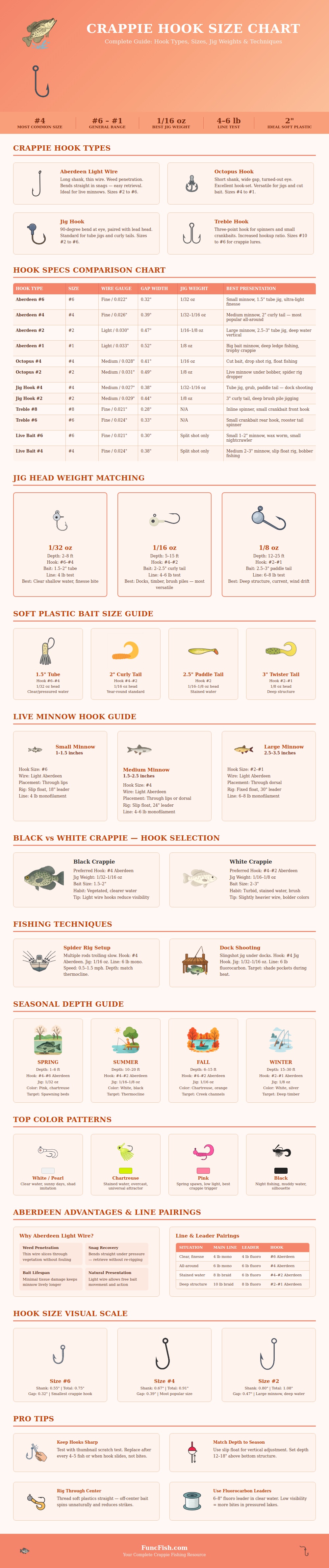
To catch crappies fish, the size of the hook must match the size of the crappie fish and the size of the bait. Because crappie has thin mouths, if the size of the hook is too large for the crappie, the hook will pull free from the fish’s mouth. Furthermore, if the size of the hook is too small for the size of the crappie fish, the large crappie will shake the hook loose from the fish mouth.
Therefore, if the crappie is too large for the hook, the crappie will not be able to take the hook into it’s mouth. A number 4 hook is the most common hook size use to catch crappie fish. A number 4 hook works best when combined with a sixteenth-ounce jig head and four-to-six-pound fishing line.
How to Choose Hooks and Gear for Crappie Fishing
Crappie fish typically grows to between eight and twelve inches in length. Different type of hooks can accomplish different purposes when fishing for crappie fish. Aberdeen hooks are designed to slice through weeds without snagging on them.
Furthermore, if an Aberdeen hook becomes stuck in brush, the Aberdeen hook will bend straight. Octopus hooks has wide gaps between the sharp points of the hook that will grab at the bait if the crappie is using cut bait under a float. Lastly, jig heads with ninety-degree eyes allows soft plastic baits to swim straight through the water.
Treble hooks, which have three or more points to the hook, will increase the probability that the bait will hook the crappie fish when using spinners. Thin wire hooks are used when fishing in clear water for crappie fish. In this case, a number 6 Aberdeen hook is the best hook size.
Aberdeen hooks have a fine gauge of approximately twenty-two thousandths of an inch that allow the hook to slice through weeds without damaging the bait. Number 6 Aberdeen hooks are used to catch small minnows or one-and-a-half inch tube of bait. If fishing for crappie fish on ledges at greater depths, use a number 2 or an number 1 hook.
A number 2 or a number 1 hook should of been combined with an eighth-ounce jig head that will allow the hook to move through the current in the lake. The weights of the jigs should be matched to the depth of the water being fished in. For shallow water that is less than eight feet deep, use a thirty-second ounce jig head because crappie fish in these depths are easy spooked.
A sixteenth ounce jig head is used for crappie fish near docks and brush piles because this jig head works best in a variety of condition. An eighth ounce jig head should be used when fishing in the presence of the wind or when fishing for crappie fish in deeper channels in the lake. Furthermore, use two-inch paddle tail bait and use stronger fishing line when using an eighth ounce jig head.
If using live minnows as bait, different sizes of hooks are used for minnows of different size. For instance, use a number 6 hook to thread a one-inch fathead minnow through the lips of the crappie fish when fishing in shallow water. For medium sized two-inch minnows, use a number 4 hook when using a bobber rig.
For three-inch shiners, use a number 2 hook and use long leaders to allow the shiners to swim freely. Aberdeen hooks are often used with live minnows because the Aberdeen hook will not damage the minnow. By minimizing the damage to the minnow, it will be able to thrash its tail for longer period of time.
Soft plastic baits come in different sizes and should be matched with certain sizes of jig head. For example, use one-and-a-half inch plastic tube with light jig heads when the water is clear. Use three-inch twister tails with jig heads when jigging for crappie fish in deep water.
Soft plastic baits should be rigged through the nose of the baits because if they are not rigged through the nose, the baits will spiral in the water and scare the crappie fish. The color of the jig head should be based off the type of crappie fish that are being targeted and the clarity of the water in the fishing area. For example, black crappie fish in vegetated creeks will take light number 4 hooks in pink or chartreuse color.
White crappie fish in stained water will take bolder number 2 hooks in white or black colors. Furthermore, crappie fish change the depth at which they fish throughout the year. For example, crappie fish prefer to remain in shallow flats of one to six feet in depth in the spring and fall.
However, in the winter and the summer, crappie fish prefer to move to channels of six to fifteen feet deep. Furthermore, crappie fish tend to move into deep timber area in the winter. The type of fishing line that is used when fishing for crappie fish will depend upon the type of fishing that will be performed.
For instance, use four-pound monofilament fishing line if fishing for crappie fish with finesse fishing techniques. Furthermore, use six-pound fluorocarbon leaders if fishing for crappie fish in clear lakes; fluorocarbon fishing line is harder for fish to see. Use eight or ten-pound braided fishing line and a fluorocarbon shock leader if fishing for crappie fish in the wind with heavy fishing setups.
Additionally, sharpen hooks after every few fish that is caught with the hook. Test the sharpness of the hook with your thumbnail. Finally, use slip floats to position the bait twelve to eighteen inches above the fishing structure.