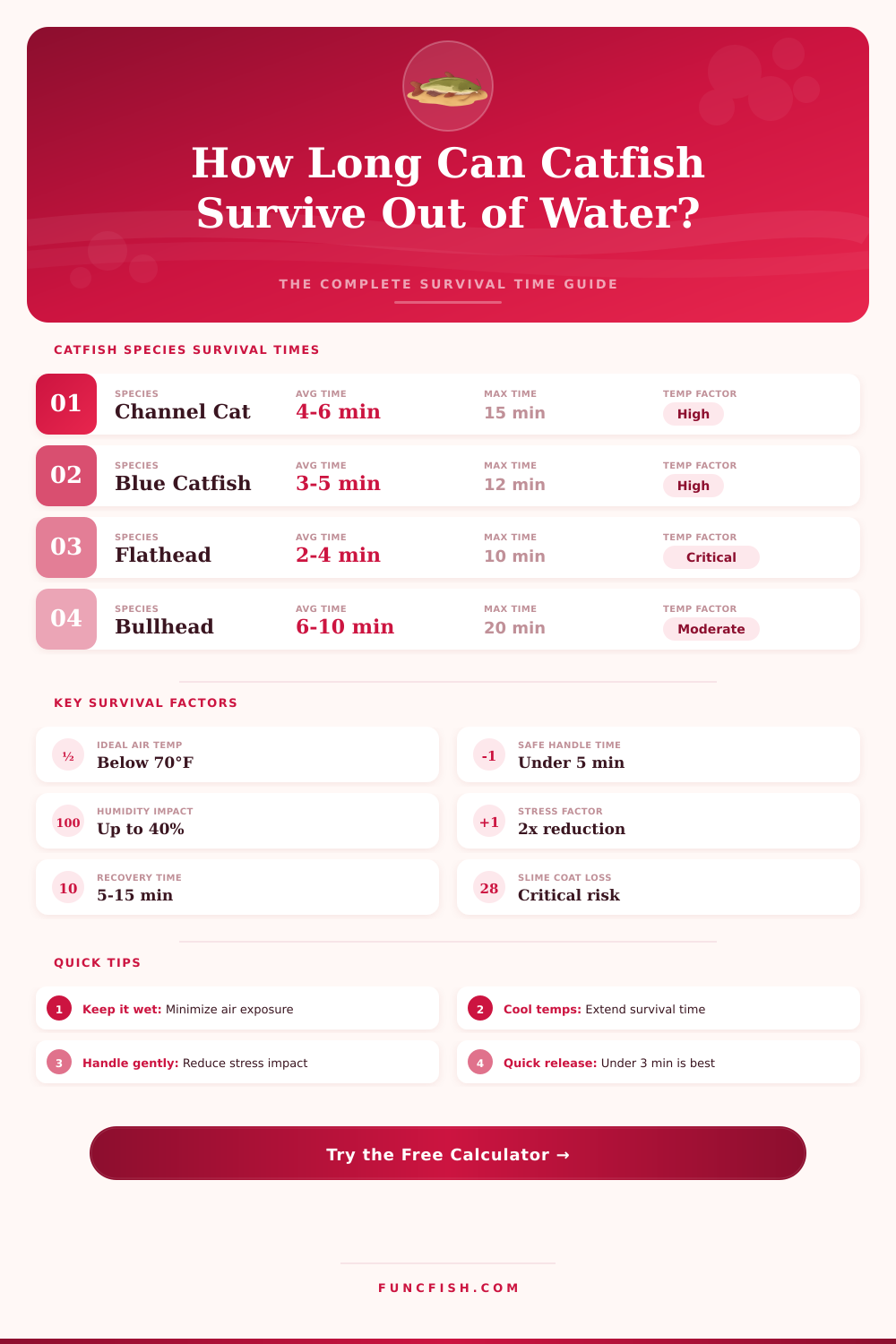
🐟 Catfish Out-of-Water Survival Time Calculator
Estimate safe handling time based on species, air temperature, humidity, and fish condition
| Air Temp (°F) | Air Temp (°C) | Survival Multiplier | Risk Level | Recommended Action |
|---|---|---|---|---|
| Below 50°F | Below 10°C | 2.0x (Double time) | Low | Extended handling OK |
| 50–65°F | 10–18°C | 1.5x | Low–Moderate | Standard precautions |
| 65–75°F | 18–24°C | 1.0x (Baseline) | Moderate | Keep brief, under 5 min |
| 75–85°F | 24–29°C | 0.75x | High | Under 3 min recommended |
| 85–95°F | 29–35°C | 0.5x | Very High | Under 90 seconds |
| Above 95°F | Above 35°C | 0.3x | Extreme | Immediate release only |
| Species | Base Survival (min) | Max Recorded | Typical Weight | Oxygen Sensitivity | Slime Coat Durability |
|---|---|---|---|---|---|
| Channel Catfish | 5 min | 15 min | 1–40 lb (0.5–18 kg) | Moderate | Good |
| Blue Catfish | 4 min | 12 min | 1–100+ lb (0.5–45+ kg) | High | Moderate |
| Flathead Catfish | 3 min | 10 min | 2–80 lb (1–36 kg) | Very High | Poor |
| Yellow Bullhead | 8 min | 25 min | 0.5–4 lb (0.2–1.8 kg) | Low | Excellent |
| Black Bullhead | 9 min | 28 min | 0.5–3 lb (0.2–1.4 kg) | Very Low | Excellent |
| White Catfish | 6 min | 18 min | 0.5–10 lb (0.2–4.5 kg) | Moderate | Good |
| Walking Catfish | 35 min | 60+ min | 1–5 lb (0.5–2.3 kg) | Very Low | Very Good |
| Fish Weight | Weight (kg) | Time Adjustment | Notes |
|---|---|---|---|
| Under 2 lb | Under 0.9 kg | +20% extra time | Small fish recover faster |
| 2–5 lb | 0.9–2.3 kg | Baseline | Standard handling |
| 5–15 lb | 2.3–6.8 kg | –10% reduced | Larger mass = more stress |
| 15–30 lb | 6.8–13.6 kg | –20% reduced | Minimize air time significantly |
| Over 30 lb | Over 13.6 kg | –35% reduced | Support body horizontally |
| Humidity Level | Slime Coat Drying Rate | Time Modifier | Recommendation |
|---|---|---|---|
| Below 30% (Very Dry) | Very Fast — 4 min to dry | –30% | Wet hands constantly |
| 30–50% (Dry) | Fast — 6 min to dry | –15% | Keep fish moist |
| 50–70% (Moderate) | Moderate — 10 min to dry | Baseline | Normal precautions |
| 70–85% (Humid) | Slow — 15 min to dry | +10% | Good conditions |
| Above 85% (Very Humid) | Very Slow — 20+ min | +20% | Near-optimal conditions |
When you catch a channel catfish, you must know how long the channel catfish can be out of the water without suffering any permanent damage from lack of water. Channel catfish require water to pass over there gill in order to take in the oxygen that they require to survive. If you remove the channel catfish from the water, the fish will begin to lose the oxygen that it need to survive.
The length of time that a channel catfish can survive without being in water depends upon a variety of factor, such as the species of the fish, the size of the catfish, the temperature of the water, and the moisture level of the environment. The species of the catfish are one of the factors that will impact the length of time that the channel catfish can survive. For instance, walking catfish can survive for long period out of the water due to the presence of lung like adaptations in their bodies that allow them to breathe air.
How Long Can a Channel Catfish Be Out of Water?
Thus, walking catfish can survive for up to 180 minutes while they are on damp grass. However, other species, like flathead catfish, have different physical characteristics than the channel catfish, such as the fact that they have to move their bodies and thrash their tail more forceful to circulate the water over their gills. Thus, flathead catfish will use up their supply of oxygen more quick.
Additionally, blue catfish have a very dense body, which requires more oxygen for the body to function normal compared to the channel catfish. The size of the catfish is another factor that will impact how long the fish can be out of the water. For example, the larger the size of the catfish, the more oxygen that their bodies will require in order to continue to function normal.
Thus, the larger catfish will last for a shorter period of time out of the water than small catfish species, such as bullhead catfish. Additionally, the temperature of the water will also impact the survival time of the catfish out of the water. If the body water temperature increase, the metabolism of the catfish will also increase, which will lead to the catfish using up its supply of oxygen at a faster rate.
The way in which you handle the fish is another factor that will impact the survival of the catfish out of the water. For instance, if you place the catfish on a dry deck, the body will begin to lose its protective slime layer, which are essential for the health of the catfish. Therefore, it is recommended that you use a knotless net or an damp sling to hold the channel catfish.
Additionally, it is also recommended that you hold the fish horizontally, under the belly of the catfish, to avoid causing stress to the fish. The length of time that the channel catfish can be out of the water can also be calculated. For instance, if you calculate the amount of time that the channel catfish can survive out of the water, you can simply subtract the elapsed time from the total survival time to determine how long the channel catfish can remain out of the water.
Additionally, you should return the catfish to the water before the elapsed time reaches the total survival time. Therefore, returning the channel catfish at 80% of the total time is a good strategy. If the stress index of the channel catfish is high, though, it is recommended that you return the catfish to the water immediately to avoid the death of the fish.
Finally, you should also observe the physical condition of the channel catfish to ensure that the fish is healthy. For instance, if the catfish is labored in breathing or if the color of its gills are changing, this could be an indication of high levels of stress in the catfish. In these cases, when you are to release the channel catfish back into the environment, it should be placed into deep water with a high amount of dissolved oxygen.
Additionally, you should face the catfish into the movement of the water to help the gills of the fish to function normal. By following these step and by considering these factor, the survival chances of the channel catfish after its release back into the river will be increased. You should of watched for signs of distress.
It’s important to keep the fishs skin moist. Youll need alot of patience. The fishs health depends on it.