
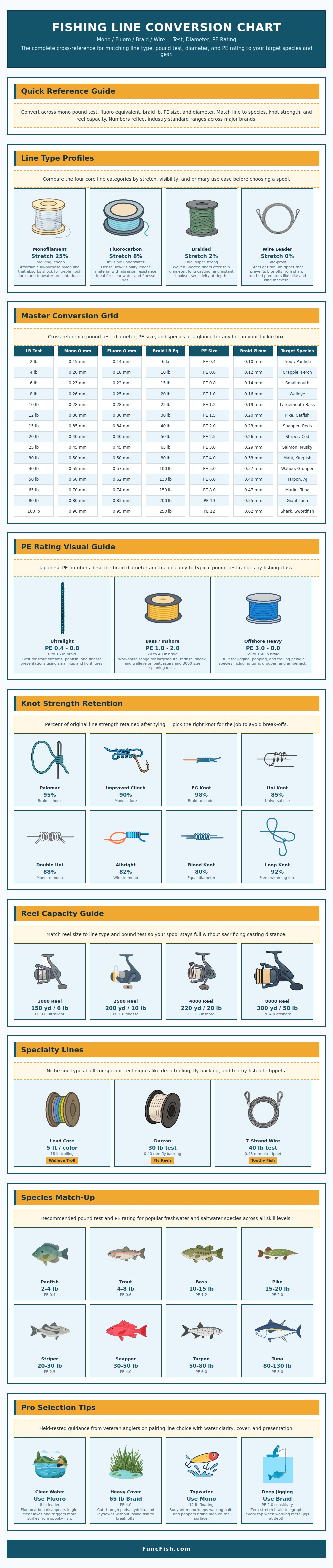
Fishing line conversion charts allows individuals to choose the correct fishing line for a variety of fishing situation. Many individuals use these charts because fishing line comes in a variety of materials, each with different property. The main types of fishing line include monofilament, fluorocarbon, braid, and wire.
Each type of fishing line feature different properties that individuals must understand before they can choose the correct fishing line for there need. Monofilament lines feature a property that allow them to stretch when pressure is placed upon the line. Additionally, the material is buoyant and will float in the water.
How to Choose the Right Fishing Line
Monofilament lines are useful for applications such as topwater fishing. Additionally, the material is relatively inexpensive. Fluorocarbon lines dont stretch much and will sink quick in water.
Fish may easily be spooked by bright objects in clear water where individuals often use fluorocarbon lines as a leaders. Braid lines have almost no stretch and have a thin diameter relative to the strength of the line. Braided lines allow individuals to cast their lines for long distances, even in the presence of wind.
Wire lines has zero stretch and are resistant to the teeth of fish. People use wire lines for fishing for species with sharp teeth. Fishing line conversion charts help individuals to determine the strength of one type of fishing line in comparison to another type of fishing line.
For instance, fishing line conversion charts can help individuals to determine what the braid equivalent of a certain pound test of monofilament line are. Many people also use the PE (polyethylene) rating system to indicate the diameter and strength of braided fishing line. Because braided line has a much thinner diameter than monofilament line of the same strength, individuals who use braided line can fit more line onto the fishing reel.
To connect fishing lines, knots are used. However, knots can sometimes cause fishing lines to break. If individuals use a knot that is not strong enough for the fishing line, the line may break more easily.
When connecting braid to the leader, strong knot are necessary. To avoid the risk of the line breaking, individuals should of practice to tie these knots. The type of fishing reel that is used can impact how individuals use the line.
For instance, people use small spinning reels with light lines, while large reels is used for heavier braided lines. Additionally, the reel must be filled with the correct amount of line. Using the wrong amount of line on the reel can lead to difficulties in fishing.
For instance, if there is too many line on the reel of thick monofilament lines, the line may experience backlashes. Conversely, if there is too little line on the reel of braided line, the drag system of the reel may not work correct. The type of fish that are to be targeted with the fishing line can also determine the type of line that should be used.
For example, species like panfish and trout has relatively low strengths and will require light lines because they are easily detected. Bass can put up more of a fight so stronger lines are required to extract the fish from weeds. Pike and musky species has strong bites and require heavy lines, and people use wire leaders because these species has sharp teeth.
In the case of saltwater environment, braided line can be used for species like snapper. However, because these species can grow to be larger, higher rating of braided line are used. In clear water, fluorocarbon is helpful because it is hard for the fish to see it.
However, individuals use braided line when fishing through vegetation. One of the most common mistake in fishing with fishing lines is to ignore the stretch of the line. Because monofilament lines have some stretch, they are less likely to injure the fish when reeling them in.
Braided lines do not stretch. Thus, they can make for strong hook sets when catching fish. However, it is harder to control the line, and it could potentially tear the mouth of the fish.
Another of the most common mistake is to fail to use a fishing leader. Because braided line is very visible to fish, individuals should use a fluorocarbon leader to the braid line to make it less visible to the fish. Finally, there are a variety of specialty fishing lines.
Lead core line is used to catch walleye and troll the fish at specific depth in the water. The color of the line allows individuals to see the depth at which the fish are being trolled. Dacron is an inexpensive material that is used for the backing of fly reels.
Additionally, multi-strand wire is used for fish species that have sharp teeth because the wire will not kink or break when the fish bite on the line. By using fishing line conversion charts and understanding the various materials from which fishing lines are made, individuals can more easily select the appropriate type of fishing line for their specific fishing environment and the species of fish that they wish to catch.