🎣 Trout Leader Length Calculator
Calculate the ideal leader length, tippet size, and section breakdown for any trout fishing scenario
| Species | Typical Weight | Leader Length | Tippet Size | Min Break Strength |
|---|---|---|---|---|
| Brook Trout | 0.5–2 lb (0.2–0.9 kg) | 7.5–9 ft | 5X–6X | 3.5–4.75 lb |
| Brown Trout | 1–8 lb (0.5–3.6 kg) | 9–12 ft | 4X–6X | 3.5–6.0 lb |
| Rainbow Trout | 1–10 lb (0.5–4.5 kg) | 9–12 ft | 4X–5X | 4.75–6.0 lb |
| Cutthroat Trout | 1–6 lb (0.5–2.7 kg) | 9–11 ft | 4X–5X | 4.75–6.0 lb |
| Lake Trout | 3–20 lb (1.4–9 kg) | 6–9 ft | 1X–3X | 8.5–13.5 lb |
| Steelhead | 5–20 lb (2.3–9 kg) | 9–12 ft | 1X–3X | 8.5–13.5 lb |
| Tippet | Diameter (in) | Diameter (mm) | Break Strength (lb) | Break Strength (kg) | Fly Hook Size |
|---|---|---|---|---|---|
| 0X | 0.011" | 0.279 mm | 15.5 lb | 7.0 kg | #1–#2 |
| 1X | 0.010" | 0.254 mm | 13.5 lb | 6.1 kg | #4–#6 |
| 2X | 0.009" | 0.229 mm | 11.5 lb | 5.2 kg | #6–#10 |
| 3X | 0.008" | 0.203 mm | 8.5 lb | 3.9 kg | #10–#14 |
| 4X | 0.007" | 0.178 mm | 6.0 lb | 2.7 kg | #14–#18 |
| 5X | 0.006" | 0.152 mm | 4.75 lb | 2.2 kg | #16–#20 |
| 6X | 0.005" | 0.127 mm | 3.5 lb | 1.6 kg | #18–#24 |
| 7X | 0.004" | 0.102 mm | 2.5 lb | 1.1 kg | #22–#28 |
| 8X | 0.003" | 0.076 mm | 1.75 lb | 0.8 kg | #26–#32 |
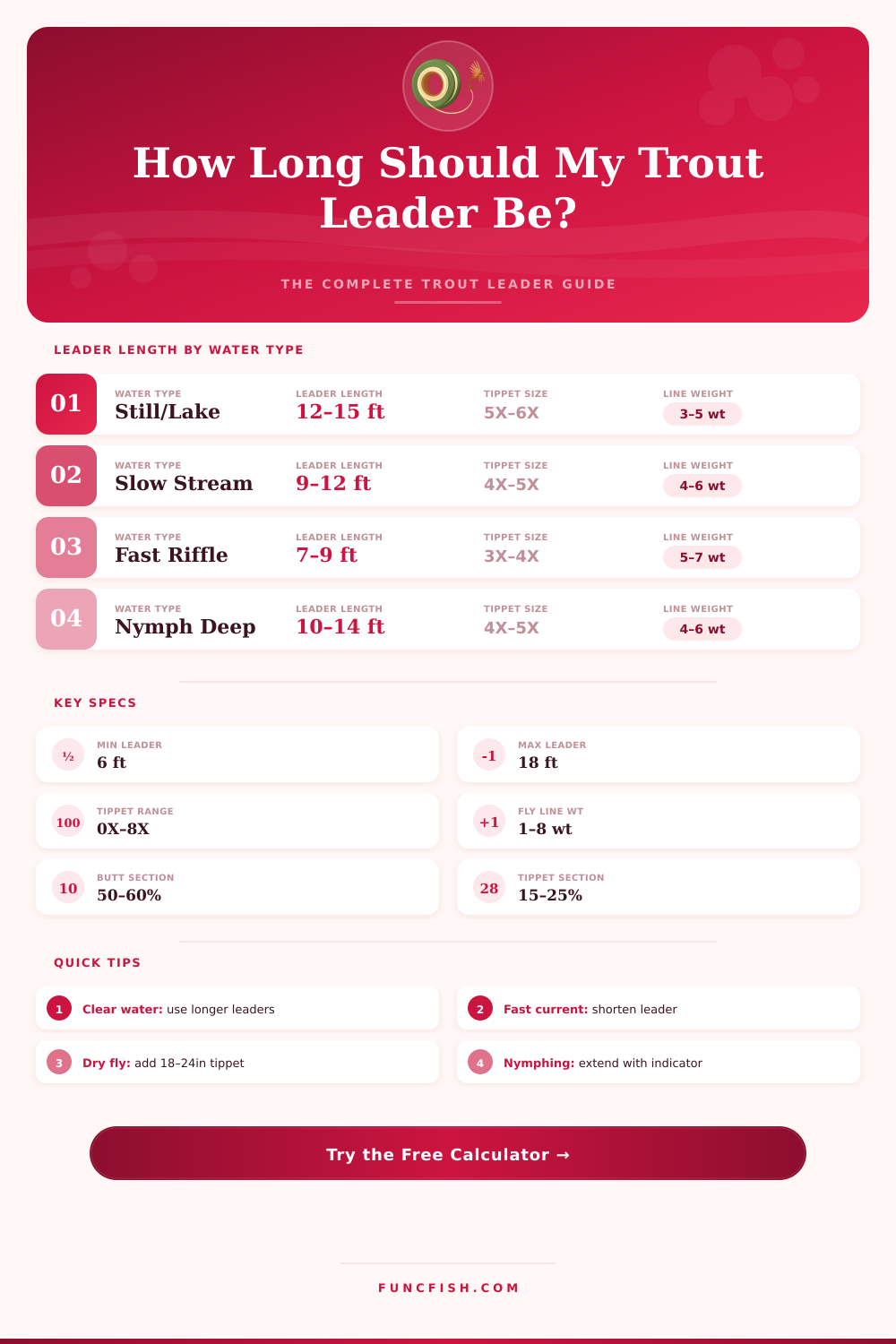
| Water Condition | Leader Length (ft) | Leader Length (m) | Technique | Notes |
|---|---|---|---|---|
| Clear Stillwater | 12–15 ft | 3.7–4.6 m | Dry fly / nymph | Long for stealth |
| Slow Clear Stream | 10–12 ft | 3.0–3.7 m | Dry fly | Delicate presentation |
| Moderate Current | 9–10 ft | 2.7–3.0 m | Nymph / dry | Standard approach |
| Fast Riffle | 7.5–9 ft | 2.3–2.7 m | Nymph / wet fly | Control & mend |
| Pocket Water | 6–7.5 ft | 1.8–2.3 m | Nymph / dry | Short for accuracy |
| Streamer Fishing | 5–7.5 ft | 1.5–2.3 m | Streamer | Direct pull needed |
| Tailwater / Spring Creek | 12–18 ft | 3.7–5.5 m | Dry fly / emerger | Super long for fussy fish |
Leader lengths is the length of the invisible line that exists between a fishing rod and a fishing fly. Leader length is an important factor to consider in the angling process because leader length will determine for you how much control you have over the fishing fly that you are using, as well as how much stealth you have when approaching a trout. If the leader length is too short for the trout you are targeting, the thick fishing line will spook the trout.
However, if the leader length is too long, the wind will catch the fishing line and make it difficult for the angler to cast the line. Thus, angling for trout with a leader length that is too short or too long can lead to unsuccessful fishing effort. Therefore, the angler must find a balance between having enough stealth and control over the fishing fly to be sucessful in there angling efforts.
How to Choose the Right Leader Length
The environment in which the angler decide to fish will dictate the length of the leader that is necessary for the angler to have success with their fishing efforts. For instance, if the angler is fishing in creek in the spring months, the water is typically very clear. Because clear water allows the trout to see the fishing line, an angler will need to use a longer leader length for their fishing line to stay away from the trout.
Additionally, if the angler is fishing in streams with many brushy areas, the angler will need to use a shorter leader length so that the angler can easy cast the fishing line underneath the branches. Water clarity will play a role in the leader length that is used when fishing; murky water allows for a shorter fishing line because the trout cant see it as easy as with clear water. The depth and speed of the water can also have an impact on the length of the fishing leader that should be used.
If an angler is fishing for nymphs or using indicators to catch the trout, the leader length should be long enough for the trout to reach the desired depth within the water. If the leader length is too short when fishing in currents, the current will pull the indicator to the side, causing the fishing line to not appear natural to the trout. However, if an angler is fishing in pocket water with many boulder, the leader length should be shorter to prevent the line from getting snagged on the boulders.
Calculators can be used to assist the angler in determining the appropriate length for the fishing leader. Factors to consider with a leader length calculator may include the length of the fishing rod that the angler will use, the distance that the line will be cast, and the depth of the water that will be fished. Anglers may also consider the material that will be used to construct the fishing leader, such as tapered monofilament or fluorocarbon line.
Fluorocarbon lines will sink more easy in bright water, for instance. Additionally, if the angler is fishing for trout that have very selective eating habits, the angler will use a finer tippet, such as a 6X or 7X tippet. However, if the angler is using streamers, the tippet should be thicker to permit the heavy streamers to have more backbone.
A common mistake that anglers make is utilizing a 9-foot leader length in all fishing situation. A 9-foot leader length works well when the conditions are moderate, but the 9-foot leader length does not account for all of the variable in fishing. For instance, if the fishing areas are exposed to alot of wind, using a shorter leader length will allow the leader to move through the wind more easy.
Additionally, if the water is very clear, a longer leader length will allow for better stealth in approaching the trout. Finally, anglers should of always test the length of their fishing leader on grass prior to beginning to fish to ensure that the leader will turn over correct when fishing.