🎣 Fluorocarbon Leader Length Calculator
Get the ideal fluorocarbon leader length, lb test, and diameter for any fishing technique or species target
| lb Test | Diameter (in) | Diameter (mm) | Typical Technique | Knot Strength (%) |
|---|---|---|---|---|
| 4 lb | 0.007" | 0.18 mm | Panfish, Trout | 85–90% |
| 6 lb | 0.009" | 0.23 mm | Trout, Bass Finesse | 85–90% |
| 8 lb | 0.010" | 0.25 mm | Bass, Walleye | 85–90% |
| 10 lb | 0.011" | 0.28 mm | Bass, Walleye, Inshore | 80–88% |
| 12 lb | 0.013" | 0.33 mm | Bass, Redfish | 80–88% |
| 15 lb | 0.014" | 0.36 mm | Inshore, Pike light | 78–85% |
| 20 lb | 0.016" | 0.41 mm | Inshore, Salmon | 75–82% |
| 25 lb | 0.018" | 0.46 mm | Pike, Nearshore | 75–82% |
| 30 lb | 0.020" | 0.51 mm | Surf, Catfish, Offshore | 72–80% |
| 40 lb | 0.022" | 0.56 mm | Offshore, Big Surf | 70–78% |
| 50 lb | 0.025" | 0.64 mm | Heavy Offshore, Shark | 68–75% |
| 80 lb | 0.031" | 0.79 mm | Big Game Shock | 65–72% |
| Species | Leader Length | FC lb Test | Notes |
|---|---|---|---|
| Largemouth Bass | 12–24 in | 10–17 lb | Finesse: lighter |
| Smallmouth Bass | 18–30 in | 8–12 lb | Clear water preferred |
| Rainbow Trout | 7–12 ft | 4–8 lb | Fly fishing standard |
| Walleye | 12–24 in | 8–12 lb | Light for jigging |
| Northern Pike | 12–24 in | 20–30 lb | Heavy abrasion |
| Redfish / Red Drum | 18–36 in | 15–25 lb | Inshore standard |
| Snook | 24–48 in | 20–30 lb | Structure abrasion |
| Striped Bass | 24–48 in | 20–30 lb | Surf or inshore |
| Mahi-Mahi | 6–12 ft | 30–50 lb | Offshore trolling |
| Yellowfin Tuna | 8–15 ft | 40–80 lb | Big game leader |
| Channel Catfish | 12–24 in | 20–30 lb | Bottom abrasion |
| Flounder | 12–24 in | 10–15 lb | Bottom structure |
| Technique | Leader Length | Metric | Reason |
|---|---|---|---|
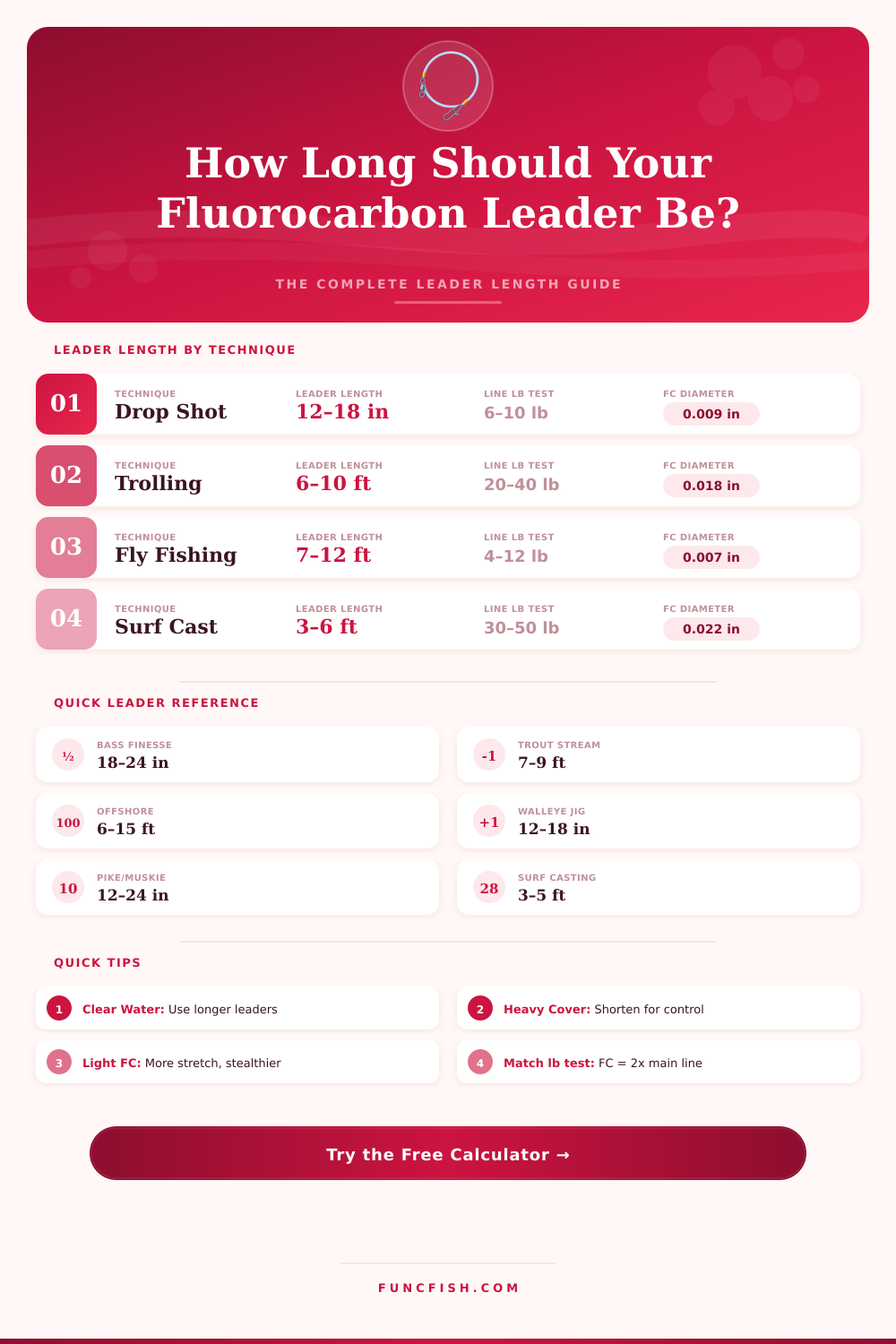
| Drop Shot | 12–18 in | 30–45 cm | Finesse precision |
| Carolina Rig | 18–36 in | 45–90 cm | Natural drift |
| Texas Rig (FC) | 12–24 in | 30–60 cm | Structure stealth |
| Ned Rig | 8–18 in | 20–45 cm | Ultra-finesse |
| Fly Fishing | 7–12 ft | 2.1–3.7 m | Presentation & drift |
| Jigging | 12–24 in | 30–60 cm | Sensitivity needed |
| Trolling | 6–15 ft | 1.8–4.6 m | Water resistance |
| Surf Casting | 3–6 ft | 0.9–1.8 m | Abrasion + shock |
| Popping/Topwater | 24–48 in | 60–120 cm | Surface lure action |
| Nymph (Fly) | 9–14 ft | 2.7–4.3 m | Indicator rig depth |
| Inshore Live Bait | 18–60 in | 45–152 cm | Natural movement |
| Ice Fishing | 8–16 in | 20–40 cm | Cold water clarity |
| Material | Visibility | Stretch | Abrasion | Sinking Rate | Best Use |
|---|---|---|---|---|---|
| 100% Fluorocarbon | Near Invisible | 3–4% | Excellent | Sinks fast | Clear water, finesse, offshore |
| Premium FC (Low Stretch) | Near Invisible | 2–3% | Excellent | Sinks fast | Sensitivity-critical presentations |
| Soft FC (High Flex) | Near Invisible | 5–7% | Good | Sinks fast | Fly fishing tippet, finesse rigs |
| Heavy FC (Abrasion) | Near Invisible | 3–5% | Outstanding | Sinks fast | Structure, rocks, oyster bars |
| Clear Monofilament | Visible | 15–25% | Fair | Neutral | Budget rigs, shock leader |
| Copolymer Mono | Moderate | 8–15% | Good | Slight sink | All-around, better than mono |
| Single-Strand Wire | Visible | ~0% | Outstanding | Sinks | Pike, muskie, sharks, bluefish |
| Titanium Wire | Low | ~1% | Outstanding | Sinks | Toothy fish, kinking resistance |
Fluorocarbon leader length are one of the various variables that affect the way that a person fish. The length of the fluorocarbon leader will impact whether or not the bait that are being used in fishing appears natural or unnatural to the fish that is being targeted. Fluorocarbon leader length that are too long may lead to the fluorocarbon leader becoming entangled during a cast or hookset.
Fluorocarbon leader lengths that are too short may lead to the main fishing line being visible to the fish, causing the fish to avoids the bait. The length of fluorocarbon leaders that anglers use in fishing presents specific trade-off for anglers. Longer fluorocarbon leaders allow the main fishing line to remain more further from the strike zone, which is beneficial for anglers who are using their fishing techniques in water that is known to be clear, as visibility of the fishing line is reduce.
How Long Should Your Fluorocarbon Leader Be
However, longer fluorocarbon leaders add to the weight of the fishing line, and the fluorocarbon leader are more likely to develop knots due to the movement of the fishing line. Shorter fluorocarbon leaders is beneficial for anglers who are fishing near heavy structure in the water, as fluorocarbon leader of such shorter lengths are easier to manage in these areas. The fishing technique that is used will determine the length of fluorocarbon leaders that should be utilize.
Finesse fishing techniques in open water require fluorocarbon leaders of longer lengths then techniques that are performed in areas with heavy cover, where shorter fluorocarbon leaders are beneficial due to the ability to move heavy lures through the vegetation. Additionally, different species of fish require fluorocarbon leader of different lengths. For instance, fish species like pike, which live in areas with abundant weeds, require shorter fluorocarbon leaders, while species like trout are easy spooked by the fishing line and require fluorocarbon leaders of longer lengths to minimize the chance of scaring the fish.
Factors like the type of knots that is used on the fishing line and the type of main fishing line will impact the length of fluorocarbon leaders that should be utilized. Slim knots, like the FG knot, will preserve the length of fluorocarbon leaders due to the minimal bulk that the knot create when the knot are formed. Bulky knots will reduce the length of fluorocarbon leaders due to the length of fluorocarbon leader that is used up to form the knot.
Additionally, braided main fishing line may require longer fluorocarbon leaders to absorb the shock of the catch that is made during a hookset. The clarity of the water in which an angler is fishing is one of the primary factor that will impact the length of fluorocarbon leaders that are used. In areas with murky water, shorter fluorocarbon leaders may be used, as fish in murky water rely more upon there instincts than their vision to locate prey.
In clear water, however, longer fluorocarbon leaders may be used to help hide the main fishing line from the fish in the water. Additionally, other factors like the depth of the water and the weight of the bait can also impact fluorocarbon leader length. By avoiding common mistake when setting up fluorocarbon leaders, anglers can reduce the likelihood that their efforts will not be fruitful.
For instance, using a fluorocarbon leader of twenty-feet in length when the length of the fluorocarbon leader may interfere with casting or hooksets is a mistake that should of be avoid. Another mistake is using fluorocarbon leaders of too short of a length in areas with clear water. Presets for fluorocarbon leaders of various lengths can be used to effectively fish for species like smallmouth bass in areas with rocks, or for redfish in flat areas.
Finally, the type of fishing rod that is used and the wind in the area in which fishing effort are performed should also be considered. Longer fluorocarbon leaders require rods of a softer action than short fluorocarbon leaders. Short fluorocarbon leaders also work well with fast-action fishing rods.
Additionally, strong winds may cause long fluorocarbon leaders to become entangled, so shorter fluorocarbon leaders should be used in strong wind condition. By considering these various factors, anglers can ensure that their fluorocarbon leaders is performing their essential functions.