🐟 Saltwater Fishing Leader Length Calculator
Calculate the ideal leader length, strength, and material for any saltwater fishing scenario
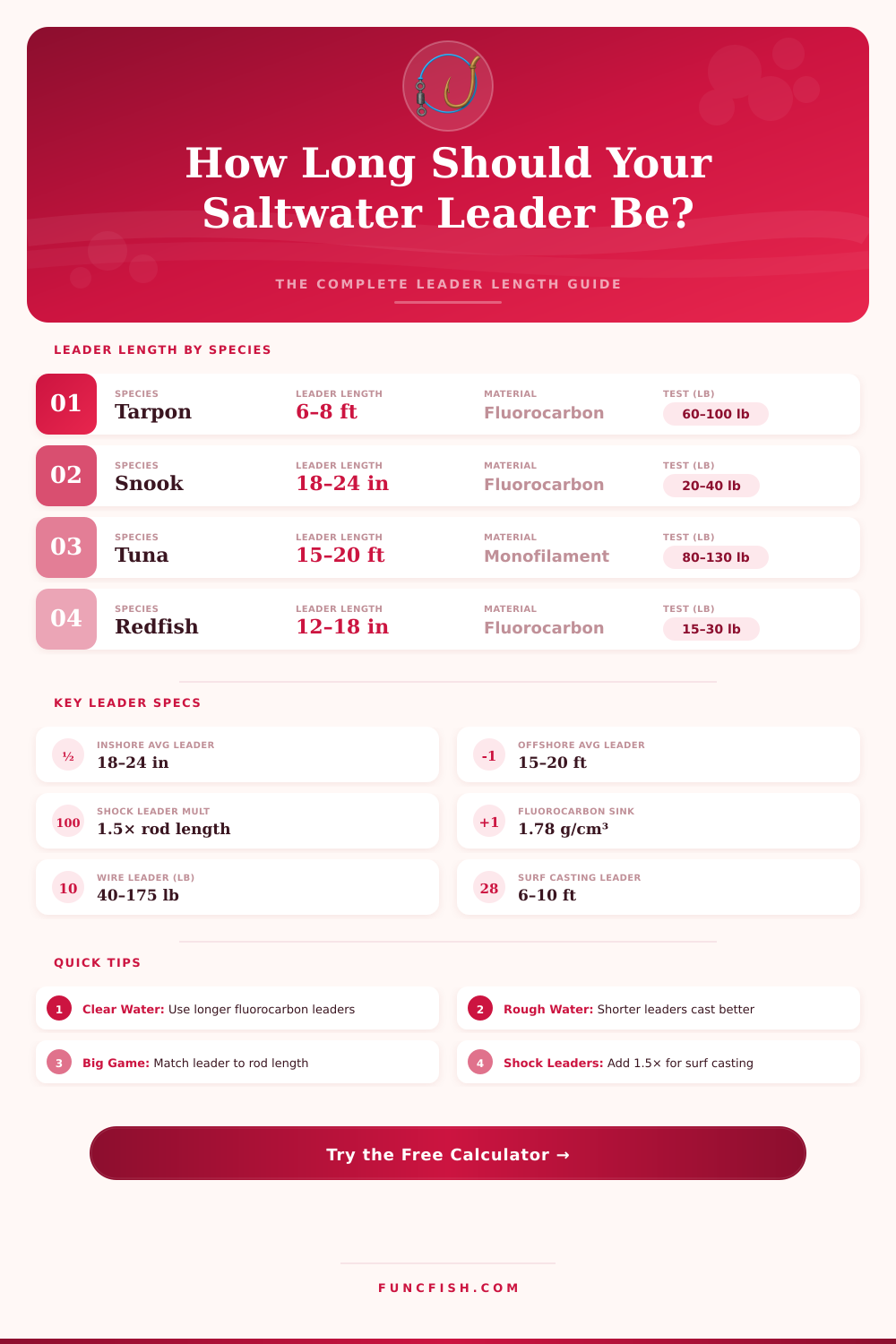
| Species | Avg Weight | Leader Length | Recommended Material | Min Test (lb) |
|---|---|---|---|---|
| Redfish | 3–15 lb (1.4–6.8 kg) | 18–24 in (46–61 cm) | Fluorocarbon | 15–30 |
| Snook | 5–20 lb (2.3–9 kg) | 18–24 in (46–61 cm) | Fluorocarbon | 20–40 |
| Tarpon | 60–150 lb (27–68 kg) | 6–8 ft (1.8–2.4 m) | Fluorocarbon | 60–100 |
| Spotted Seatrout | 1–5 lb (0.5–2.3 kg) | 12–24 in (30–61 cm) | Fluorocarbon | 10–20 |
| Flounder | 1–8 lb (0.5–3.6 kg) | 12–18 in (30–46 cm) | Fluorocarbon | 10–20 |
| Striped Bass | 5–40 lb (2.3–18 kg) | 24–36 in (61–91 cm) | Monofilament | 20–50 |
| Yellowfin Tuna | 20–200 lb (9–91 kg) | 15–20 ft (4.6–6.1 m) | Monofilament | 80–130 |
| Mahi-Mahi | 5–50 lb (2.3–22.7 kg) | 12–20 ft (3.7–6.1 m) | Fluorocarbon | 30–80 |
| Shark | 50–500+ lb (23–227+ kg) | 12–24 in (30–61 cm) | Wire | 80–250+ |
| Pompano | 1–4 lb (0.5–1.8 kg) | 18–24 in (46–61 cm) | Monofilament | 10–20 |
| Scenario | Base Length (Imperial) | Base Length (Metric) | Key Factor |
|---|---|---|---|
| Clear Inshore Flats | 18–36 in | 46–91 cm | Stealth critical |
| Murky Backwater | 12–18 in | 30–46 cm | Short OK, abrasion key |
| Offshore Trolling | 15–25 ft | 4.6–7.6 m | IGFA compliance |
| Live Bait Offshore | 6–10 ft | 1.8–3 m | Natural presentation |
| Surf Casting | 6–10 ft | 1.8–3 m | Abrasion from sand |
| Shock Leader Surf | 1.5× rod length | 1.5× rod length | Cast impact absorption |
| Jigging (vertical) | 3–6 ft | 0.9–1.8 m | Action preservation |
| Popping / Topwater | 3–5 ft | 0.9–1.5 m | Lure action key |
| Material | Visibility | Abrasion Resistance | Stretch | Best Use |
|---|---|---|---|---|
| Fluorocarbon | Near invisible | Excellent | Low (3–5%) | Clear water, wary fish |
| Monofilament | Low–moderate | Good | High (15–30%) | General use, surf, trolling |
| Stainless Wire | High | Excellent | None | Shark, toothy fish |
| Titanium Wire | High | Excellent | Minimal | Shark, billfish, kink resistant |
| Nylon-Coated Wire | Moderate | Very Good | Minimal | Wahoo, barracuda, pike |
| Heavy Mono Shock | Moderate | Very Good | Moderate | Surf casting shock absorption |
| Copolymer | Low | Good | Moderate (8–15%) | Budget alternative to fluoro |
| Braided Leader | High | Low–moderate | Very Low (<1%) | Sensitivity-critical jigging |
Saltwater leader are the pieces of line that connect a main fishing line to a hook or an lure. The length of a saltwater leader are crucial for succesful fishing. If a saltwater leader is too short, the main fishing line may flash in the water and spook the fishes.
However, if a saltwater leader is too long, then the saltwater leader may get in the way of the current or pilings. A saltwater leader of the appropriate length will ensures that the fish will bite the hook. The clarity of the water is one of the primary considerations when select the length of a saltwater leader.
How Long Your Saltwater Leader Should Be
In very clear water, such as flats where bonefish lives, fishermen use long saltwater leaders of nine or ten feet to hide the main fishing line from the fish. In murky water, such as surf areas or reefs, where fish do not closely inspect the bait, fishermen use shorter saltwater leaders of three to five feet. The physical environment where fishing occurs will dictate the length of the saltwater leader.
If the fishing spot is near mangroves or piers with pilings, fishermen use shorter saltwater leaders so that the long saltwater leader does not get in the way. Shorter saltwater leaders is also used for fishing near reef edge and rock piles. Long saltwater leaders are used in open water where fishing is not likely to cause any tangling of the saltwater leader.
The type of fish that is being targeted will also affect the length of the saltwater leader. For example, tarpon exhibit acrobatic movements so a longer saltwater leader is needed with some give in the line. For species with teeth, like kingfish and tuna, fishermen use shorter saltwater leaders and wire saltwater leader are used to avoid the risk of the teeth of the fish clipping the fluorocarbon material of the saltwater leader.
Current and wind are two environmental factors that will impact saltwater leader use. Strong currents will bow the saltwater leader which will reduce its length so a more strong main fishing line is needed. The wind may also impact the movement of the saltwater leader.
You should considered this movement when setting up the fishing line. The knot in the saltwater leader also impact the length of the saltwater leader. For instance, an FG splice knot will consume fourteen inches of saltwater leader and a haywire twist knot will consume an even more greater length of saltwater leader.
This length must be accounted for in determining the total length of the saltwater leader. If the knots do not account for the length of the saltwater leader, the saltwater leader will be shorter then desired. A common mistake is to ignore the need for a reserve of length for the knots in the saltwater leader.
The saltwater leader should be measured with extra length to allow for the knots, otherwise the saltwater leader will be too short once the fish are hooked. Another common mistake is to focus on the strength of the saltwater leader rather than the presentation of the saltwater leader to the fish in very clear water. Finally, the saltwater leader should be inspected for any damage.
Saltwater leaders are exposed to salt and the suns UV rays which can deteriorate the materials use in its production. Additionally, the constant movement of the saltwater leader in the water can create wind knots which also damage the saltwater leader. Any saltwater leader exposed to the sun or damaged must be refreshed to ensure it will not break while fighting a caught fish.