🎣 Jigging Leader Length Calculator
Calculate the ideal leader length, strength, and material for your jigging setup based on depth, technique, and target species
Near Invisible
High Stretch
Bite Resistant
Low Memory
Kink Resistant
Abrasion Proof
Flexible & Tough
Budget Option
| Technique | Typical Depth | Rec. Leader Length | Metric Equiv. | Leader Strength |
|---|---|---|---|---|
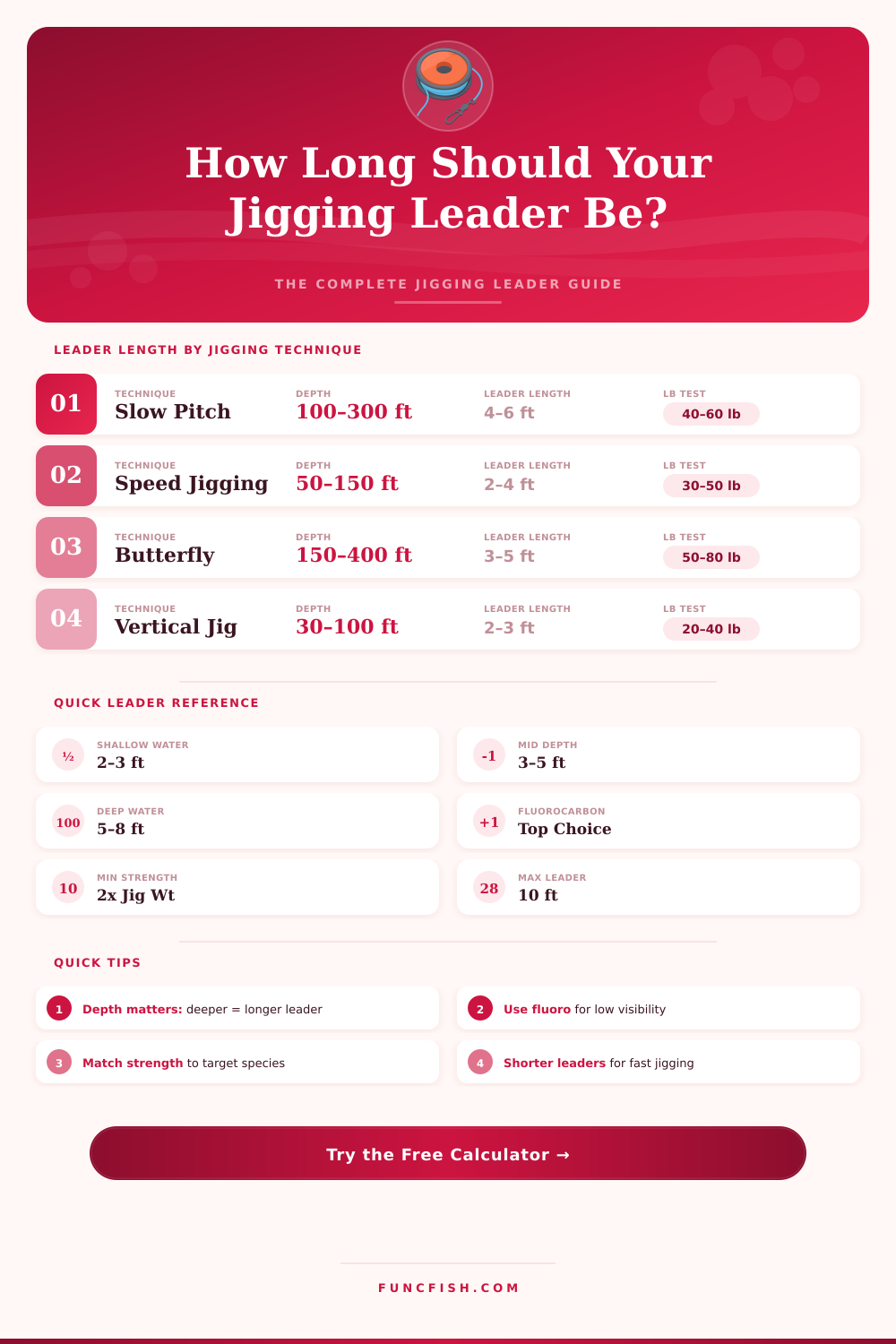
| Slow Pitch | 100–400 ft | 4–7 ft | 1.2–2.1 m | 40–80 lb |
| Speed Jigging | 50–200 ft | 2–4 ft | 0.6–1.2 m | 30–60 lb |
| Butterfly Jigging | 150–500 ft | 3–6 ft | 0.9–1.8 m | 50–100 lb |
| Vertical Jigging | 30–150 ft | 2–4 ft | 0.6–1.2 m | 20–50 lb |
| Micro Jigging | 10–60 ft | 1.5–3 ft | 0.45–0.9 m | 6–20 lb |
| Species | Avg Weight | Min Leader Lb | Ideal Material | Leader Length |
|---|---|---|---|---|
| Yellowfin Tuna | 40–200 lb | 80 lb | Fluorocarbon | 5–7 ft |
| Amberjack | 20–100 lb | 60 lb | Fluorocarbon | 4–6 ft |
| Grouper | 5–50 lb | 50 lb | Monofilament | 4–7 ft |
| Largemouth Bass | 1–12 lb | 15 lb | Fluorocarbon | 2–3 ft |
| Snapper | 1–20 lb | 30 lb | Fluorocarbon | 3–5 ft |
| Halibut | 10–200 lb | 80 lb | Monofilament | 5–8 ft |
| Trout | 0.5–8 lb | 8 lb | Fluorocarbon | 2–3 ft |
| King Mackerel | 5–60 lb | 80 lb (wire) | Wire/Titan. | 3–5 ft |
| Shark | 50–500+ lb | 200 lb (wire) | Wire | 4–8 ft |
| Walleye | 1–10 lb | 10 lb | Fluorocarbon | 2–3 ft |
| Material | Refractive Index | Stretch % | Abrasion Resist. | Recommended Use |
|---|---|---|---|---|
| Fluorocarbon | 1.42 (near water) | 2–4% | Very High | Clear water, wary fish |
| Monofilament | 1.49 | 20–30% | Moderate | General purpose |
| Single Strand Wire | N/A | <1% | Extreme | Sharp-toothed species |
| Titanium Wire | N/A | ~3% | Extreme | Kink-resistant wire rigs |
| Copolymer | 1.46 | 10–15% | High | General, low memory |
| Coated Wire | N/A | 1–2% | Very High | Toothy fish, flexible |
| Braided Sleeve | N/A | ~0% | Extreme | Rocky bottom, abrasion |
| Heavy Nylon | 1.53 | 25–35% | Low | Budget, light species |
Leader length are critical to jigging because leader length determine how the jig move in the water and how the person can control the jig. If the leader is too long, the jig may drift or becomes tangled. However, if the leader is too short, the jig will not move in a natural fashion.
The person must find a balance between the visibility of the jig and how much control they has over it. Another critical factor in determining an ideal leader length is clarity of the water. In clear water, fish can see the unnatural movement of the jig, so the jig should have a longer leader to emulate a fleeing baitfish.
How to Choose the Right Leader Length for Jigging
However, if the leader is too long, it may act as a sail for the jig in deep water or strong currents. The type of fish also play a critical role in determining the ideal leader length. For example, small panfish dont require long leaders, but large fish such as pike require short wire leaders because their sharp teeth will cut through the material in the line.
If the jigging spot includes reef or wreck, a longer leader will allow it to clear the structures. The speed of the current in the area also determine the ideal length of the jigging leader. If the current is strong, a shorter leader will allow the jig to move in a straight line through the water.
However, if the water is relatively calm, a longer leader will allow it to fall in more naturaly fashion from the point of cast. The weight of the jig will also influence the leader length. Light jig require more space to move in the water, while heavy jig can have a shorter leader to help them punch through heavy currents.
The length of the rod will dictate the maximum length of the jigging leader. A leader that is too long will not pass through the guides on the rod. The material that the jigging leader is made of will change the way the jig move in the water.
For example, fluorocarbon lines will sink and are best for clear water because fish find fluorocarbon difficult to see. Fluorocarbon also has low stretch, so it allow for the jig to make sharp movements in the water. Fish with sharp teeth, such as pike, use wire leaders because wire is difficult for their teeth to cut.
Wire also has zero stretch to ensure that every movement of the rod is transfered to the jig. Monofilament lines have more stretch than fluorocarbon or wire leaders and are used to absorb the force of the fish. Monofilament lines will require a longer length on the jig head so the line does not bow in the water.
The length of the jigging leader should also be adjusted for specific environment. For example, in areas with a strong tide, a long monofilament line may cause the jig to balloon out in the water. In this situation, the monofilament line should be shorter.
If jigging near coral reef, a fluorocarbon leader will hug the edge of the coral without catching on it. Many commercial jig come with a baseline measurement for the length of the leader. For example, a two-foot leader may accompany micro jig, while a five-foot leader will accompany slow-pitch jig.
However, a person should not rely on these measurements because they dont account for every scenario. For example, the person must consider the test strength of the leader. If it is to fine for the type of fish in the area, it may snap when hook.
To get the ideal length for the jigging leader, the person can observe the angle of the braid on the jigging line and the movement of the jig. If the jig is moving too slow compared to the movement of the fishing rod, the leader is too long for the current. If the jig does not move in a natural fashion to mimic fleeing baitfish, the leader is too short for the water clarity.
Finally, a person must make sure that the length of the jigging leader does not go beyond the capacity of the rods guides to avoid causing problem when casting the line.