
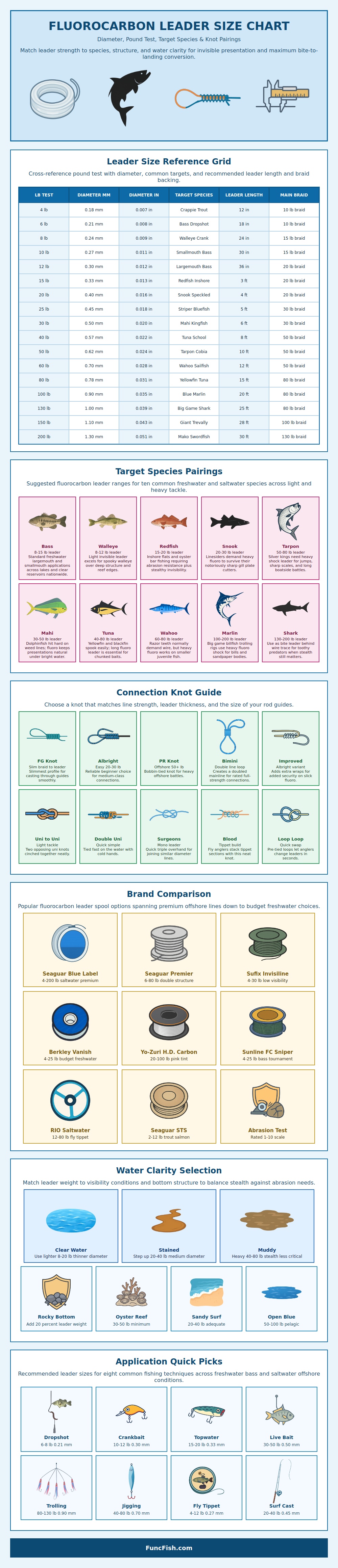
Fluorocarbon leader are a type of fishing line that can be connected to a braided mainline. The reason for the use of fluorocarbon leaders are that fluorocarbon leaders are nearly invisibly in the water, fluorocarbon leaders are more resistant to abrasion than monofilament lines, and fluorocarbon leaders sink quick in the water allowing for the bait to drift in a natural manner. Additionally, the person using the fishing line must ensure that the person using the fishing line selects the correct size of fluorocarbon leader as the size of the fluorocarbon leader will determine if the fish can see the fluorocarbon leader or if the fluorocarbon will break when fighting with the fish.
Braid line are often strong and thin but are also very reflective of the light. If the fishing line is too reflective the fish will be spooked. Fluorocarbon leaders bend the light in a manner similar to water which makes it invisible to the fish.
How to Choose and Use Fluorocarbon Leaders
Fluorocarbon leaders are also more resistant to the damage of rocks, shells, and the teeth of the fish. If the fluorocarbon leader is too light the fish with sharp teeth may snap the fluorocarbon line. Fluorocarbon leaders that are too heavy may spook the fish in the water if the water is clear.
The type of fish that you are targeting with your fishing line will dictate the thickness of the fluorocarbon leader. For instance, if you are targeting panfish or trout in clear water the fluorocarbon leader should be thin to avoid being seen by the fish. If the fish targeted are species like bass or walleye, a fisherman will use a thicker fluorocarbon leader to provide more strength in the line.
For those fishing in saltwater area for redfish or snook a heavier fluorocarbon leader should be used as these fish live in areas with many oyster bars and mangroves that can damage the line. For those fishing offshore for tuna or mahi-mahi, a fisherman should use a fluorocarbon leader that is both long and stout as these fish is strong and powerful. The clarity of the water and the structures beneath the water will also dictate the type of fluorocarbon leader that you use.
In clear water the fluorocarbon leader should be thin to reduce the chance that the fish will detect it. If the water is muddy or stained the fluorocarbon leader can be thicker. Additionally, if the area being fished is rocky or contains shell reefs a fluorocarbon leader with a higher pound test is required to reduce abrasion of the fluorocarbon leader.
If the area being fished are sandy areas the fluorocarbon leader can be lighter as the sand does not create abrasion to the fluorocarbon leader. The connection between the braided mainline and the fluorocarbon leader are also important. The knots used must allow the braided mainline to move through the guides on the fishing rod easy.
Bulky knots may create wind knots or backlashes. For freshwater environments knots like the uni-to-uni knot can be used. For saltwater and offshore fishing more specialized knots can be used or the person can double the fishing lines.
The knots must be tight and lubricated with water before being secured as fluorocarbon lines are slick and knots that are not properly secured may become undone during fishing. Depending on the fishing technique fluorocarbon leaders may need to be of a different type. For instance when dropshotting the fluorocarbon leader should be very thin.
When using topwater lure the fluorocarbon leader must be strong enough to allow for a hookset to be completed. For trolling or vertical jigging in deep water a thick fluorocarbon leader should be used to allow for strong currents and large fish to be handled. There are many different brand of fluorocarbon fishing leaders on the market.
However any good fluorocarbon leader will have low stretch as this allows for better hooksets. Additionally fluorocarbon leaders will have UV resistance to prevent the line from degrading in the sunlight. Furthermore people can test fluorocarbon leaders to determine if the fluorocarbon has memory or not as this will impact the way the fluorocarbon moves in the water.
Many anglers make mistake when using fluorocarbon leaders. One of the most common is using a fluorocarbon leader that is too thick for the catching situation. This is done for the strength of the line yet will result in fewer fish being caught as the fish will be able to detect the line.
Another common mistake is forgetting to ensure that the braided main line has the same strength as the fluorocarbon leader. Any difference in strength may cause the braided mainline to snap. Finally these lines should of always be wetted prior to securing the knots as this will ensure proper seating of the knots in the fluorocarbon line.