🎣 Switch Rod Calculator
Find the ideal rod length, line weight, grain window & head system for any two-hand switch fishing scenario
| Line Weight | Skagit Grain Window | Scandi Grain Window | Spey Grain Window | Head Length (Skagit) |
|---|---|---|---|---|
| 3 wt | 150–200 gr | 130–180 gr | 120–160 gr | 15–18 ft |
| 4 wt | 175–240 gr | 150–210 gr | 140–190 gr | 16–20 ft |
| 5 wt | 225–300 gr | 190–260 gr | 175–235 gr | 18–22 ft |
| 6 wt | 280–375 gr | 240–320 gr | 220–290 gr | 20–24 ft |
| 7 wt | 350–450 gr | 290–380 gr | 270–355 gr | 22–26 ft |
| 8 wt | 425–540 gr | 350–460 gr | 325–430 gr | 24–28 ft |
| 9 wt | 500–630 gr | 420–545 gr | 390–510 gr | 26–30 ft |
| 10 wt | 580–720 gr | 490–630 gr | 455–590 gr | 28–32 ft |
| 11 wt | 660–820 gr | 560–720 gr | 520–675 gr | 30–34 ft |
| 12 wt | 750–930 gr | 630–810 gr | 585–760 gr | 32–36 ft |
| Species | Typical Weight | Rod Weight | Head System | Rod Length | Leader (lb test) |
|---|---|---|---|---|---|
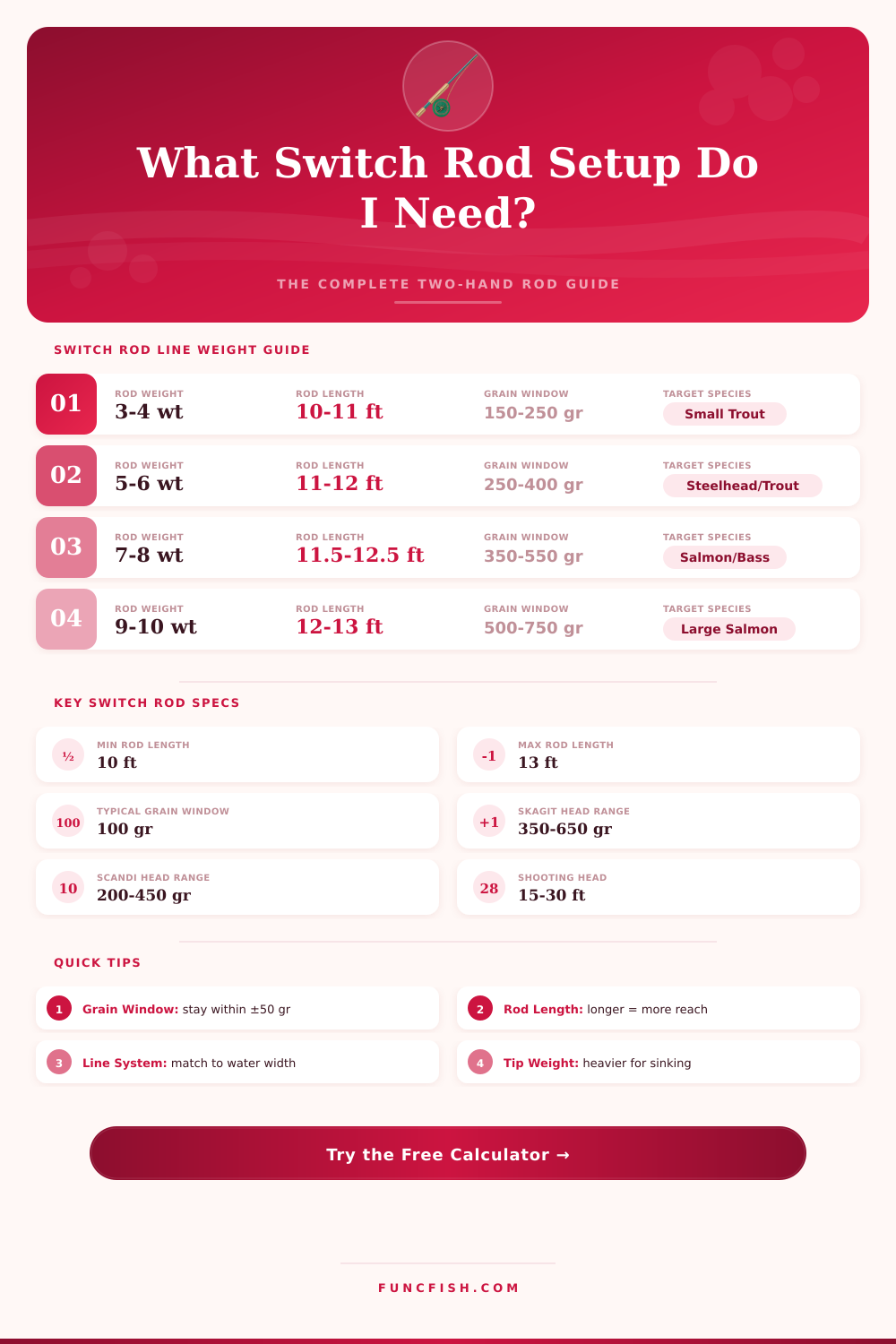
| Small Stream Trout | 0.5–3 lb / 0.2–1.4 kg | 3–4 wt | Scandi / Euro | 10–11 ft | 4–8 lb |
| Sea-Run Cutthroat | 1–5 lb / 0.5–2.3 kg | 5–6 wt | Scandi | 10.5–11.5 ft | 8–12 lb |
| Summer Steelhead | 5–15 lb / 2.3–6.8 kg | 6–8 wt | Scandi / Skagit | 11–12 ft | 10–16 lb |
| Winter Steelhead | 8–20 lb / 3.6–9 kg | 7–9 wt | Skagit | 11.5–13 ft | 12–20 lb |
| Atlantic Salmon | 6–30 lb / 2.7–13.6 kg | 7–9 wt | Scandi / Spey | 11.5–13 ft | 12–20 lb |
| Chinook Salmon | 15–50 lb / 6.8–22.7 kg | 9–11 wt | Skagit | 12–13 ft | 20–30 lb |
| Coho Salmon | 6–20 lb / 2.7–9 kg | 7–9 wt | Skagit / Scandi | 11–12.5 ft | 12–18 lb |
| Pike (Fly) | 3–25 lb / 1.4–11.3 kg | 8–10 wt | Skagit | 11–12.5 ft | 30–50 lb (wire) |
| Bass Streamer | 1–8 lb / 0.5–3.6 kg | 6–8 wt | Skagit / Hybrid | 11–12 ft | 12–20 lb |
| System | Head Length | Best For | Typical Grain Load | Casting Style |
|---|---|---|---|---|
| Skagit | 15–32 ft / 4.6–9.8 m | Sinking tips, heavy flies, tight loops | 250–750 gr | Sustained Anchor |
| Scandi | 25–40 ft / 7.6–12.2 m | Floating lines, light flies, delicate pres. | 150–550 gr | Touch & Go |
| Long Belly Spey | 45–75 ft / 13.7–22.9 m | Large rivers, distance, classic techniques | 300–700 gr | Traditional D-Loop |
| Integrated Shooting Head | 30–50 ft / 9.1–15.2 m | Versatility, distance shooting | 200–600 gr | Sustained Anchor |
| Hybrid Mid-Head | 35–55 ft / 10.7–16.8 m | Moderate rivers, all-round use | 225–575 gr | Touch & Go / Anchor |
| Euro / Mono Rig | N/A (monocore) | Small rivers, tight quarters, nymphing | 0–100 gr | High-stick Nymph |
Matching the weight and lengths of a fly line to a switch rod will ensure that the rod function correctly. A switch rod can be used between a single-hand rod and a two-hand rod. For a switch rod, the line grain weight should be specific to load the rod correctly.
If the line is too light, it will not load the rod and will not reach the targets. If the line is too heavy for the rod, it will overwhelm the rod, and the angler will struggle to control the rod correctly. The grain weight of the line must match an environment and the kind of fish to be targeted.
How to Choose the Right Fly Line for a Switch Rod
For example, for trout fishing, the grain weight should be lighter, such as 200 grain, since the fish are small, and the rivers is clear. For targets like salmon or pike, the grain weight should be more heavier at around 500 grains since the flies are bigger, and the water has more current. The heavier grain weight for the fly line will help it to move the larger fly through the water proper.
Additionally, the grain weight will help it to sink to the desired depth. The head length of the fly line to be used should be matched with the casting environment. If a person have limited casting room, a short head length for the line will help them to cast more fast.
For open areas with plenty of casting room, a longer head length for the line will help the angler to cast further with less effort. The wind in which the fishing will occur will affect the grain weight of the line. If the conditions is calm, a light grain weight is suitable for the line.
For windy conditions, a heavier grain weight will remain stable in the wind. Scandi lines and Skagit lines has specific uses. Scandi lines are for producing smooth, elegent cast.
These lines have a longer head length with a lighter grain weight. Skagit lines are for heavier flies and deeper water. These lines have a shorter head length and a heavier grain weight.
Hybrid lines have the features of both styles and is perfect for anglers who want to have the features of both types of lines. The physical characteristic of the fly will influence the kind of line to be used. For example, if the flies are large or have heavy sink tips, it will add weight to the line.
Heavier flies requires a line with more grain weight or a shorter head length. Using a heavy sink tip for the fly requires the angler to use a Skagit style line. Skagit-style lines are designed to move heavy loads of flies through the water.
Using a light kind of fly requires the angler to use a Scandi-style line. These lines are designed for lighter loads. A person can also use the available casting room to determine the kind of fly line to use.
For areas where there is limited space with many tree, a line with a short head length will make it easy for the angler to cast in these areas. For open spaces, a longer head length will help the angler to cast further. The stiffness of the switch rod will have an influence on the grain weight of the line.
For stiff rods, more grain weight can be used. For softer rods, less grain weight are needed. By matching the line grain, the head length, and the type of fly to the switch rod and the fishing environment, the angler will experience more efficient casts when use the fly rod.