
Fishing wire is a tool that is used to place bait at specific depth in the water. Many angler use monofilament and braided line to catch fish. However, these fishing lines may float or bow when placed in the water.
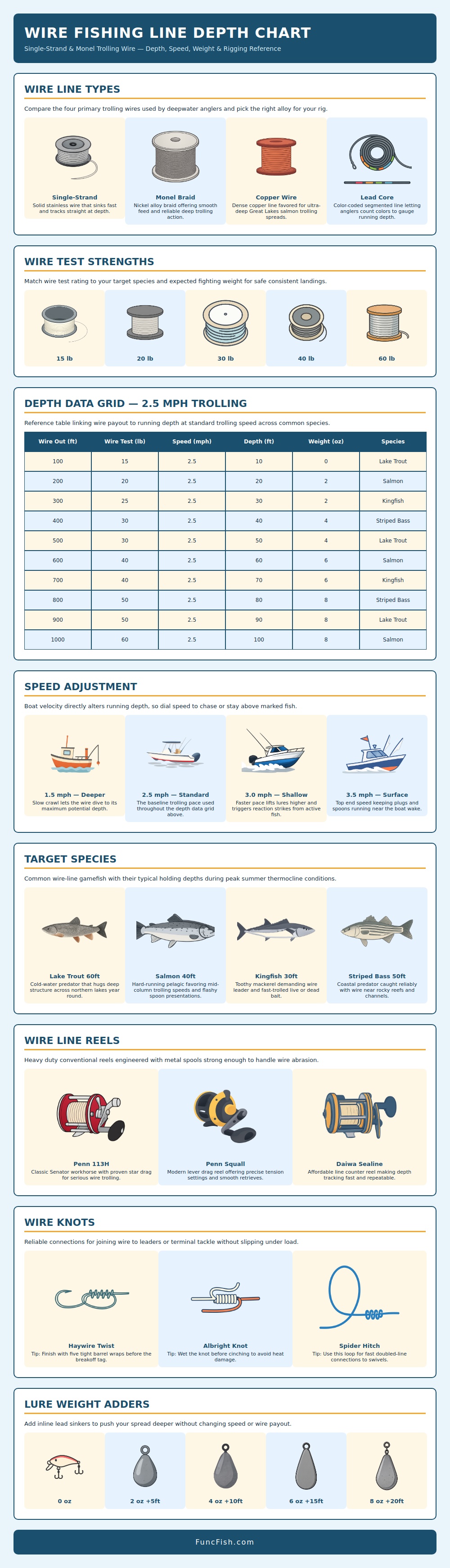
Fishing wire is more dense than fishing lines, and it dont float or bow when placed in the water. Additionally, because fishing wire is heavy, it sink quickly to the desired depth to where the fish is present in the water. There are various type of fishing wire that anglers can use when fishing.
How to Use Fishing Wire
Single-strand stainless fishing wire is rigid and does not move from the water current. Braided fishing wire also feed easily off the fishing reel. Additionally, copper fishing wire is dense and sinks more further in the water than other types of fishing wire.
Anglers must choose an appropriate type of fishing wire based off the type of fish they are fishing for. The strength of the fishing wire should match the size of the fish being targeted. Using fishing wire that is too light may result in the fish break the fishing wire.
Conversely, fishing wire that is too strong may prevent the bait from move correctly in the water. Metal spool fishing reels is best used with fishing wire. By letting out less of the fishing wire, the bait will remain closer to the surface in shallow water.
By letting out more of the fishing wire, the bait will reach deeper waters. Additionally, the boat operator can also adjust the speed of the boat to control the depth of the bait. Using slow speeds when trolling the boat will allow the fishing wire to travel deeper in the water.
Using more speed will raise the bait and the fishing wire. Thus, the speed of the boat is a tool that can be used to control the depth at which the bait travels in the water. Different types of fish lives at different depths in the water.
For example, lake trout live near the bottom of the water. Using fishing wire allows anglers to reach the bottoms where lake trout live. Some fish live in the middle of the water column.
In this case, anglers must adjust the length of the fishing wire to reach these area. Fishing wire is also beneficial for fishing for fish with sharp teeth. The sharp teeth of these fish can easily cut the monofilament fishing lines.
However, the teeth cant easily cut the fishing wire. To rig the fishing wire, various strong fishing knots must be used. You should wet these fishing knots with water before being tied and pulled slowly to ensure the fishing wire does not slip off while fishing.
Additionally, inline fishing weight can be used to facilitate the sinking of the fishing wire to deeper waters. Using a system to track how much fishing wire is being released will allow anglers to repeat the bait success. Anglers can also mark their fishing rods to show how much fishing wire is required at specific depths.
Thus, using fishing wire allows anglers to be precise in where the bait go and how deep the wire can travel to where the fish is livig and staying.