🧊 Frozen Fish Storage Life Calculator
Calculate exact freezer storage times based on species, fat content, packaging, and temperature
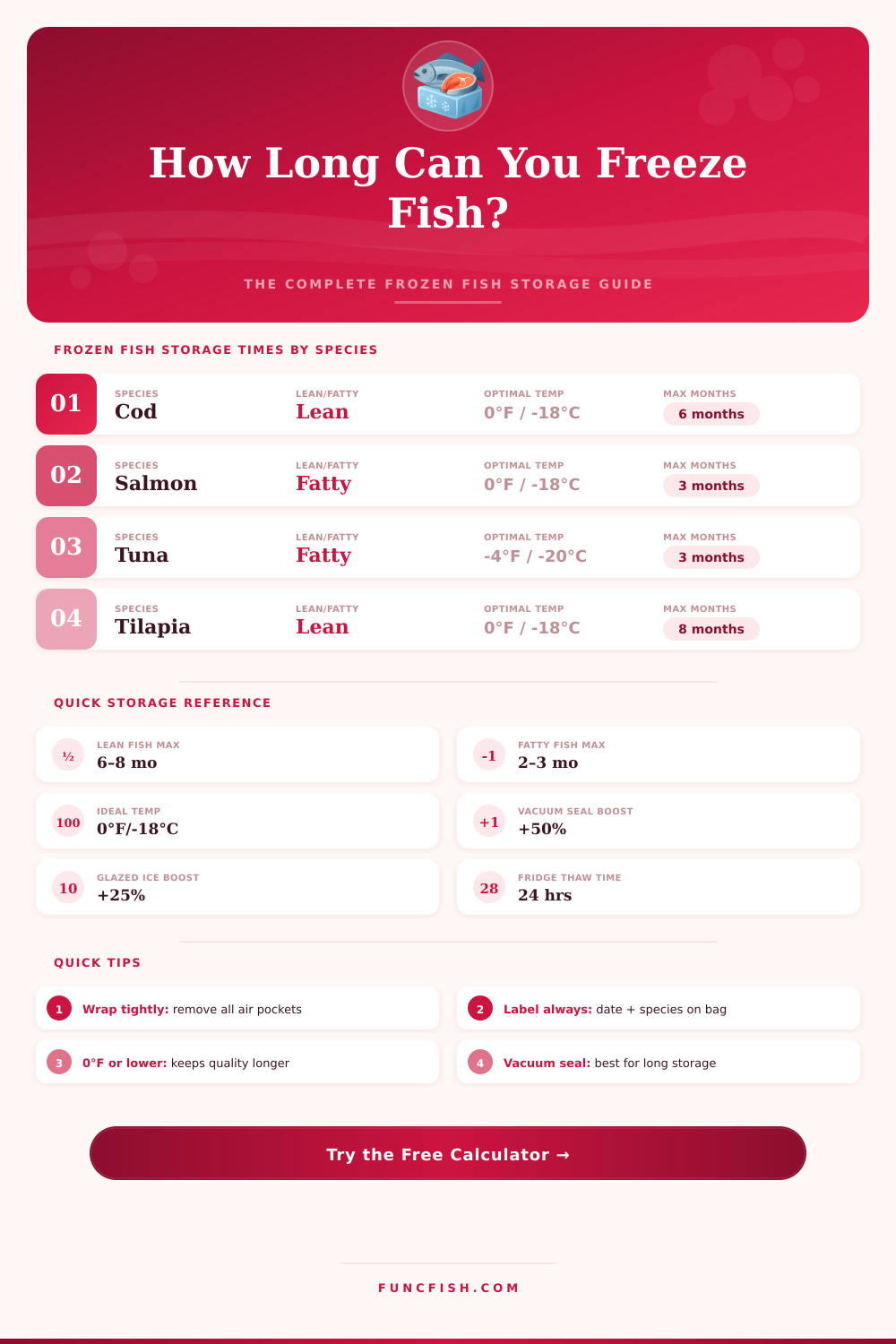
| Species | Fat Type | Base Months (0°F) | Vacuum Seal | Fat Content |
|---|---|---|---|---|
| Cod | Lean | 4–6 months | 6–8 months | <2% fat |
| Tilapia | Lean | 4–6 months | 6–8 months | ~3% fat |
| Walleye | Lean | 4–6 months | 6–8 months | ~1% fat |
| Bass | Lean | 4–6 months | 6–8 months | ~2% fat |
| Catfish | Lean | 4–5 months | 5–7 months | ~3% fat |
| Flounder | Lean | 4–6 months | 6–8 months | <2% fat |
| Perch | Lean | 4–6 months | 6–8 months | ~1% fat |
| Salmon | Fatty | 2–3 months | 3–4 months | ~13% fat |
| Tuna | Fatty | 2–3 months | 3–4 months | ~5% fat |
| Trout | Fatty | 2–3 months | 3–4 months | ~8% fat |
| Mackerel | Fatty | 1–2 months | 2–3 months | ~13% fat |
| Halibut | Fatty | 2–3 months | 3–4 months | ~5% fat |
| Shrimp | Shellfish | 3–6 months | 6–9 months | <1% fat |
| Crab | Shellfish | 3–6 months | 6–8 months | ~2% fat |
| Lobster | Shellfish | 3–6 months | 6–8 months | ~1% fat |
| Packaging Method | Storage Multiplier | Freezer Burn Protection | Best For |
|---|---|---|---|
| Vacuum Sealed | 1.5x (max life) | Excellent | All fish, long storage |
| Freezer Bag (Zip) | 1.1x | Good (if air removed) | Short/medium storage |
| Plastic Wrap + Foil | 0.9x | Moderate | Up to 3 months |
| Ice Glaze | 1.25x | Very Good | Whole fish |
| Unwrapped | 0.5x | Poor | Not recommended |
| Freezer Type | Temp (°F) | Temp (°C) | Storage Multiplier |
|---|---|---|---|
| Fridge-Freezer Combo | 5°F | -15°C | 0.75x |
| Home Upright Freezer | 0°F | -18°C | 1.0x (baseline) |
| Chest Freezer | -4°F | -20°C | 1.15x |
| Deep Freeze | -10°F | -23°C | 1.3x |
| Commercial Freezer | -13°F | -25°C | 1.5x |
Freezing fishes allows people to store fish for a long time. However, freezing fish doesnt prevent the quality of the fish from decrease over time. The quality of the fish often deteriorate due to the texture of the fish changing, the oil in the fish becoming rancid, and the moisture in the fish evaporating due to a freezer burn.
The fish is safe to eat if the freezer maintains a proper temperature for the fishes. However, the quality of the fish will decline if the fish are stored in the freezer for too many month. It is essential to understand the different factor that affect the storage life of the fish so that people can store the fishes correctly and for the best possible outcome.
How to Keep Frozen Fish Fresh
The type of fish that you chooses will affect how long the fish will remain high quality when frozen. Lean fish, such as whitefish, will remain high quality for longer than oily fishes. The reason for this is that oily fish contain more fat that will oxidize more quickly.
A whole fish will remain high quality longer than a skinless fillet of the same species of fish. This is because the skin and bone of the fish will protect the texture of the meat from drying out. The way that you package the fish will also have an impact on how long the fish will remain high quality when frozen.
Using a vacuum bag to package the fish will provide longer period of high quality than if you store the fish in a loose bag. This is because a vacuum bag will remove the air pocket around the fish so that the fish will not dry out. The type of freezer that you use will also have an impact on the storage life of the frozen fish.
Using a chest freezer that maintains a temperature of zero degree Fahrenheit or below will allow the fish to last longer in the freezer than if you stored the fish in a frost-free upright freezer. This is because when the freezer door is open, the warm air that comes out of the refrigerator will allow the ice crystals within the fish to grow larger. The growth of large ice crystals will make the flakes of the frozen fish feel mealy and soft when eat.
Using a thin layer of ice, or glaze, on the fish will provide a protective layer of the fish against the cold air in the freezer. This glaze will protect the fish from dry out. The size and thickness of the fish will also impact the quality of the fish that you can expect from the frozen fish.
Thick cut of fish or whole fish will take longer to reach the center of the fish to freeze. When the center of the fish take longer to freeze, the ice crystals that form within the fish will be larger. The large ice crystals will puncture the cell wall of the fish that will lead to the fish having a soft texture.
Slim fillet of fish will freeze quickly because the cold will easily reach the center of the fish. The fast freezing of the slim fillets will help to preserve the texture of the fish. Using a calculator will allow you to estimate the remaining storage life of your frozen fish.
The calculator will take into account the species of the fish that you have placed in the freezer. The calculator will also determine the cut of the fish and how it was package, as well as the thickness of the glaze on the fish. Furthermore, the calculator will also take into account the length and the weight of the fish to determine how much bulk the fish contain.
Based off this information, the calculator will provide information regarding the number of months that the fish will retain its high quality, as well as the risk of freezer burn. If the risk of freezer burn is high, the fish may need to be used in recipes that contain heavy sauces to compensate for the dry texture of the fish that may result from the freezer burn. Certain types of fish require different habit in the freezing process to maintain the quality of the fish.
Fish that are high in oil will require the use of vacuum seal to prevent the oil in the fish from turning rancid. Lean fish, on the other hand, will last for eight month or more in the freezer. The vacuum sealing of these lean cut of fish is not required.
How often that you open the freezer door will also impact how long the fish will remain high quality. If you open the freezer door frequently, the temperature of the fish will fluctuate from cold to warm temperature. These fluctuation in temperature will shorten the life of the fish while in the freezer.
Certain mistake when freezing fish can shorten the life of the fish and the quality of the texture of the fish. One of the most common mistake is placing the fish into the freezer immediately after purchasing the fish from the market. During this time, the fish has been exposed to room temperature for some time.
This time spent at room temperature will allow the enzyme in the fish to soften the protein in the fish. Another of the most common mistake is placing fish of odd shape into the freezer. The shape of the fish will trap air within the fish package.
Air within the frozen fish will cause the texture of the fish to dry out over time. A person should follow the rule of first in, first out with the fish in the freezer. This will ensure that the fish is used in the order that it was place in the freezer.
Finally, people should always ensure that the freezer is maintained at zero degrees Fahrenheit or less in order to extend the life of the frozen fish. You should of checked the temperature regularily.