🌡️ Fish Room Temperature Safety Calculator
Calculate safe holding temperatures, thermal stress risk, and acclimation parameters for live fish
| Water Temp (°F) | Water Temp (°C) | Max Dissolved O2 (mg/L) | Fish Stress Risk |
|---|---|---|---|
| 39°F | 4°C | 13.1 mg/L | Very Low |
| 50°F | 10°C | 11.3 mg/L | Low |
| 59°F | 15°C | 10.1 mg/L | Low |
| 68°F | 20°C | 9.1 mg/L | Moderate |
| 77°F | 25°C | 8.3 mg/L | Moderate–High |
| 86°F | 30°C | 7.5 mg/L | High |
| 95°F | 35°C | 6.9 mg/L | Critical |
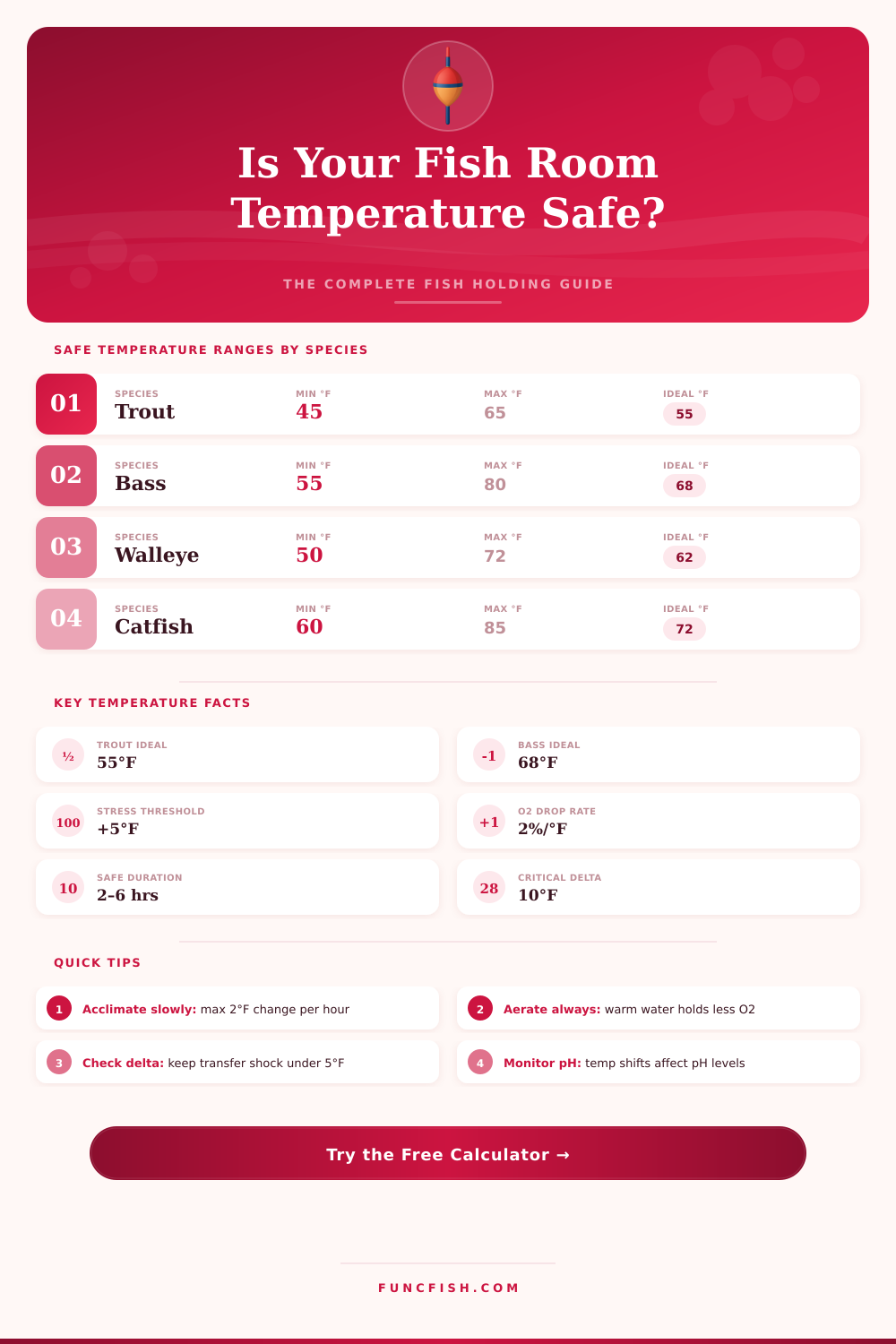
| Species | Safe Range (°F) | Ideal Holding (°F) | Lethal High (°F) |
|---|---|---|---|
| Rainbow Trout | 45–65°F | 52–58°F | 77°F |
| Brown Trout | 45–68°F | 55–62°F | 79°F |
| Largemouth Bass | 55–80°F | 65–72°F | 93°F |
| Smallmouth Bass | 52–75°F | 62–70°F | 88°F |
| Walleye | 50–72°F | 58–65°F | 85°F |
| Channel Catfish | 60–85°F | 70–78°F | 97°F |
| King Salmon | 40–58°F | 45–55°F | 68°F |
| Crappie/Bluegill | 60–80°F | 65–72°F | 90°F |
| Northern Pike | 50–68°F | 55–63°F | 82°F |
| Tilapia | 70–90°F | 75–85°F | 105°F |
| Fish Weight (lb) | Min Water (gal) | Recommended (gal) | Max Fish per 10 gal |
|---|---|---|---|
| Under 0.5 lb | 2 gal | 3–5 gal | 5 fish |
| 0.5–1 lb | 3 gal | 5–7 gal | 3 fish |
| 1–2 lb | 5 gal | 7–10 gal | 2 fish |
| 2–5 lb | 8 gal | 12–15 gal | 1 fish |
| 5–10 lb | 12 gal | 18–25 gal | 0.5 fish |
| Over 10 lb | 20 gal | 30+ gal | 0.3 fish |
| Holding Method | Temp Stability | O2 Support | Max Safe Duration |
|---|---|---|---|
| Livewell (Aerated) | Moderate | Good | 6–8 hours |
| Recirculating Tank | High | Excellent | 24+ hours |
| Bucket (No Aeration) | Low | Poor | 30–60 min |
| Insulated Transport Box | High | Moderate | 4–12 hours |
| Ice-Chilled Cooler | Very High | Low | 2–6 hours |
Fish safety depend on the temperature of a fish. Bacteria grows rapidley in the temperature range between 40 and 140 degrees Fahrenheit. This range of temperatures is referred to as an danger zone for food safety.
Bacteria can double in number every twenty minute if fish is within the danger zone. Because fish contain high moisture and soft proteins, fish reach the danger zone faster than other type of meat. The type of fish you use will determine how fast the fish will warm up.
How to Keep Fish Cold and Safe
Oily fish will warm up more fast due to the fat in the fish. Lean white fish will warm up more slow because of the lack of fat in these type of fish. Additionally, the shape of the fish will also impact how fast the fish will warm up.
Whole fish will stay cold longer than fish fillets because the skin and bones of the fish act as an insulation. Skinless fish fillets will warm up more faster than whole fish because all of the flesh of the fillet is exposed to the ambient temperature in the room. The thickness and the weight of the fish will also play a significant role in how fast the fish warms up.
Fish steaks that is thick will warm up more slowly than fish flakes that are thin. The thicker the fish, the more time it take for the heat to transfer to the entire piece of fish. Heavy pieces of fish will also take longer to warm up because the mass of the fish determine how fast the temperature changes.
If the room that the fish is in is hotter than others, the fish will warm up faster. For example, if the room is 68 degrees, you will have more time to prepare the fish before the danger zone is reach. However, if the room is at 85 degrees, like in the summertime in the United States, you will have much less time.
Air movement and humidity in the room will also play a significant role in how fast the fish warms up. If there is a fan in the room, the fish will warm up faster because fans increase the rate of evaporation from the fish. High humidity in the air will warm up the fish because the moisture will hold onto the heat near the fish.
However, if you cover the fish tightly in plastic wrap, the moisture will allow bacteria to breed in the fish. To ensure that the fish is safe to eat, there is a few steps you can take. First, pull the fish from the refrigerator while the fish is still cold.
Secondly, portion the fish quick to ensure that it doesnt sit out of the safe temperature range for too long. Use an ice bath to keep the fish cold while you prepare it. Using an ice bath will give you approximately 30 minute of extra time before the fish reaches the danger zone.
Pack the fish with frozen gel packs if you are transporting the fish or having a picnic with the fish. The frozen packs will keep the fish chilled for a longer period than packing the fish with fish that has been removed from the refrigerator. Use a fish safety calculator to determine how long the fish will be safe before it reach the danger zone.
The calculator take the type of fish, the thickness of the fish, the room temperature, and air movement to determine the safe time window for the fish. The calculator will determine the risk score and if the fish is at a low risk or high risk of bacterial infection. If the fish feel slimy or smells bad, dont risk your health by eating the fish.
If the fish feels slimy or smells bad, discard the fish. Therefore, to prepare and handle the fish properly, you have to work quickly and keep the fish cold until the time when it is cook or safely eaten.