🎣 Drop Shot Rig Calculator
Calculate leader length, sinker weight, hook size & line strength for any depth or species
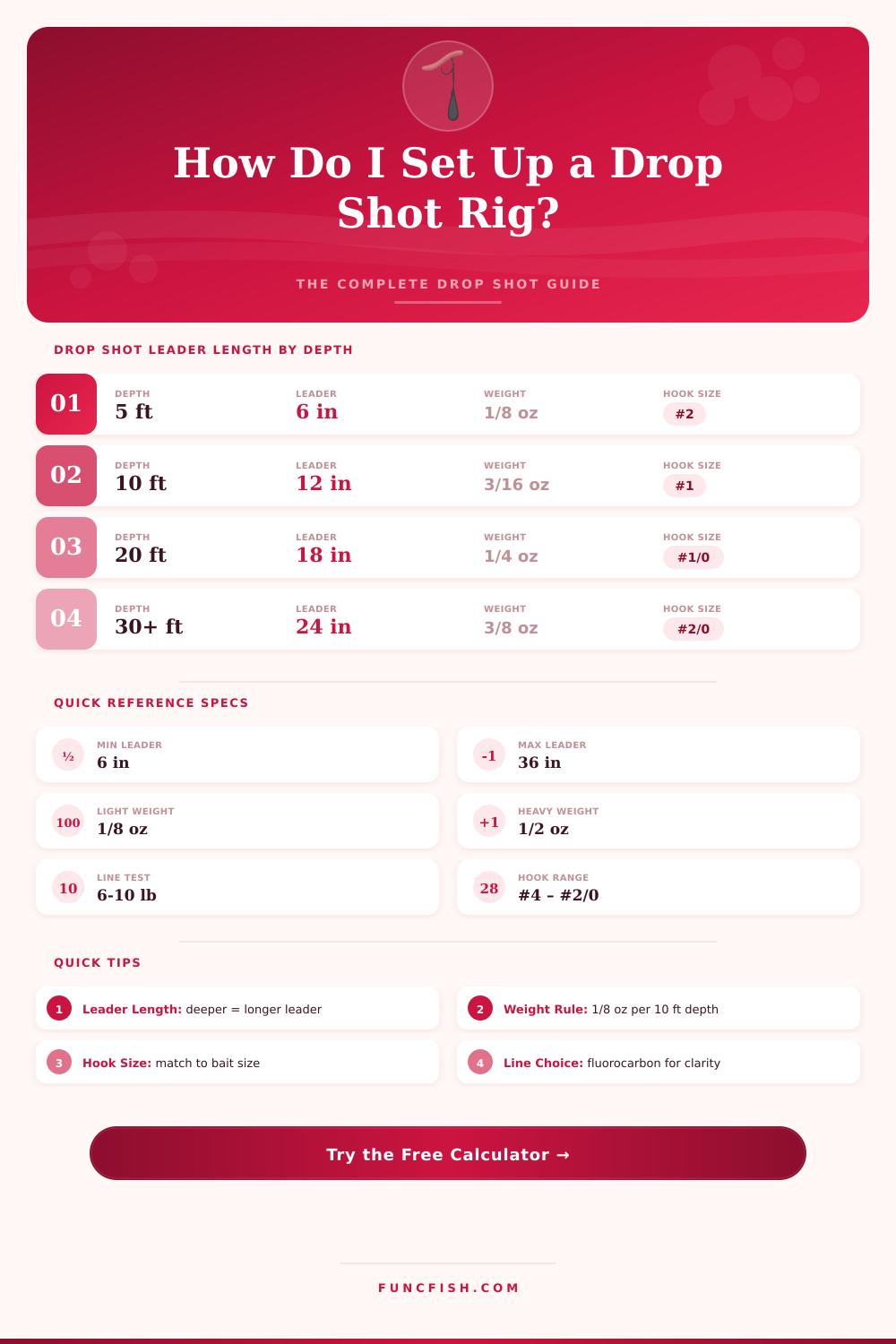
| Water Depth | Recommended Leader | Leader (Metric) | Technique Note |
|---|---|---|---|
| 0 – 5 ft (0–1.5 m) | 4 – 8 in | 10 – 20 cm | Short leader for tight structure |
| 5 – 10 ft (1.5–3 m) | 8 – 12 in | 20 – 30 cm | Standard shallow presentation |
| 10 – 20 ft (3–6 m) | 12 – 18 in | 30 – 45 cm | Most versatile range |
| 20 – 30 ft (6–9 m) | 18 – 24 in | 45 – 60 cm | Suspend bait in strike zone |
| 30 – 50 ft (9–15 m) | 24 – 36 in | 60 – 90 cm | Extended leader for deep fish |
| 50+ ft (15+ m) | 30 – 48 in | 75 – 120 cm | Use heavier sinker to hold bottom |
| Species | Typical Weight | Line Test | Hook Size | Bait Size |
|---|---|---|---|---|
| Largemouth Bass | 1–8 lb (0.5–3.6 kg) | 6–12 lb | #1 – #2/0 | 3–5 in |
| Smallmouth Bass | 0.5–5 lb (0.2–2.3 kg) | 6–10 lb | #2 – #1 | 2.5–4 in |
| Walleye | 1–10 lb (0.5–4.5 kg) | 6–10 lb | #4 – #1 | 3–5 in |
| Trout (stream) | 0.25–3 lb (0.1–1.4 kg) | 4–6 lb | #6 – #4 | 2–3 in |
| Yellow Perch | 0.25–1.5 lb (0.1–0.7 kg) | 4–6 lb | #8 – #4 | 1.5–2.5 in |
| Crappie | 0.25–2 lb (0.1–0.9 kg) | 4–6 lb | #6 – #4 | 1.5–2.5 in |
| Striped Bass | 5–30 lb (2.3–13.6 kg) | 15–25 lb | #2/0 – #4/0 | 4–8 in |
| Pike / Muskie | 5–30 lb (2.3–13.6 kg) | 17–25 lb | #1/0 – #3/0 | 4–7 in |
| Line Type | Stretch | Visibility | Best Use | Diameter (10 lb) |
|---|---|---|---|---|
| Fluorocarbon | Low (15–20%) | Nearly invisible | Clear water, leader | 0.010–0.012 in (0.25–0.30 mm) |
| Monofilament | High (25–30%) | Visible | Budget option, forgiving | 0.011–0.013 in (0.28–0.33 mm) |
| Braided Line | None (<5%) | High visibility | Deep/heavy cover | 0.006–0.008 in (0.15–0.20 mm) |
| Braid + Fluoro Leader | Minimal | Leader: invisible | Best sensitivity + stealth | Braid: 0.006 in / Leader: 0.010 in |
A drop shot rig is a fishing setup that use a weight to help the bait anchor to teh bottom of the water, and uses a hook to suspend the bait above the weight. Drop shot rigs are used to help keep the bait suspended in the water column, where most fishes likes to feed. Drop shot rigs can be used to fish for various species of fish, including bass, walleye, and crappie.
Drop shot rigs work best when each of the components of the rig are balance with each other; the weight, the hook, the bait, and the distance between the weight and the hook must all be compatible with each other for the rig to be effective. The distance between the weight and the hook is one of the most critical component of a drop shot rig. The hook should be placed between 6 and 18 inches above the weight.
How to Set Up a Drop Shot Rig
If the distance between the hook and the weight is too short, the bait may end up snagging on rocks or other debris on the bottom. If the distance between the hook and the weight is too long, the bait may drift too far from the fish to effectivey catch them. The depth of the water and the strength of the current will impact the type of weight that should be used in the drop shot rig.
For instance, in waters shallower than 8 feet, you can use lighter weights. In deep waters deeper than 12 feet, however, heavier weights will ensure that the weight does not drift too far from the bottom. Additionally, if the current in the area is especially strong, a heavier weight will ensure that the weight will remain in place.
The type of bait that you will use in the drop shot rig will impact the type of hook that should be used. For instance, if using slim bait like slim worms, smaller hooks can be used. Bulky baits or shad imitations, however, require heavier gaps in the hooks to allow for the bulky bait to move free.
Additionally, the type of hook should also take into consideration the type of fish that is to be targeted. For instance, thin wire hooks are used for species like crappie, which have small body, while stout, sharp hooks are used for species like redfish, which have more physical strength. Finally, the type of underwater terrain will play a key role in the type of drop shot rig that is to be used.
For instance, if the area to be fished includes rocks, the hook will need to be felt on the bottom. Conversely, if the area to be fished includes underwater brush, a more compact drop shot rig will not get stuck in the brush. The type of fishing line that is used can also impact the performance of the drop shot rig.
Braided fishing lines are useful for drop shot rigs because the vibration from the bottom will be transmitted along the line to the fishing rod. Fluorocarbon lines are useful for drop shot rigs because fluorocarbon is difficult for fish to see in clear water. Copolymer lines are a middle ground between fluorocarbon and braided lines.
Finally, the strength of the fishing line should be considered; using a line that is too thin, for instance, one that is less than 8 pounds, can allow for too much stretch in the line, which can reduce the sensitivity of the line. The drop shot rig should be adjusted according to the type of fish that is being target, and the environment in which the fishing is to occur. For instance, if targeting species like crappie, minimal drop and deadstick presentations can be used.
For targeting species like bass, shaking the bait without moving the weight can provide movement to the target species. Additionally, vertical jigging can be used to shorten the distance between the bait and the bottom. Finally, when fishing in a tide area, the leader should be extended to allow for the bait to move freely in the tides.
A few of the most common mistakes in using drop shot rigs is using a weight that is too heavy; too much weight will reduce the sensitivity of the line. Using bait that is too large for the hook is another common mistake; this will bury the point of the hook in the bait. Finally, while not part of the drop shot rig itself, the length of the rod should be considered; using a longer rod will allow for the leader of the line to be pushed upward in clear water; a shorter rod will allow for more control when using a drop shot rig in areas that include underwater brush.
The drop shot rig can be adjusted while fishing to account for changes in the environment. For instance, if the sinker is skipping along the bottom, the size of the weight can be increased. Additionally, if the bait is curling, the distance between the hook and the weight can be increased.
Only one of these variables should be adjusted at a time, so as to determine which adjustment result in the best success in catching fish. Through the adjustment of each of these variables, it is possible to create an effective drop shot rig according to the specific fishing environment.