🎣 Ned Rig Calculator
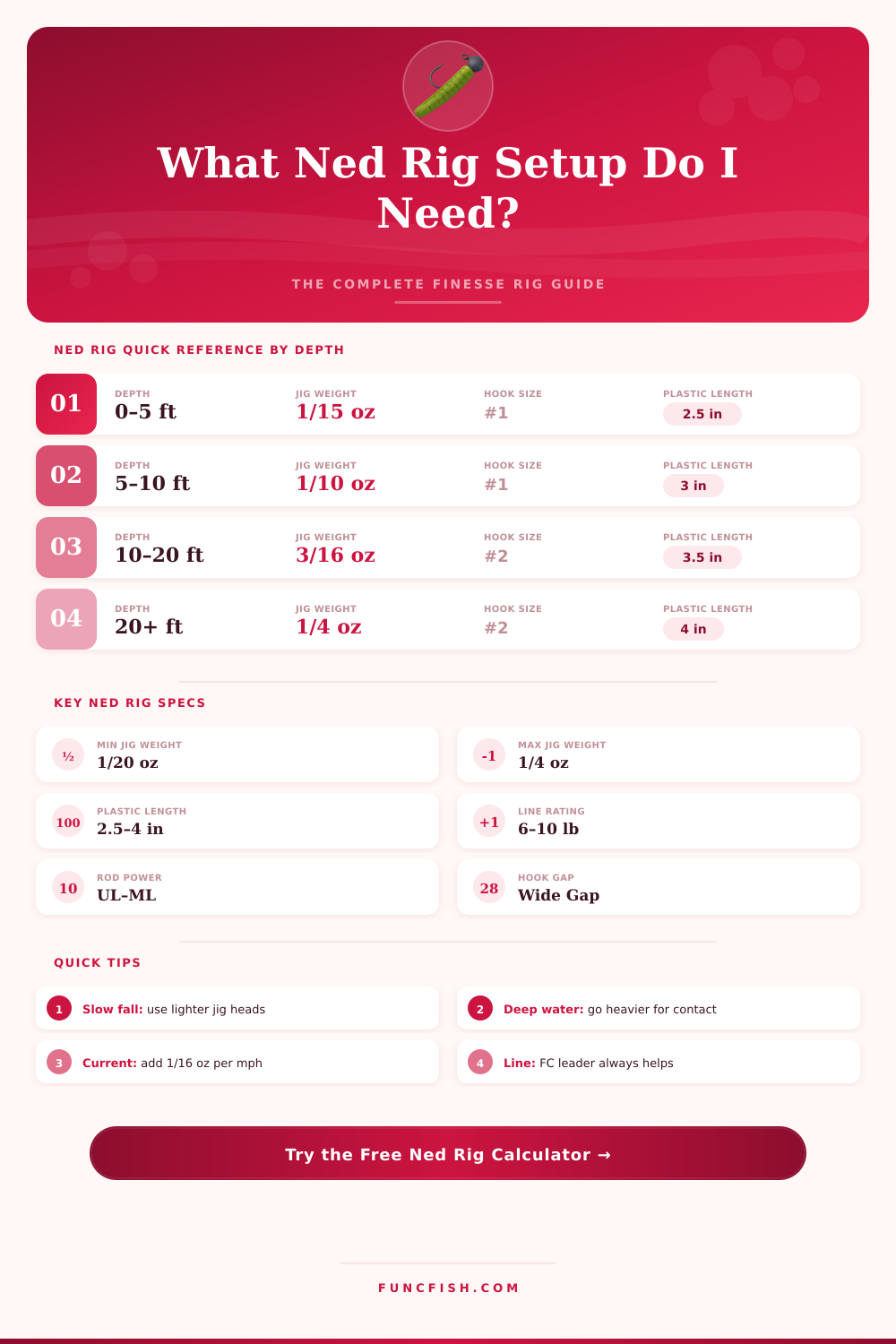
Find the perfect jig head weight, hook size, and plastic length for any depth, current, and technique
| Depth (ft) | Depth (m) | Still Water (oz) | Slow Current (oz) | Moderate Current (oz) | Metric (g) |
|---|---|---|---|---|---|
| 1–4 ft | 0.3–1.2 m | 1/20 oz | 1/15 oz | 1/8 oz | 1.4–3.5 g |
| 4–8 ft | 1.2–2.4 m | 1/15 oz | 1/10 oz | 3/16 oz | 1.9–5.3 g |
| 8–12 ft | 2.4–3.7 m | 1/10 oz | 3/16 oz | 1/4 oz | 2.8–7.1 g |
| 12–18 ft | 3.7–5.5 m | 3/16 oz | 1/4 oz | 5/16 oz | 5.3–8.9 g |
| 18–25 ft | 5.5–7.6 m | 1/4 oz | 5/16 oz | 3/8 oz | 7.1–10.6 g |
| 25+ ft | 7.6+ m | 5/16–3/8 oz | 3/8 oz | 1/2 oz | 8.9–14.2 g |
| Species | Typical Weight | Plastic Size | Jig Weight | Line Test | Hook Size |
|---|---|---|---|---|---|
| Largemouth Bass | 1–8 lb (0.5–3.6 kg) | 3–4 in (7.6–10 cm) | 1/10–1/4 oz | 8–12 lb | #1–#2 |
| Smallmouth Bass | 1–5 lb (0.5–2.3 kg) | 2.5–3.5 in (6.4–8.9 cm) | 1/15–3/16 oz | 6–10 lb | #1–#2 |
| Walleye | 1–7 lb (0.5–3.2 kg) | 2.5–3.5 in (6.4–8.9 cm) | 3/16–1/4 oz | 6–10 lb | #1–#2 |
| Spotted Bass | 0.5–4 lb (0.2–1.8 kg) | 2.5–3 in (6.4–7.6 cm) | 1/15–3/16 oz | 6–10 lb | #2–#4 |
| Trout | 0.25–3 lb (0.1–1.4 kg) | 2–2.75 in (5–7 cm) | 1/20–1/10 oz | 4–8 lb | #4–#6 |
| Panfish / Crappie | 0.1–1 lb (0.05–0.45 kg) | 1.5–2.5 in (3.8–6.4 cm) | 1/32–1/16 oz | 4–6 lb | #4–#8 |
| Scenario | Main Line | FC Leader | Leader Length | Rod Action |
|---|---|---|---|---|
| Clear Shallow | 6 lb FC or 10 lb braid | 6 lb FC | 12–18 in (30–46 cm) | UL-Fast |
| Stained Water | 8–10 lb FC or 15 lb braid | 8 lb FC | 12 in (30 cm) | L-MF |
| Deep Structure | 10–15 lb braid | 8–10 lb FC | 10–14 in (25–36 cm) | ML-Mod |
| River / Current | 10 lb braid | 8 lb FC | 8–12 in (20–30 cm) | ML-Fast |
| Heavy Cover | 15–20 lb braid | 10–12 lb FC | 8–10 in (20–25 cm) | M-Fast |
| Dock Shooting | 6–8 lb FC | None needed | — | UL-Mod |
A ned rig is used to catch fish when other type of lures are not successfully catching any fish. The ned rig consist of a weighted, mushroom shaped head attached to a soft plastic worm. The effectiveness of the ned rig is dependent upon the various component of the ned rig matching one another.
For instance, if the mushroom head are too heavy, the mushroom head will quickly sink to the bottom of the water column. If the mushroom head is too light, it will drift with the current in the water. Additionally, if the gap between the hook teeth is not appropriate for the size of the plastic worm, the plastic worm will not remain in the proper position on the hook.
How to Use a Ned Rig
The ned rig is effective in that it mimic the small and vulnerable organisms that live in the water. For instance, the plastic worm can mimic a small fish or a small crustacean. Many angler use this type of jig to catch smallmouth bass, which tend to strike at a ned rig that remains within the strike zone of the fish.
The strike zone is the area in which the bass is likely to encounter the plastic worm and eat it. Furthermore, in order to keep the plastic worm within the strike zone, the angler must control the fall rhythm of the plastic worm. The fall rhythm of the plastic worm is the time it takes for the plastic worm to sink to the bottom of the water column.
A fall rhythm of two to three second is typically used. The depth of the water will impact the weight of the mushroom head. In water that is five feet deep, for instance, it is better to use a lighter mushroom head, such as one that weigh 1/16 ounce.
In deeper waters, however, such as those deeper than ten feet, it is better to use a heavier mushroom head. A heavier mushroom head will allow for the plastic worm to travel through the water more effective. Furthermore, a heavy mushroom head will be necessary if there is wind on the water or if the water has a strong current.
The plastic worm determine what type of movement the plastic worm will make in the water. For instance, a thin plastic worm will experience some drag within the water, which will allow it to glide slow. A thick plastic worm will move more water than a thin plastic worm, causing it to sink more quickly.
Furthermore, if the plastic worm is too thick for the hook, the plastic worm may cause the hook to have a wider gap to avoid having the plastic worm bunch together on the hook. If the plastic worm bunches together, it will not exhibit the proper movement. Additionally, you can trim plastic worms with floppy tails to provide more desirable movement of the plastic worm.
The hook is another important component of the plastic worm. The size of the hook will allow the plastic worm to exhibit natural movement. For instance, a #1 or 1/0 hook size work best with a four inch plastic worm.
If the angler is fishing in areas with wood or shells in the bottom, a stout wire hook will not bend. In open water, however, a light wire hook with a wider gap will work best with thick plastic worms. If these two components does not match, the jig will not work properly.
The fishing line also has an impact upon the effectiveness of the plastic worm. For instance, fluorocarbon fishing line will sink quick and fish will have difficulty seeing it in clear water. Braided fishing line will allow the angler to better handle the wind, but they will feel every movement of the plastic worm.
An alternative to these two lines is copolymer line, which allow for the benefits of fluorocarbon and braided line. Furthermore, the angler should adjust the fall rhythm according to the temperature of the water and the water clarity. If the water is cold, the fish are not as active so using a slower fall rhythm will work best.
For clarity, if the water is clear the fish will view the plastic worm closely; therefore, the angler will use a slower fall rhythm. In stained water, however, a faster and bolder fall rhythm will be used. Additionally, if the bottom of the water is rocky the movement of the plastic worm can be steady.
If the bottom of the water has grass, however, it is better for the plastic worm to make lighter movements to avoid getting it stuck in the vegetation. There are some mistake that can occur when using a plastic worm jig. For instance, one of the most common is using a mushroom head that is too heavy for the depth of the water.
If this is the case, the mushroom head will not hover in the water column. Another mistake is using a hook that do not match the plastic worm. The plastic worm will bunch together on the hook.
Finally, another mistake is ignoring the temperature of the water. If this is avoided the plastic worm may move too fast for the fish in the water. To avoid these mistakes, each variable should of be test one at a time.