🎣 Texas Rig Calculator
Find the perfect hook size, sinker weight, line strength & leader length for any scenario
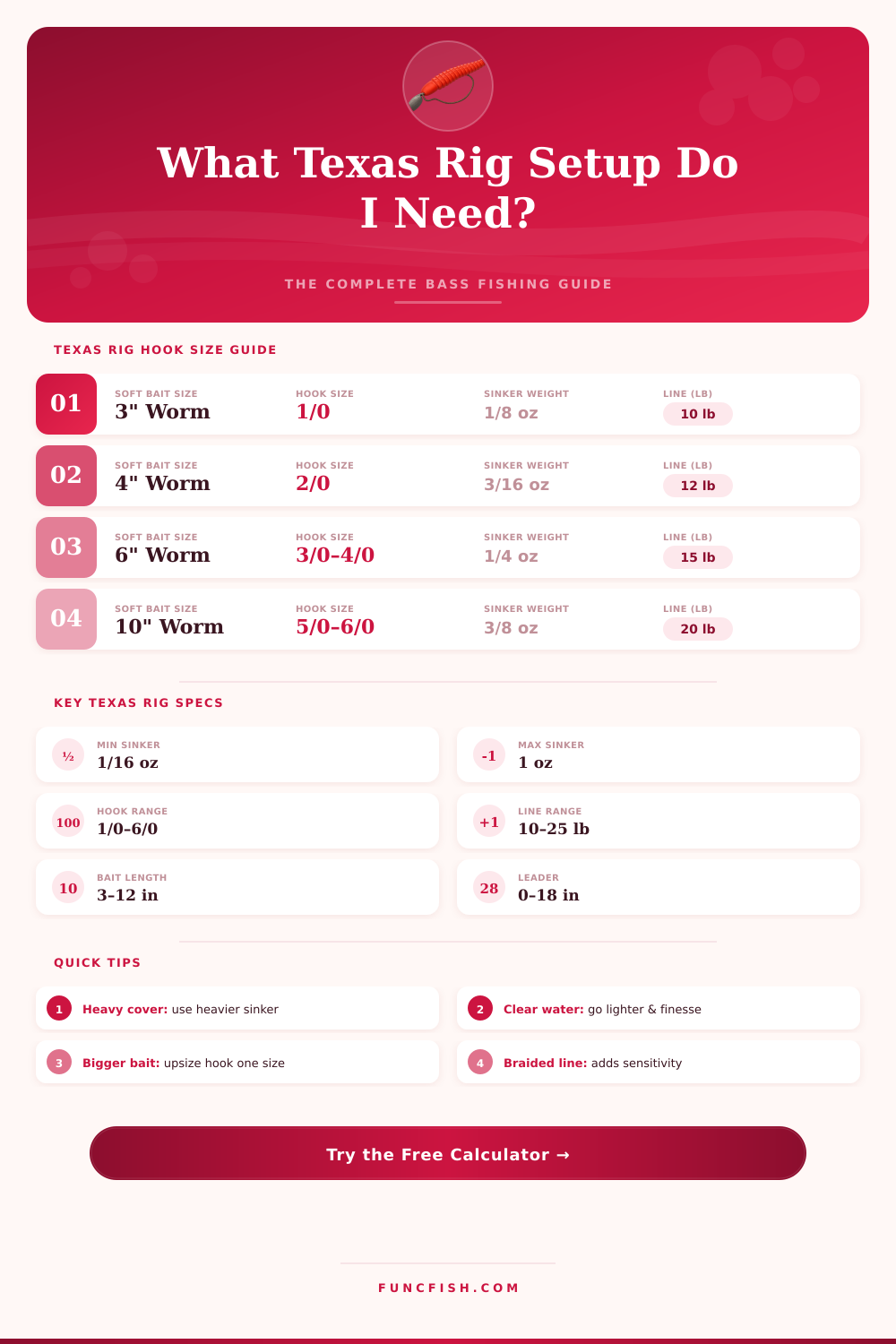
| Soft Bait | Bait Length | Recommended Hook | Hook Gap (in / cm) |
|---|---|---|---|
| Finesse Worm | 3" (7.6 cm) | 1/0 EWG | 0.5" / 1.3 cm |
| Worm | 4" (10.2 cm) | 2/0 EWG | 0.6" / 1.5 cm |
| Worm | 5" (12.7 cm) | 3/0 EWG | 0.7" / 1.8 cm |
| Worm | 6" (15.2 cm) | 3/0–4/0 EWG | 0.8" / 2.0 cm |
| Worm | 7" (17.8 cm) | 4/0 EWG | 0.9" / 2.3 cm |
| Worm | 10" (25.4 cm) | 5/0–6/0 EWG | 1.1" / 2.8 cm |
| Crawfish | 3" (7.6 cm) | 2/0 Wide Gap | 0.65" / 1.7 cm |
| Creature Bait | 5" (12.7 cm) | 4/0–5/0 EWG | 1.0" / 2.5 cm |
| Lizard | 6" (15.2 cm) | 3/0–4/0 EWG | 0.9" / 2.3 cm |
| Tube | 4" (10.2 cm) | 3/0 Tube Hook | 0.75" / 1.9 cm |
| Sinker Weight | Metric Equiv. | Ideal Depth | Cover / Conditions |
|---|---|---|---|
| 1/16 oz | 1.8 g | 1–4 ft (0.3–1.2 m) | Finesse, clear water |
| 1/8 oz | 3.5 g | 3–8 ft (0.9–2.4 m) | Light cover, shallow |
| 3/16 oz | 5.3 g | 6–12 ft (1.8–3.7 m) | Moderate cover |
| 1/4 oz | 7.1 g | 8–15 ft (2.4–4.6 m) | Moderate-heavy cover |
| 3/8 oz | 10.6 g | 12–20 ft (3.7–6.1 m) | Heavy cover / structure |
| 1/2 oz | 14.2 g | 15–25 ft (4.6–7.6 m) | Deep flipping |
| 3/4 oz | 21.3 g | 20–35 ft (6.1–10.7 m) | Thick grass / offshore |
| 1 oz | 28.3 g | 30+ ft (9.1+ m) | Deep ledges / current |
| Species | Typical Weight | Line Strength | Hook Size |
|---|---|---|---|
| Largemouth Bass | 2–8 lb (0.9–3.6 kg) | 12–20 lb | 3/0–4/0 EWG |
| Smallmouth Bass | 1–4 lb (0.5–1.8 kg) | 10–15 lb | 2/0–3/0 EWG |
| Spotted Bass | 1–3 lb (0.5–1.4 kg) | 10–14 lb | 2/0–3/0 EWG |
| Walleye | 1–5 lb (0.5–2.3 kg) | 8–12 lb | 1/0–2/0 EWG |
| Pike | 3–15 lb (1.4–6.8 kg) | 20–30 lb | 4/0–6/0 EWG |
| Catfish | 2–20 lb (0.9–9.1 kg) | 20–30 lb | 4/0–6/0 Wide |
| Panfish / Crappie | 0.25–1 lb (0.1–0.5 kg) | 4–8 lb | 1–1/0 |
| Line Type | Stretch | Visibility | Best Use |
|---|---|---|---|
| Fluorocarbon | Low (7%) | Near Invisible | Clear water, finesse, drop shot |
| Monofilament | High (25%) | Low Visibility | General use, topwater, live bait |
| Braided Line | None (0%) | High Visibility | Heavy cover, sensitivity, flipping |
| Braid + Fluoro Leader | Near Zero | Low at terminal | Deep, heavy structure, versatile |
A Texas rig is a type of fishing setup that consist of a few different components. The effectiveness of a Texas rig depend upon how well the components of that rig work together. If the Texas rig has too light of weight, the weight will drift away from the bait.
However, if the weight of a Texas rig is too heavy, the weight will fall quick to the bottom of the water column, making the Texas rig feel lifeless when fishing. In order to use a Texas rig effectively, there is three component that should be matched to each other: the weight of the Texas rig, the size of the hook on the Texas rig, and the style of the pegging on a Texas rig. The type of cover in which a Texas rig is being used will impact the weight of that Texas rig.
Choose the Right Weight, Hook, and Peg for Your Texas Rig
If the fishing is being performed in areas that contain grass, such as grass edges where the water is calm, the weight can be lighter. In these areas, a 3/16 ounce weight can be used because the stems in the grass will allow the light weight to pass through the grass. However, in areas that contain thick mat or brush, the weight will have to be heavier.
In these areas, a 3/8 ounce or 1/2 ounce weight should be used. Additionally, the depth of the water will also impact the weight of the Texas rig. A weight that is effective for deep water may not work as well in areas where the water is shallowly.
The size of the bait that you will use in a Texas rig will impact the size of the hook that is used. For slim bait, such as a slim worm, a 3/0 hook will work best in that the point of the hook will reach the fish without tearing the plastic worm. However, if the bait that is used is thick, such as creature bait or beaver bait, a larger sized hook, such as a 4/0 or a 5/0 hook, should be used.
In this case, there needs to be more gap on the hook for the thick plastic bait to enter the hooks jaw without damaging the bait. In these situations, the profile of the bait should be measured to ensure that the thickness of the bait is account for, not the length of the bait. The conditions of the water will also impact the materials that are used in a Texas rig.
In clear water, the weight of the Texas rig should use tungsten because tungsten is dense enough to allow the bait to quickly sink to the bottom of the water, and tungsten creates less noise in the water then other metals. However, if the water contains mud or if the water is moving in the environment, lead or alloy material should be used for the weight. This is because lead and alloy materials are heavy enough to cut through the moving water.
Additionally, if the wind or the current impacts the water, the angle of the fishing line will change. Therefore, if the line is changing angles, the weight of the Texas rig should be increased to account for the weight of the fish. The style of the Texas rig will impact the fishing action of the bait.
For example, if the fishing is being performed in open banks with no weeds or grass, a free sliding peg can be used for the Texas rig. However, if the fishing is to be performed in areas that contain heavy grass, rubber or toothpick pegs can be used so that the weight of the Texas rig does not become bury in the grass. Additionally, the distance between the weight and the hook should be set correctly.
If the distance is too short, the Texas rig will feel stiffly. However, if the distance is too long, the Texas rig will snag on objects in the water. Depending on the different location in which Texas rigs will be cast, preset Texas rigs can be prepared in advance.
For areas with grass pockets, a Texas rig with a 1/4 ounce tungsten weight, a 4-inch worm, and a 3/0 hook can be prepared. For areas with timber or thick cover, a Texas rig with a heavy weight, a flipping hook, and a double peg can be prepared. In each of these cases, it is important to ensure that the components of the Texas rig harmonize with one another.
If they dont, the Texas rig will not work effectively. Many people pay close attention to the fall rate of their Texas rig. However, a few different factors actualy cause the fall rate of a Texas rig.
The fall rate of a Texas rig is caused by the density of the materials that are used, the drag that the bait create, and the friction created by the pegging of the Texas rig. Ideally, the fall rate of a Texas rig should be between 4 and 8 seconds for every ten feet of depth. This fall rate is ideal for triggering a reaction bite from the fish being targeted with the Texas rig.
Additionally, the power of the rod that will be used with the Texas rig and the strength of the fishing line should be consider. If the fishing line is too light for the weight of the fish that are present in the water, the line will bow under the weight of the fish, and the Texas rig will not effectively function.