🎣 Dropper Loop Rig Calculator
Calculate total line length, loop spacing, leader length, and hook placement for your perfect multi-hook dropper rig.
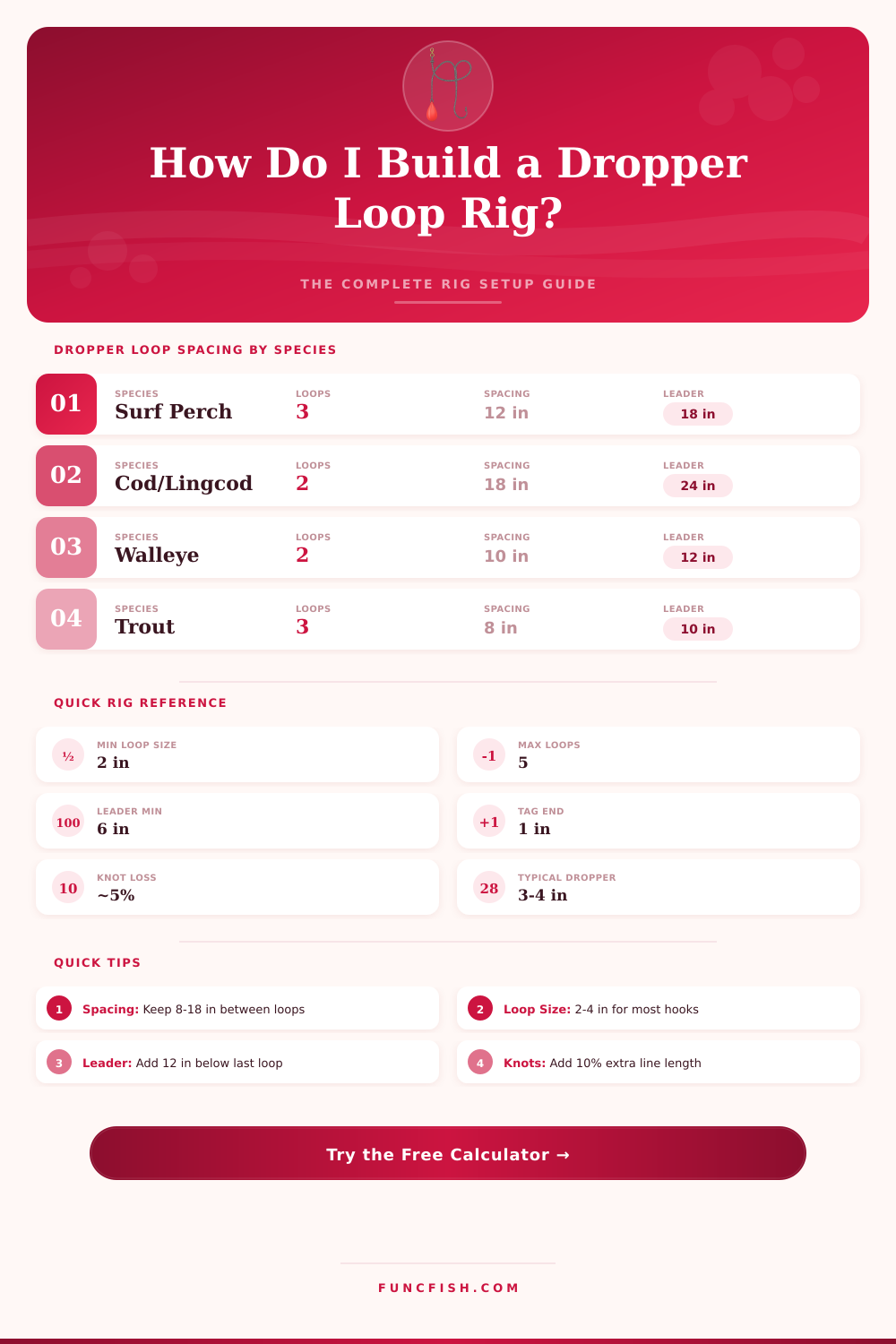
| Species / Target | Rec. Loops | Loop Spacing (in) | Loop Spacing (cm) | Loop Size (in) | Bottom Leader (in) |
|---|---|---|---|---|---|
| Surf Perch | 3 | 12 | 30.5 | 2–3 | 18 |
| Rockfish / Lingcod | 2–3 | 18 | 45.7 | 3–4 | 24 |
| Walleye | 2 | 10 | 25.4 | 2–3 | 12 |
| Trout (stream) | 2–3 | 8 | 20.3 | 2 | 10 |
| Crappie / Panfish | 2–3 | 8 | 20.3 | 1.5–2 | 10 |
| Cod (offshore) | 2 | 20 | 50.8 | 4–5 | 24 |
| Flounder | 2 | 14 | 35.6 | 3 | 18 |
| Striped Bass | 2–3 | 16 | 40.6 | 3–4 | 20 |
| Snapper | 2 | 18 | 45.7 | 3 | 22 |
| Perch (lake) | 3 | 10 | 25.4 | 2 | 12 |
| Line Type | Test Strength | Knot Strength | Diameter (in) | Diameter (mm) | Best Use |
|---|---|---|---|---|---|
| Mono 6 lb | 6 lb / 2.7 kg | ~85% | 0.009 | 0.23 | Trout, panfish |
| Mono 10 lb | 10 lb / 4.5 kg | ~85% | 0.011 | 0.28 | Bass, walleye |
| Mono 15 lb | 15 lb / 6.8 kg | ~80% | 0.013 | 0.33 | Surf, inshore |
| Mono 20 lb | 20 lb / 9.1 kg | ~80% | 0.016 | 0.41 | Surf, perch |
| Mono 30 lb | 30 lb / 13.6 kg | ~75% | 0.020 | 0.51 | Bottom, cod |
| Fluoro 10 lb | 10 lb / 4.5 kg | ~80% | 0.010 | 0.25 | Clear water |
| Fluoro 20 lb | 20 lb / 9.1 kg | ~78% | 0.014 | 0.36 | Inshore, bay |
| Braid 20 lb | 20 lb / 9.1 kg | ~95% | 0.007 | 0.18 | Sensitivity |
| Braid 30 lb | 30 lb / 13.6 kg | ~95% | 0.009 | 0.23 | Deep, heavy |
| Braid 50 lb | 50 lb / 22.7 kg | ~95% | 0.012 | 0.30 | Offshore |
| Hook Size | Loop Size (in) | Loop Size (cm) | Target Species | Typical Bait |
|---|---|---|---|---|
| #10 – #8 | 1.5–2 | 3.8–5.1 | Trout, panfish | Small worms, eggs |
| #6 – #4 | 2–2.5 | 5.1–6.4 | Walleye, perch | Minnows, crawlers |
| #2 – #1 | 2.5–3 | 6.4–7.6 | Bass, crappie | Shad, grubs |
| 1/0 – 2/0 | 3–4 | 7.6–10.2 | Striped bass, surf | Squid, cut bait |
| 3/0 – 4/0 | 4–5 | 10.2–12.7 | Cod, lingcod | Mackerel, herring |
| 5/0 – 6/0 | 5–6 | 12.7–15.2 | Large cod, snapper | Whole squid, large bait |
A dropper loop rig is a fishing tool that employs a main leader that holds multiple hook and baits at different depths. This type of fishing rig allow a fisherman to present multiple baits onto the water at once. However, to properly use this fishing rig, there are specific requirements regarding the spacing of the loop and the weights of the sinkers that the fisherman will use.
If the baits are not spaced proper or if the fisherman dont use the appropriate weight of sinkers, the dropper loop rig will tangle, and the hooks will become disorganized in the water. The spacing requirement for the loops on a dropper loop rig will depend on the type of bait being use and the type of water condition. For example, if fishing for snapper on a pier, the fisherman should space two loops between 10 and 16 inch apart.
How to Set Up a Dropper Loop Rig
For this scenario, the fisherman will use the three-quarter ounce sinker to hold the dropper loop rig in place against the light wave that are common on piers. However, if fishing for sea bass on a reef drift, the loops will be spaced 8 inches apart and a heavier pyramid sinker will be used. The heavier pyramid sinker is required for these conditions since reef drift contain stronger currents that might snag a lighter sinker.
The length of the dropper branch used in a dropper loop rig will also depend on the size of the bait. If the bait that the fisherman will use is a slim worm, only a four inch branch will be required. However, if the size of the bait will be a large piece of crab, the branch will need to be at least eight inches long.
The longer branch is required to allow the large bait to not come into contact with the main leader of the dropper loop rig. In scenarios where the texture of the sea floor are soft, egg sinker can be used. However, in scenarios where the sea floor is rough, pyramid or noodle sinkers should be employed.
These types of sinkers will remain in place on rough sea floor and will not get caught on those projections as easily as other type of sinkers. Depending on where the fisherman intend to fish, there are different dropper loop rig configurations that are used. On a pier, a double loop dropper loop rig configuration will be used with a sinker that weighs between three-quarter ounce and one ounce.
In the surf, the loops should be spaced between 12 and 20 inches apart with a heavier sinker use to combat the movement of the ocean wave. For reef drift scenarios, a three-loop dropper loop rig will be set up with a sinker between one and two ounce in weight. Bays seams will utilize a two-loop dropper loop rig with a sinker between one-half and three-quarter ounces in weight.
To properly use a dropper loop rig, there are some rules that the fisherman should follow. The first rule is that the fisherman should not use too many loops in shallow waters. This is because the baits will tangle.
The length of the dropper branches should be long enough so that the bait does not touch the main leader of the dropper loop rig. If the fisherman is using large bait like squid, the branches should be more longer. Another rule is that if the dropper loop rig continually tangles when being fished, the fisherman should shorten the bottom branch or increase the weight of the sinker.
Finally, the fisherman should test the dropper loop rig in a bucket of water prior to being fish in the ocean.