
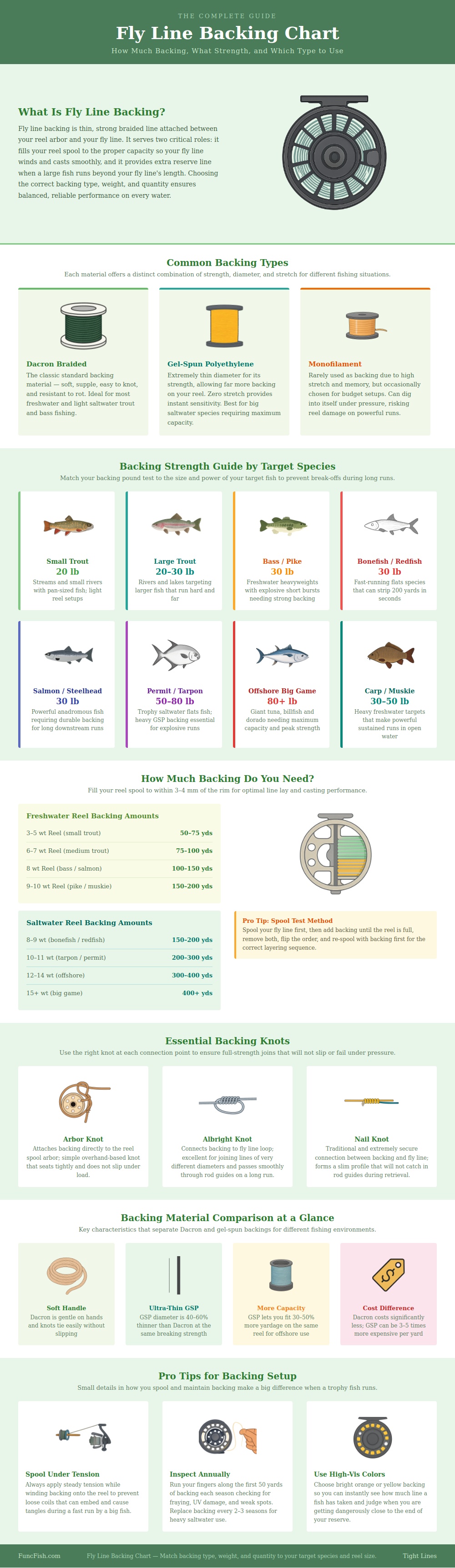
Fly line backing is an thin braided line that sits between the fly line and the reel arbor on a fishing reel. This component are necesary to provide extra length for fishes when they pull the line away from the fishing reel. If there isnt enough fly line backing, the fish will pull all of the fly line off of the reel, and the fish will escape the fishing line because the line has ended.
The line also increase the diameter of the spool, which makes the line sit at a apropiate depth for the fly fish to cast the line properly. The type of fly line backing that you should use depend on the type of fish that you will target and the environment in which fishing will occur. Small fishes, such as brook trout, will require less fly line backing then large fish, such as steelhead or bonefish, because the small fish will not cover as much distance while being caught.
What Is Fly Line Backing and How to Use It
Similarly, you should match the strength of the fly line backing to the strength of the fish to avoid snapping the line while fighting the fish. The material for the fly line backing can also differ. Dacron braided line are a popular material for fly line backing because it is soft and easy knotted.
This type of line is also helpful for freshwater fishing because it dont rot. Gel-spun polyethylene is another material that you can use for the line. This material is more thinner than dacron braided line.
Additionally, more yards of gel-spun polyethylene can fit on the fishing reel; however, it is
Monofilament is another material that can be used for fly line backing. However, people typically avoid monofilament because it is stretchy and can cause tangle in the fly line. The amount of fly line backing that you need to use will depend on the size of your reel and the type of water that you are fishing in.
If you are fishing in freshwater, you will only need a small amount of fly line backing. However, if you are fishing in saltwater, you will need a large amount of fly line backing. Fill the reel with fly line backing until there is only a quarter inch of space left at the rim of the reel.
If there is too much space between the fly line and the end of the reel spool, the fly line will not sit correct in the reel. Additionally, if there is too little space between the fly line and the end of the reel, the fly line may overflow the reel. The knots used to attach the fly line to the fly line backing must be secure to avoid the line fail during the fishing process.
Use an arbor knot to attach the fly line to the reel arbor. This type of knot will prevent the fly line from slip off the reel arbor. Use an Albright knot or nail knot to attach the fly line to the fly line backing.
The Albright knot is useful for connecting lines of different diameter. Additionally, the nail knot will stay secure and will not come undone. To maintain your fly line backing, wind it when you are installing the fly line to ensure that you pack the backing tightly on the reel.
This will prevent the line from getting in tangles, or “birds nests.” Use fly line backing in bright color, like orange or yellow, so you can easily see how much line backing is left on your reel. Inspect the backing regularly for damage or wear. If you use the line backing in saltwater, replace it every few fishing season.