⚓ Downrigger Weight Calculator
Find the perfect downrigger weight for your trolling depth, speed, and conditions
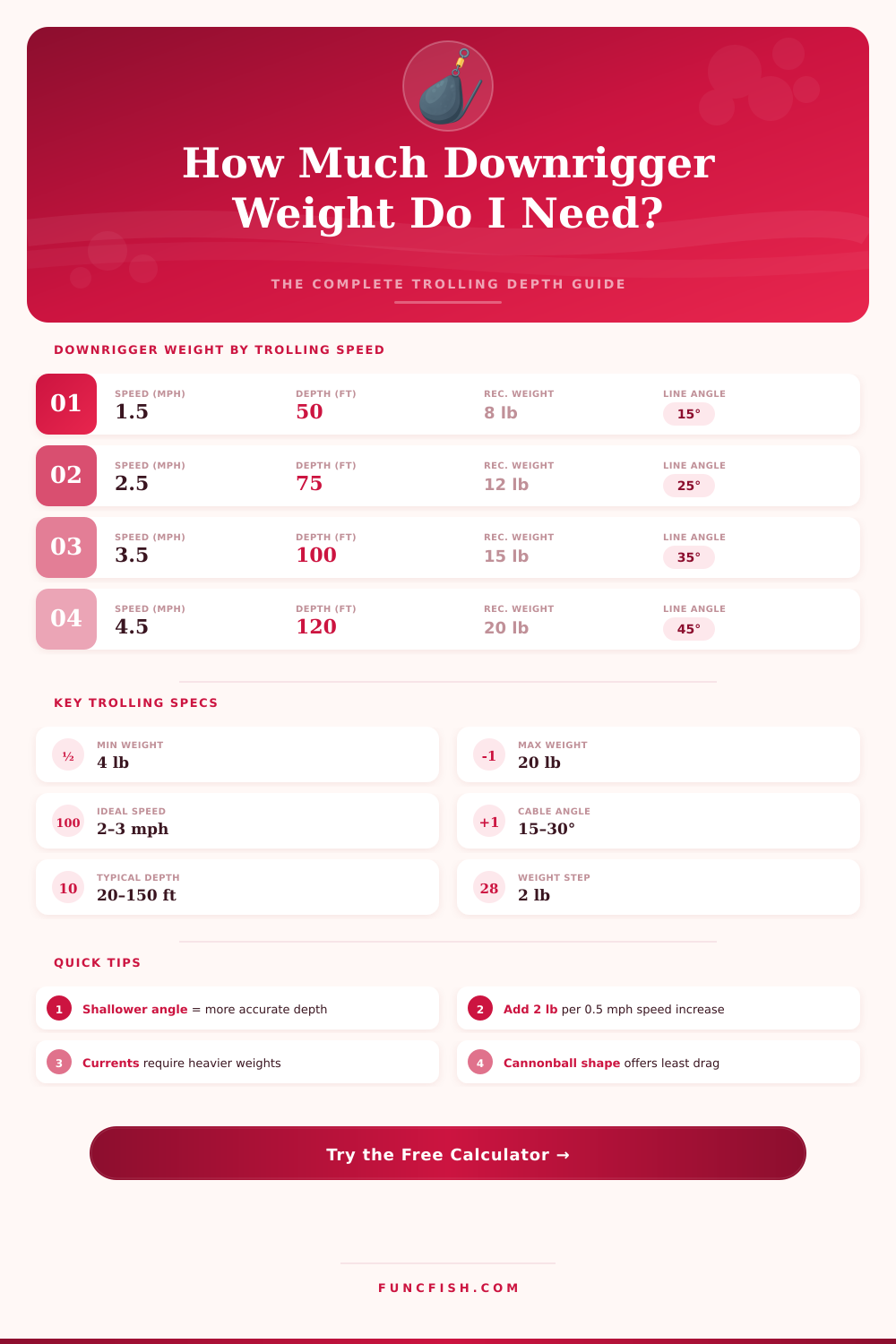
| Speed (mph) | Speed (km/h) | 50 ft / 15 m Depth | 75 ft / 23 m Depth | 100 ft / 30 m Depth | 150 ft / 46 m Depth |
|---|---|---|---|---|---|
| 1.5 | 2.4 | 6 lb / 2.7 kg | 8 lb / 3.6 kg | 10 lb / 4.5 kg | 12 lb / 5.4 kg |
| 2.0 | 3.2 | 7 lb / 3.2 kg | 9 lb / 4.1 kg | 12 lb / 5.4 kg | 15 lb / 6.8 kg |
| 2.5 | 4.0 | 8 lb / 3.6 kg | 10 lb / 4.5 kg | 14 lb / 6.4 kg | 18 lb / 8.2 kg |
| 3.0 | 4.8 | 10 lb / 4.5 kg | 13 lb / 5.9 kg | 16 lb / 7.3 kg | 20 lb / 9.1 kg |
| 3.5 | 5.6 | 12 lb / 5.4 kg | 15 lb / 6.8 kg | 18 lb / 8.2 kg | 24 lb / 10.9 kg |
| 4.0 | 6.4 | 14 lb / 6.4 kg | 18 lb / 8.2 kg | 22 lb / 10 kg | 28 lb / 12.7 kg |
| Species | Typical Depth | Speed Range | Rec. Weight | Technique |
|---|---|---|---|---|
| Chinook Salmon | 60–120 ft / 18–37 m | 2.0–3.5 mph | 10–15 lb | Flasher + Bait |
| Coho Salmon | 30–80 ft / 9–24 m | 2.5–4.0 mph | 8–12 lb | Spoon / Plug |
| Lake Trout | 80–160 ft / 24–49 m | 1.5–2.5 mph | 12–20 lb | Spoon / Tube |
| Brown Trout | 20–60 ft / 6–18 m | 2.5–3.5 mph | 6–10 lb | Stickbait / Spoon |
| Walleye | 15–40 ft / 5–12 m | 1.5–2.5 mph | 6–10 lb | Crawler Harness |
| Kokanee Salmon | 40–80 ft / 12–24 m | 1.2–2.0 mph | 4–8 lb | Small Spoon + Dodger |
| Striped Bass | 20–60 ft / 6–18 m | 2.0–3.0 mph | 8–14 lb | Plug / Umbrella Rig |
| Muskellunge | 10–35 ft / 3–11 m | 3.0–5.0 mph | 10–16 lb | Large Crankbait |
| Whitefish | 50–120 ft / 15–37 m | 1.0–2.0 mph | 10–18 lb | Jigging Spoon |
| Landlocked Salmon | 30–70 ft / 9–21 m | 2.0–3.0 mph | 6–12 lb | Streamer / Spoon |
| Cable Angle | Depth % of Cable | Depth Loss (50 ft cable) | Depth Loss (100 ft cable) | Adjustment |
|---|---|---|---|---|
| 10° (ideal) | 98% | 1 ft / 0.3 m | 2 ft / 0.6 m | Minimal — add 0 lb |
| 15° | 97% | 1.5 ft / 0.5 m | 3 ft / 0.9 m | Add 0–1 lb |
| 20° | 94% | 3 ft / 0.9 m | 6 ft / 1.8 m | Add 1–2 lb |
| 30° (acceptable) | 87% | 7 ft / 2.1 m | 13 ft / 4.0 m | Add 2–4 lb |
| 40° | 77% | 12 ft / 3.6 m | 23 ft / 7.0 m | Add 4–6 lb |
| 50° (too much) | 64% | 18 ft / 5.5 m | 36 ft / 11 m | Add 6+ lb or slow down |
When you use a downrigger to fish, you need to choose an downrigger ball weight that is appropriate for the fishing conditions. The downrigger ball weights is used to pull the fishing line and the lures down to a specific depth. However, if the downrigger ball weight is too light, the ball weight will blow back toward the surface.
This will cause the bait to move in shallow water instead of the targeted depth. You need to match the downrigger ball weight to the speed of your boat, the current in the water, and the type of baits you are using. The speed of the boat is one of the primary factors when selecting the downrigger ball weight.
How to Choose the Right Downrigger Ball Weight
As the speed of the boat increases, the resistance of the water will increase. For instence, if you increase the boat speed from 2.0 to 2.5 miles per hour, you will need a heavier downrigger ball weight to help your bait maintain the targeted depth. The second major factor is the current in the water.
The current will place a side load on the downrigger ball weight. This side load will force the ball weight to pull horizontal. You also need to consider the type of bait you are using.
Some baits will create more drag in the water than others. For example, a flasher-dodger combo will create more drag than a slim spoon. Consequently, a heavier downrigger ball weight are needed for a flasher-dodger combo.
The third factor is the downrigger cable. If you use a stainless steel wire downrigger cable instead of a coated line or braided line, there will be less drag on the line. This will allow for the use of a lighter downrigger ball weight.
Another consideration is the shape of the downrigger ball weight. The drag coefficient of the ball weight will impact how well it resists blowback. For instance, a torpedo shape ball weight will resist blowback better than a pancake-shaped ball weight.
A pancake-shaped ball weight may stall when using rough waters. However, it will hold it’s position when trolling at slow speeds. The chop on the water surface will also impact the downrigger ball weight.
If there are large waves, the force of the water on the line can be unpredictable. If the water is calm, you can use a light downrigger ball weight to target shallow waters. For offshore waters with high winds, you should use a heavy downrigger ball weight.
The angle of the fishing line should remain under 20 degree from the vertical position of the boat. This will allow the bait to remain at the targeted depth. Many downrigger anglers will try to use there experience and the downrigger ball weight they use the last time they fished in these areas.
However, the fishing conditions will change. When using a downrigger ball weight, include a safety margin of 10%. This will allow for unexpected changes in the water conditions.
For example, if there are unexpected ripples in the water or if the bait gets stuck on a submerged weed, the safety margin for the downrigger ball weight will allow the weight to overpower these conditions. Using wire cable instead of monofilament line is another benefit when using a downrigger. The monofilament line will billow out in the water, but the wire will remain in a straight line.
Therefore, a heavier downrigger ball weight will allow the fishing line to maintain a tight angle to the target depth. This will allow fishermen to cast tight spreads without tangling the line. The type of fish you are targeting will determine the downrigger ball weight requirements.
If the target species is kokanee, you should use a lighter downrigger ball weight and lighter lures. For chinook salmon in offshore waters, heavy flashers require a certain amount of downrigger ball weight to maintain the depth of 150 feet, so a heavier downrigger ball weight and heavy flashers are recommended. For walleye in the depth in the middle of the lake, a balanced cannonball downrigger ball weight will allow the bait to maintain a steady track.
For muskie in fast and rough waters, use a pancake shaped downrigger ball weight to provide the proper stability to the bait. Another factor to consider when using a downrigger is the amount of cable you let out from the downrigger. The more cable let out, the more drag on the line.
This will require a heavier downrigger ball weight to help the bait reach the targeted depth. If you notice that your bait is surfing the water surface, this indicates that the downrigger ball weight is too light for your fishing conditions. Always avoid undersizing your downrigger ball weight because this will force your bait to remain in shallow water.
On the other extreme, overweighting the downrigger ball weight will strain the motor of your fishing boat. Therefore, avoid overweighting the ball weight. To ensure that you use the appropriate amount of downrigger ball weight, always perform test casts in the area where you will be fishing.
Make note of the different downrigger ball weight and the throttle speeds you use to maintain your bait in the targeted depth. Finally, make a log of the downrigger ball weight you have used for different types of fish, depths, and water conditions. This log will help you to quickly make adjustments to your downrigger ball weight settings when you go fishing again.