🎣 Boilie Size Calculator
Find the perfect boilie diameter, hook size & hair rig length for any carp fishing scenario
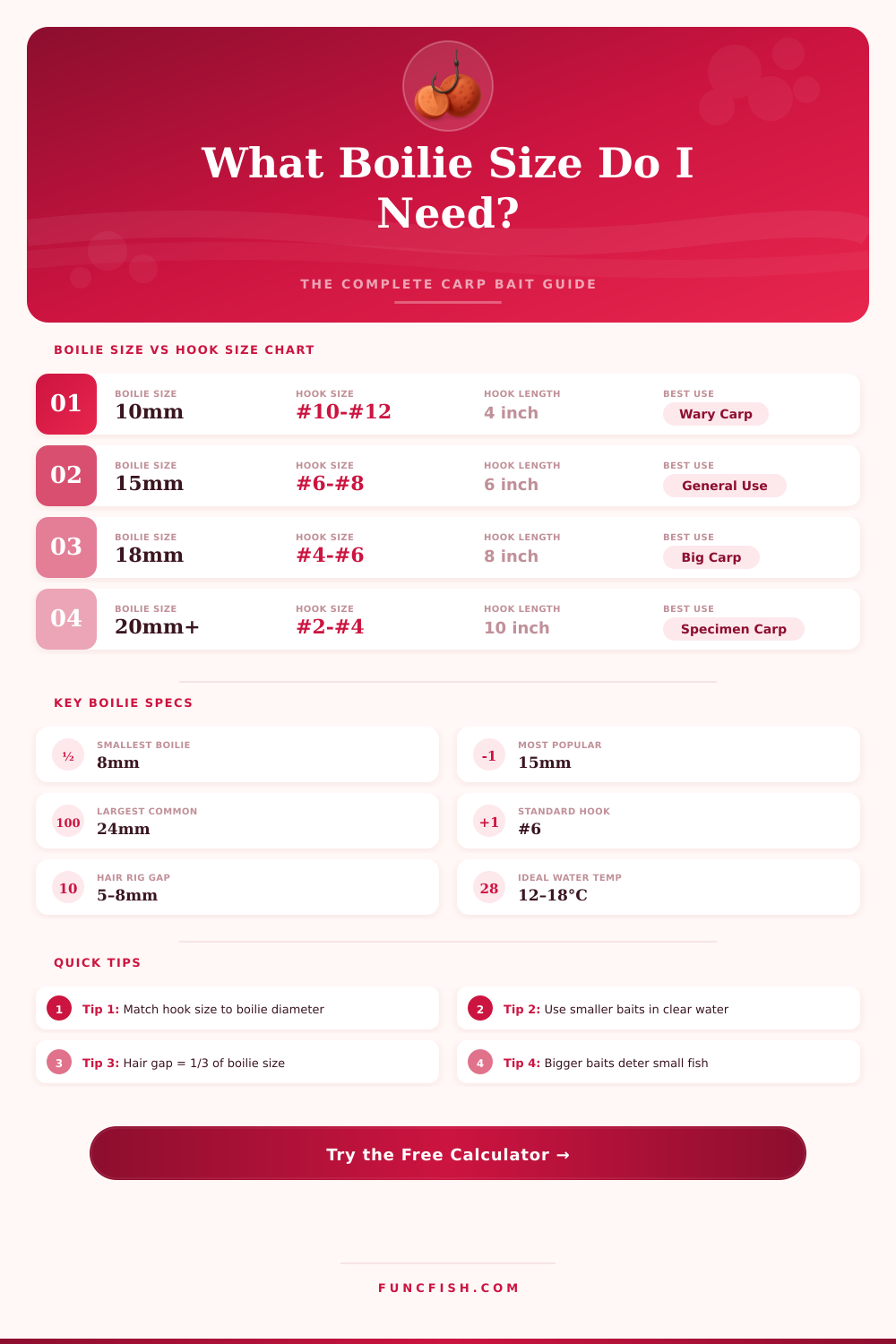
| Boilie Size | Hook Size | Hair Gap (mm) | Hook Length (cm) | Best Scenario |
|---|---|---|---|---|
| 8mm | #12 – #14 | 3–4mm | 5–8cm | Pressured, crystal clear |
| 10mm | #10 – #12 | 4–5mm | 6–10cm | Wary carp, syndicates |
| 12mm | #8 – #10 | 4–6mm | 8–12cm | Tricky / winter fishing |
| 14mm | #6 – #8 | 5–7mm | 8–14cm | General use, zig rigs |
| 15mm | #6 – #8 | 5–8mm | 10–15cm | All-round favourite |
| 18mm | #4 – #6 | 6–9mm | 10–16cm | Specimen carp, margins |
| 20mm | #2 – #4 | 7–10mm | 12–18cm | Big fish, deter nuisance |
| 24mm | #1 – #2 | 8–12mm | 14–20cm | Specimen only |
| Carp Type | Typical Weight | Boilie Size | Hook Size | Rig Style |
|---|---|---|---|---|
| Common Carp | 5–25 kg (11–55 lb) | 15–18mm | #4 – #6 | Hair Rig / Chod |
| Mirror Carp | 5–30 kg (11–66 lb) | 15–20mm | #4 – #6 | Hair Rig / Snowman |
| Leather Carp | 5–25 kg (11–55 lb) | 15–18mm | #4 – #6 | Stiff Hinge / Chod |
| Crucian Carp | 0.5–2 kg (1–4 lb) | 8–10mm | #10 – #14 | Short Hair / Pole |
| Grass Carp | 5–20 kg (11–44 lb) | 15–20mm | #4 – #6 | Surface / Bottom |
| Ghost Carp | 4–18 kg (9–40 lb) | 12–18mm | #6 – #8 | Wafter / Pop-Up |
| F1 / Hybrid | 0.5–3 kg (1–7 lb) | 8–12mm | #10 – #12 | Micro Hair / Pellet |
| Boilie Type | Buoyancy | Hook Length Adjust | Best Water | Hair Gap Adjust |
|---|---|---|---|---|
| Standard Bottom Bait | Sinking | Standard | Firm / Gravel | Standard |
| Pop-Up | Floating | +20% | Weedy / Silty | +10% |
| Wafter | Neutral / Balanced | –10% | All Bottom Types | Standard |
| Surface Bait | Floating | Very Short (3–5cm) | Surface Only | Minimal |
| Zig Foam / Bait | Floating | N/A (mid-water) | Open Water | Minimal |
| Snowman Rig | Semi-Buoyant | +15% | Silty / Weedy | +15% |
| Half & Half Trimmed | Near Neutral | Clear / Gravel | –5% | |
| Dumbbell | Sinking | Standard | Method / Feeder | Standard |
Selecting the correct size of boilies for carp fishing is an important part of the fishing process. To select the correct size of boilie for the carps you are fishing for, you must consider a variety of different variable. If you dont consider these different variables before you begin to fish, you may experience either missed runs or you may experience the fish taking your bait but eating the bait too small for your satisfaction.
The first of the variables to consider is the weight of the target carps. Large carp will not typically commit to a very small boilie, and small carp will not typically commit to a very large boilie. The second variable to consider is the temperature of the water in which you are fishing.
How to pick the right boilie size for carp fishing
If the water temperature are low, the carp will have low metabolisms, and they will eat their bait more surgicaly. Therefore, in these conditions, smaller diameter of boilie may be desired. The third of the variables to consider is the nuisance fish in the same body of water.
If there are many small fish in the same body of water as the carp, those small fish will eat the small boilies. Therefore, to avoid these small fish from eating the bait, you can use a larger size of boilie. However, if the lake is experiencing high angling pressure, the fish may be wary of use large baits.
In these cases, small baits may be more effective to entice the fish to bite. The fourth variable to consider is the casting range for your day. If your fishing location are more than a few hundred yards from your boat, a larger size of boilie will help it maintain its shape in the air.
However, if you are fishing in shallow margins of the lake, a smaller size of boilie will be more subtle and attractive to the carp. The type of lakebed in which you are fishing is another variable. Deep silt bed will often swallow the small baits, while hard lakebeds will allow for more precision in placing the bait.
Another variable that will impact the size of boilie that you use is the type of rig that you use to fish. If you are using bottom baits, the bait will rest upon the lakebed. If you are using wafters, the bait will hover just above the lakebed.
Lastly, snowmen baits will sit above the lakebed. Each of these type of rigs will require different sizes of boilie. Additionally, you should also consider the size of the hook.
If you have a large hook, you will need a large boilie, and if you have a small hook, you will need a small boilie. Using too larger or too small of a boilie for the size of the hook can prevent the hook from performing proper. Another variable to consider is the hardness of your baits.
If the water in which you are fishing is warm, your baits will soften more quick. If the boilie softens too quickly, the bait may fall off of a hair rig that you use to fish. Therefore, you should test the hardness of your baits by dropping them into water.
If they dissolve quick, the baits are for fish with high metabolisms. If they dissolve slowly, the baits are for those long fishing session. Finally, there are reference tables that can help you to determine the size of boilie that you should use based off your specific fishing scenario.
For instance, cold canals typically utilize baits in the size of 10 to 12mm with a size 8 to 10 hook. Large pits may use baits of 18 to 20mm with size 2 to 4 hooks. In each scenario, however, provide a safe window of one size larger or one size smaller of bait, as the brands of baits may vary in size, and the conditions of the water may change throughout the fishing session.