🎣 Fly Line Shooting Head Calculator
Calculate optimal shooting head weight, length, grain load & running line specs for your fly rod setup
| Head Type | Typical Length | Density (g/cm³) | Sink Rate (IPS) | Best Use |
|---|---|---|---|---|
| Floating (F) | 20–36 ft (6–11 m) | <1.0 | N/A — Floats | Dry fly, surface presentations |
| Intermediate (I) | 18–30 ft (5.5–9 m) | 1.01–1.03 | 1–2 IPS | Stillwater, light wind streamer |
| Sink Tip (F/S) | 20–32 ft (6–10 m) | Varies | 2–4 IPS tip | Rivers, nymphing, moderate depth |
| Full Sink S1 | 18–28 ft (5.5–8.5 m) | 1.04–1.06 | 1.5–2.5 IPS | Slow retrieve, stillwater shallow |
| Full Sink S3 | 18–28 ft (5.5–8.5 m) | 1.07–1.10 | 3–4 IPS | Mid-depth lakes, moderate current |
| Full Sink S5 | 15–24 ft (4.5–7.3 m) | 1.12–1.20 | 5–6 IPS | Deep lakes, fast rivers |
| Scandi | 28–36 ft (8.5–11 m) | <1.0 | N/A — Floats | Switch, light Spey, delicate fly |
| Skagit | 18–28 ft (5.5–8.5 m) | Varies | N/A — with tips | Heavy tips, big flies, Spey rivers |
| Species | Rod Weight | Head Type | Grain Range | Head Length |
|---|---|---|---|---|
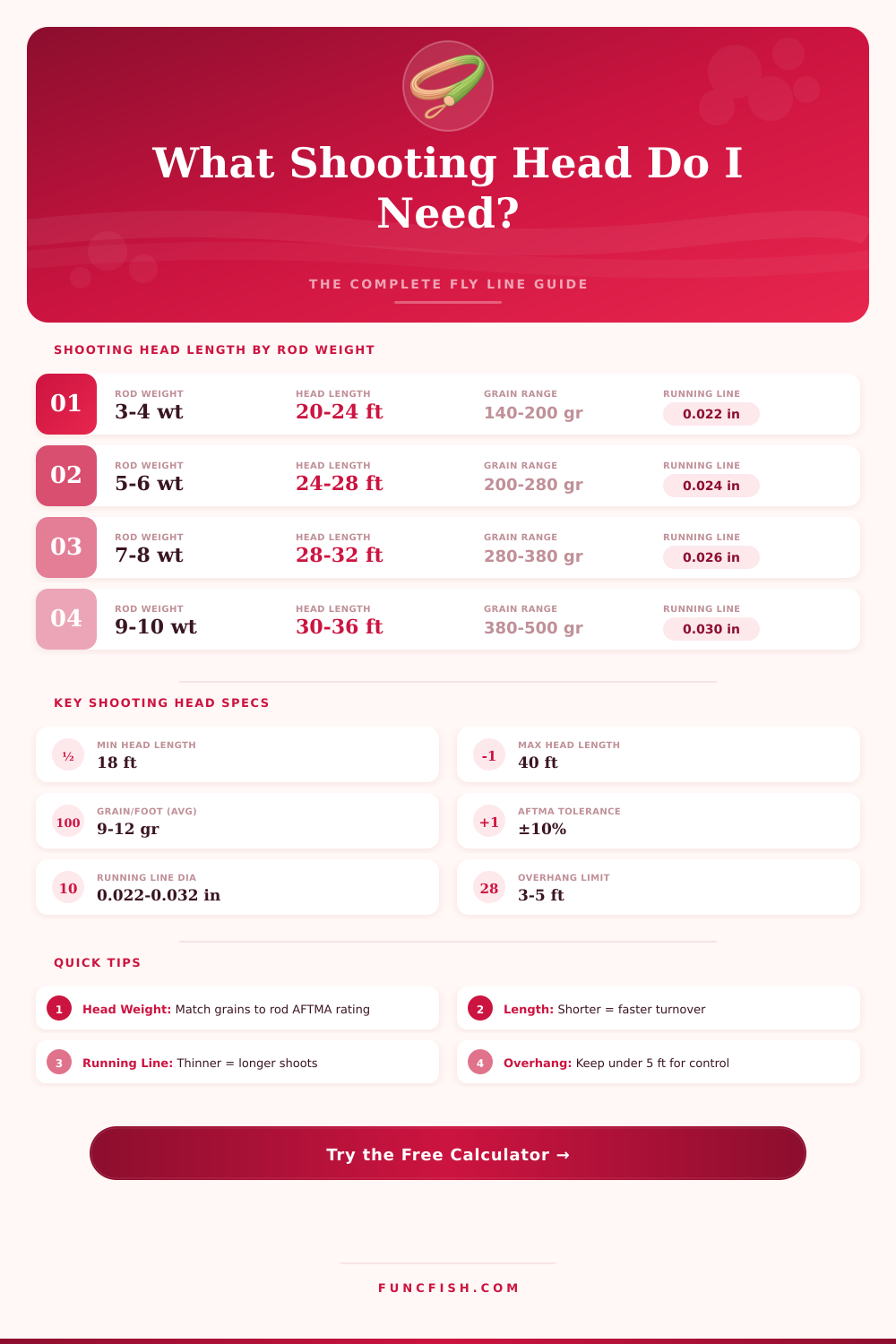
| Brown / Rainbow Trout | 3–6 wt | Floating / Sink Tip | 140–210 gr | 20–28 ft (6–8.5 m) |
| Steelhead | 7–9 wt Switch/Spey | Skagit / Scandi | 400–600 gr | 22–30 ft (6.7–9 m) |
| Atlantic Salmon | 8–10 wt Spey | Scandi / Skagit | 450–650 gr | 28–38 ft (8.5–11.5 m) |
| Largemouth Bass | 6–8 wt | Floating / Sink Tip | 210–270 gr | 22–28 ft (6.7–8.5 m) |
| Bonefish / Permit | 7–9 wt | Floating / Intermediate | 240–300 gr | 26–32 ft (8–9.7 m) |
| Tarpon | 10–12 wt | Floating / Intermediate | 340–450 gr | 28–36 ft (8.5–11 m) |
| Pike / Musky | 8–10 wt | Floating / Slow Sink | 270–360 gr | 24–30 ft (7.3–9 m) |
| Striped Bass | 9–11 wt | Intermediate / Sink | 300–420 gr | 26–34 ft (8–10.4 m) |
| Running Line Type | Diameter | Shoot Distance | Memory | Tangle Risk |
|---|---|---|---|---|
| Mono Running Line | 0.022–0.028 in (0.56–0.71 mm) | Excellent | High (stiff cold) | Low |
| Coated Running Line | 0.030–0.038 in (0.76–0.97 mm) | Good | Low | Medium |
| Braided Shooting Line | 0.018–0.024 in (0.46–0.61 mm) | Very Good | Very Low | High |
| Oval / Amnesia Mono | 0.024–0.030 in (0.61–0.76 mm) | Good | Medium | Low |
Selecting teh correct weight for a fly fishing line requires understanding the specific limits of the fishing rod that a person will use with that line. Every fishing rod has a grain window; a grain window is the range of weights of line that are designed to work with that fishing rod. If the fishing line that is selected for use with a fishing rod has too much weight, the fishing rod will bend too much with that line.
If the fishing line that is selected for use with a fishing rod has too little weight, the fishing rod will not bend enough with that line. Many angler may choose a fishing line weight based off only upon the label that is placed on the fishing rod; however, it is incorrect to base your choice of line weight solely upon the label of the fishing rod, since the densities of lines of different types is not the same. There are different family of line heads, each of which have different weights and shapes.
How to Choose the Right Fly Line and Weight
Lines with Scandi heads are generally lighter than lines with other types of heads, and have longer taper. Scandi heads are useful in casting lines into the air. Lines with Skagit heads are generally more heavier than lines with other types of heads, and have more compact design.
Skagit heads are useful when casting heavy fly into tight spaces. Compact heads are of the middle weight of Scandi and Skagit heads, and are useful in different conditions. Each of these types of heads have biases towards their weights and lengths, and each bias will influence the way in which the line loads on the fishing rod.
The type of environment in which a person will use the fishing rod will also influence the type of line head that is used. If the fishing location has many branches or brush, a line with a compact head will prevent the line from becoming caught on the branches. The presence of wind will also influence the type of line head that is to be used; with the presence of wind, long line will be more difficult to cast.
Finally, the weight of the fly that a person will bait will influence the type of line head that is used; with a heavy and large fly, more grains of line weight will be required to effectively cast the line. Additionally, the length of the sink tip will impact the lines weight; with a heavy sink tip, the total weight of the line will change, and, therefore, impact the type of line head that should of be used with that fishing rod. A persons casting style will dictate the type of line head that is to be used with a fishing rod.
For instance, individuals that use sustained anchor casts will find that a Skagit head work best with their fishing rod. Individuals that use touch and go casts will find that a Scandi head will work best with the fishing rod. Individuals that use overhead casts will find that lines with lighter heads work best.
Thus, a persons casting style, the weight of the baited fly, the presence of wind, and the length of the sink tip will influence the weight of grains of the line head that a person select. The density of the line is another critical factor in the selection of lines for fishing. Density is a measurement of the weight of the line in grains per foot of the line.
A person should not select a line based only upon its length; the density of the line is what will influence how the line pulls on the fishing rod. For instance, a T14 sink tip contains more weight than a T11 sink tip, so the T14 sink tip will require a different type of line head than the T11 sink tip. Additionally, if the person intends to use a heavy sink tip for baiting, the person will need to adjust the weight of the line head to account for the additional weight of the sink tip; this will ensure that the fishing rod bend correctly.
Thus, ensuring that the line head and sink tip work together to bend the fishing rod correctly is referred to as creating a balanced system. There will always be tradeoffs in the selection of the proper line for fishing. For instance, assuming that a person intends to use two different type of line heads of the same grain window, the person will have to make a selection between a short head or a long head.
Short heads are generally beneficial for fishing near banks, but long heads are beneficial in fishing in calm area of water. Additionally, if a person feels that the fishing rod is loading too late, they can always adjust the grain weight of the line to the higher end of the grain window. If a person is experiencing too much splash when fishing with their line, they can always adjust the length of the line or the weight of the sink tip.
These types of adjustments will allow a person to find the proper line for their fishing rod and fishing condition.