🎣 Fishing Reel Inches Per Turn Calculator
Calculate your reel's retrieve rate (IPT) using spool diameter and gear ratio — for spinning, baitcasting, and offshore reels
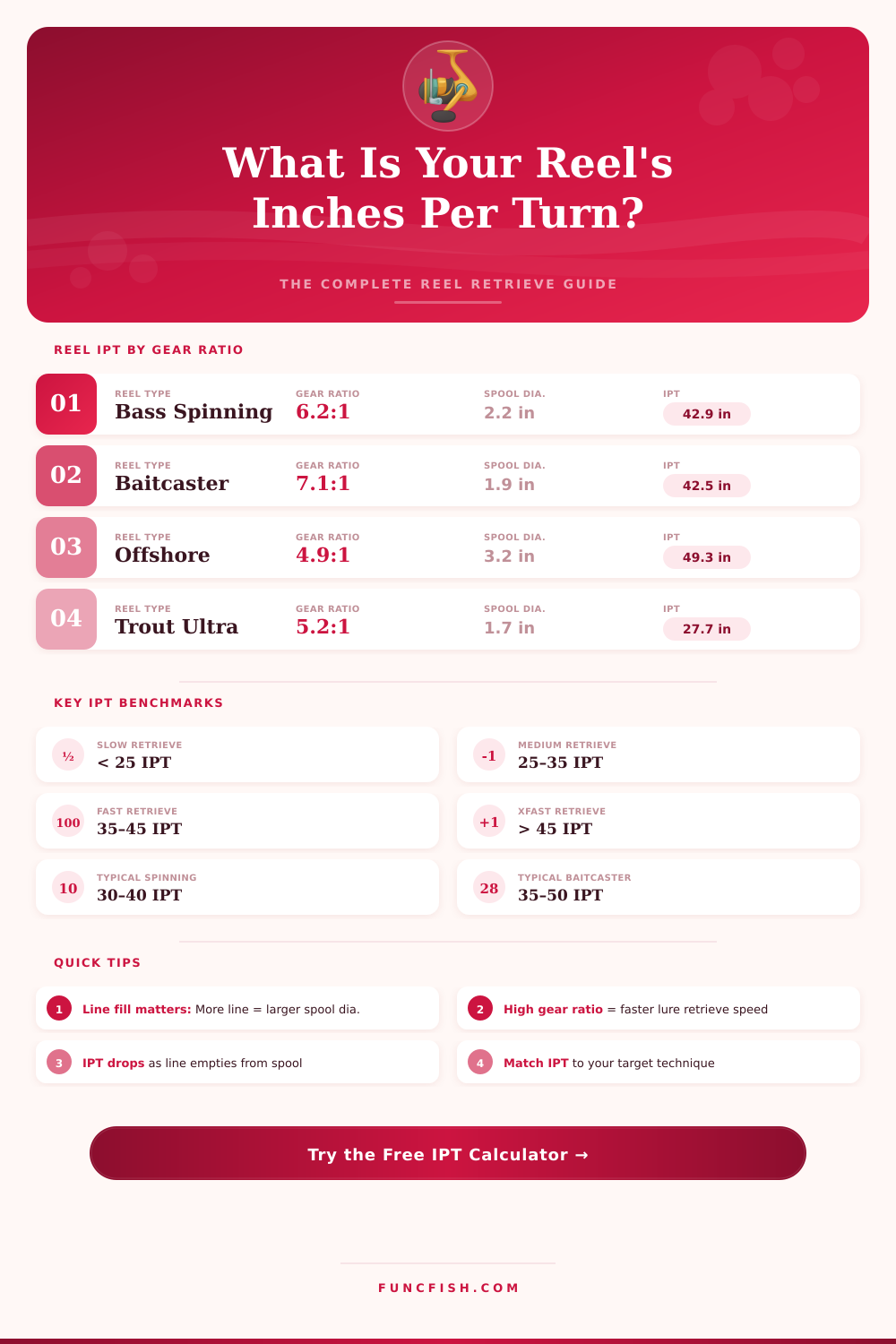
| Reel Type | Gear Ratio | Spool Dia. (in) | IPT (in) | IPT (cm) |
|---|---|---|---|---|
| Ultralight Spinning 1000 | 5.0:1 | 1.5 | 23.6 | 59.9 |
| Light Spinning 2500 | 5.2:1 | 1.7 | 27.8 | 70.6 |
| Medium Spinning 3000 | 6.2:1 | 2.0 | 39.0 | 99.1 |
| Medium Spinning 4000 | 6.2:1 | 2.2 | 42.8 | 108.7 |
| Heavy Spinning 5000 | 5.7:1 | 2.6 | 46.6 | 118.3 |
| Heavy Spinning 6000 | 5.7:1 | 2.9 | 52.0 | 132.1 |
| Light Baitcaster | 7.1:1 | 1.7 | 37.9 | 96.2 |
| Medium Baitcaster | 6.3:1 | 1.9 | 37.6 | 95.5 |
| Heavy Baitcaster | 5.4:1 | 2.1 | 35.6 | 90.4 |
| Offshore Medium | 4.9:1 | 3.2 | 49.3 | 125.2 |
| Offshore Heavy | 4.2:1 | 4.1 | 54.1 | 137.5 |
| Target Species | Typical Weight | Rec. IPT Range | Gear Ratio |
|---|---|---|---|
| Panfish (Bluegill, Crappie) | 0.25–1 lb (0.1–0.5 kg) | 20–30" | 5.0–5.5:1 |
| Trout (Stream) | 0.5–3 lb (0.2–1.4 kg) | 25–35" | 5.0–6.0:1 |
| Bass (Largemouth) | 1–8 lb (0.5–3.6 kg) | 30–45" | 6.2–7.5:1 |
| Bass (Smallmouth) | 1–5 lb (0.5–2.3 kg) | 28–42" | 6.0–7.1:1 |
| Walleye | 1–10 lb (0.5–4.5 kg) | 28–38" | 5.7–6.4:1 |
| Pike / Muskie | 5–40 lb (2.3–18 kg) | 35–50" | 6.0–7.1:1 |
| Striped Bass | 5–30 lb (2.3–13.6 kg) | 38–52" | 5.7–6.6:1 |
| Redfish / Inshore | 2–15 lb (0.9–6.8 kg) | 32–45" | 6.2–7.0:1 |
| Offshore Tuna/Mahi | 10–100+ lb (4.5–45+ kg) | 40–65" | 4.9–6.0:1 |
| Technique | Ideal IPT (in) | Ideal IPT (cm) | Gear Ratio |
|---|---|---|---|
| Crankbait (Slow) | 25–33" | 63.5–83.8 cm | 5.0–5.4:1 |
| Spinnerbait | 30–38" | 76.2–96.5 cm | 6.2–6.6:1 |
| Topwater / Frog | 35–45" | 88.9–114.3 cm | 7.0–7.5:1 |
| Jigging / Drop Shot | 25–35" | 63.5–88.9 cm | 5.5–6.4:1 |
| Flipping & Pitching | 38–50" | 96.5–127.0 cm | 7.1–8.1:1 |
| Trolling | 40–60" | 101.6–152.4 cm | 4.5–5.5:1 |
| Swimbait (Large) | 28–38" | 71.1–96.5 cm | 5.3–6.0:1 |
| Finesse / Light Jig | 22–32" | 55.9–81.3 cm | 5.0–6.0:1 |
Inches per turn is a measurement of how much fishing line a reel will recover during one single turn of the reels handle. Many anglers believes that the gear ratio for the reel is the only measurement of how fast the line will be retrieved from the reel. However, the gear ratio dont account for how much line will pass through one turn of the handle, as the amount of line that a fishing reel will recover are dependent upon two main factor, the diameter of the spool upon which the fishing line is wound, and the changing diameter of that spool as fishing line is used.
The first of these factors is the fill level of the fishing line that is loaded onto the reel. When a fishing reel is filled with line, the diameter of the spool is the largest it will be. The greater the diameter of the spool, the larger number of inches of fishing line that will pass through one turn of the reels handle.
What Inches Per Turn Means and What Affects It
However, as fishing line is removed from the spool, the diameter of the spool will decrease. If the spool contain line but is half-empty of the total capacity of the spool, the diameter of the spool will be smaller than when it was full of fishing line. Consequently, the amount of inches of line that will pass through one turn will be less than when the spool was full of fishing line.
The second of these factors is the thickness of the fishing line that is being used. Thicker lines will take up more space within the spool, and the lines may not allow for as even a lay of the fishing line onto the spool as thin lines do. Additionally, thicker lines may create more drag upon the spool than thin lines do.
This drag will cause the line to exit the reel more slowly. For these reasons, thin braided line often allow for the maximum inches per turn, while heavy monofilament lines will reduce the inches per turn. Another factor that can influence the inches per turn is the type of fishing reel that is being used.
For example, some types of fishing reels will lay the fishing line differently onto the spool than others. Most spinning reels will lay the fishing line in a tight fashion on the spool, preserving the inches per turn. Other reel type may lay the line more loosely, leading to more slip of the fishing line from the reel.
Another factor that can influence inches per turn is the amount of load that is placed upon the fishing line. Any load placed upon the line will cause the line to exit the reel more slowly than if there was no load upon the line. Thus, the theoretical inches per turn of a spinning reel will likely be higher then the actual inches of line that will pass through the reel when a person is fishing with a lure in the water.
One of the potential error that a person can make is in the setting of the drag on the fishing reel. If the drag is too light, the spool may stutter when the load on the fishing line is placed upon it, reducing the inches per turn. If the drag is too tight, the person will have to fight the reel when line is retrieved, again making the retrieve of the line more difficultly.
In either of these cases, the best method of determining inches per turn is to measure the diameter of the spool using calipers, as the diameter of spool may differ between brand of fishing reels. By understanding the inches per turn of a spinning reel, a person can gain an understanding of the performance of that reel. If a person knows the inches per turn of a reel, that person can make a decision as to which reel to use for a specific task.
Thus, while there are many factor that affect fishing line performance while fishing (such as wind, water clarity, and line memory), knowing the inches per turn of a reel allow a person to have control over the fishing lines retrieve rate.