🎣 Fly Leader Taper Calculator
Design custom tapered fly leaders — get exact section lengths, diameters & tippet specs for any fly fishing scenario
| Material | Stiffness | Visibility | Abrasion Resist. | Stretch | Best Use |
|---|---|---|---|---|---|
| Monofilament Nylon | Medium | Low | Good | High (25-30%) | General, Dry Fly |
| Fluorocarbon | Medium-High | Very Low | Excellent | Low (4-6%) | Nymph, Clear Water |
| Copolymer | Low-Medium | Low | Good | Medium (15-20%) | Dry Fly, Light Tippet |
| Hard Monofilament | High | Low | Very Good | Low | Butt Section |
| Braided Core | Very Low | Medium | Fair | Very Low | Delicate Presentation |
| Polyleader/Sink Tip | N/A | Low | Good | Low | Streamer, Wet Fly |
| Species | Typical Size | Leader Length | Tippet Size | Material | Taper Formula |
|---|---|---|---|---|---|
| Wild Trout (small stream) | 6-14 in / 15-36cm | 7-9 ft / 2.1-2.7m | 5X-7X | Nylon/Copolymer | 60/20/20 |
| Trout (tailwater) | 10-20 in / 25-51cm | 9-12 ft / 2.7-3.7m | 5X-7X | Fluorocarbon | 55/15/30 |
| Bass (largemouth) | 1-5 lb / 0.5-2.3kg | 6-8 ft / 1.8-2.4m | 1X-3X | Monofilament | 60/20/20 |
| Bonefish | 2-8 lb / 0.9-3.6kg | 9-10 ft / 2.7-3.0m | 10-12 lb | Fluorocarbon | 65/20/15 |
| Tarpon | 40-150 lb / 18-68kg | 8-9 ft / 2.4-2.7m | 20-30 lb | Hard Mono | 65/20/15 |
| Atlantic Salmon | 5-25 lb / 2.3-11.3kg | 9-12 ft / 2.7-3.7m | 2X-4X | Nylon | 60/20/20 |
| Panfish/Bluegill | 4-12 oz / 113-340g | 7-9 ft / 2.1-2.7m | 5X-7X | Copolymer | 55/15/30 |
| Euro Nymph Target | 8-20 in / 20-51cm | 12-16 ft / 3.7-4.9m | 5X-6X | Fluorocarbon | 90/10/0 |
| Formula | Butt % | Mid/Taper % | Tippet % | Best For |
|---|---|---|---|---|
| Standard 60/20/20 | 60% | 20% | 20% | All-around dry fly, general use |
| Harvey 65/15/20 | 65% | 15% | 20% | Accuracy, technical dry fly |
| Long Tippet 55/15/30 | 55% | 15% | 30% | Spooky trout, slow water |
| Short Power 70/15/15 | 70% | 15% | 15% | Windy conditions, heavy flies |
| Euro Nymph 90/10/0 | 90% | 10% | Sighter+tippet ring | Czech/Euro nymphing |
| Saltwater 65/20/15 | 65% | 20% | 15% | Bonefish, tarpon, permit |
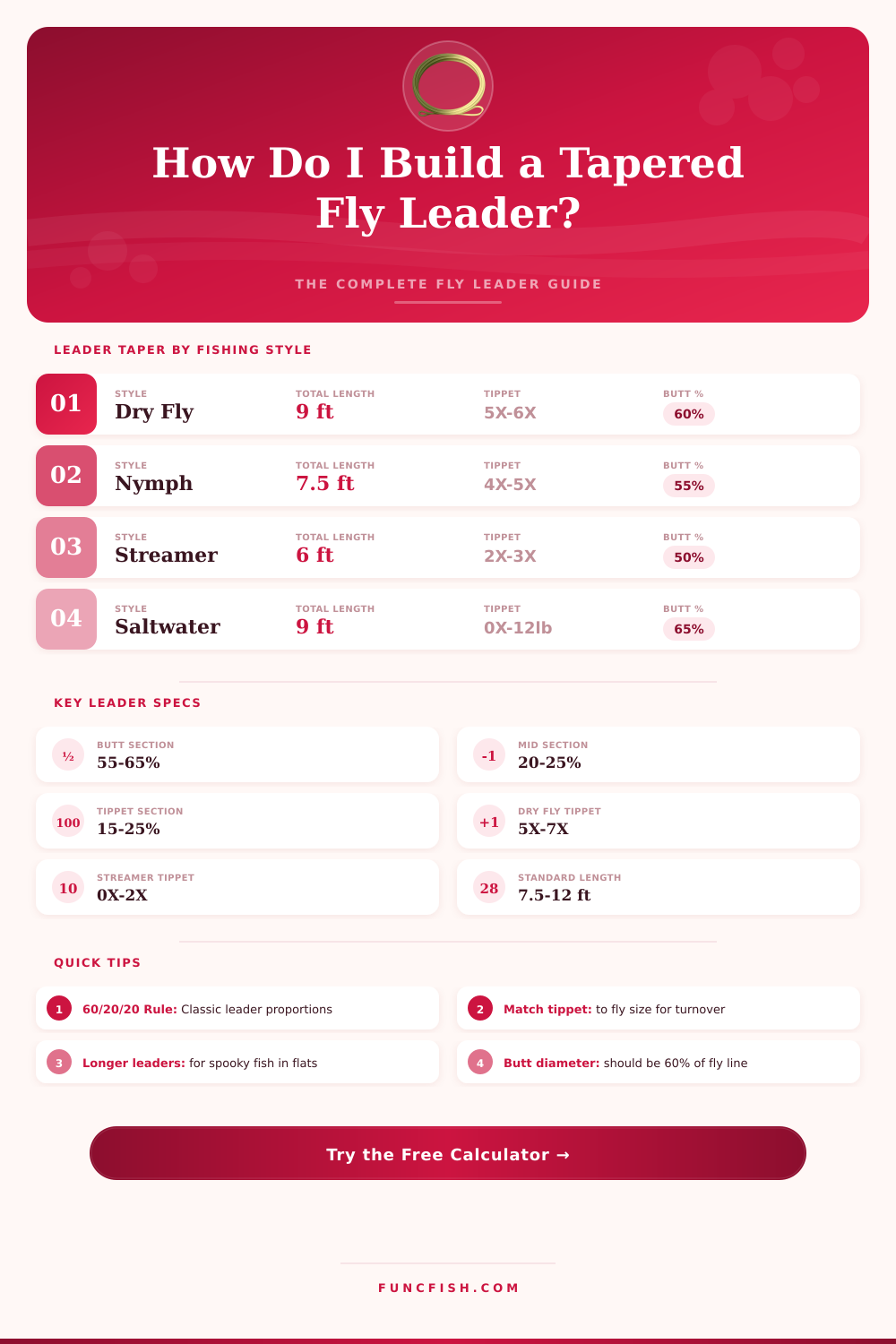
A fly leader are the component of fly fishing tackle that connect the fly line to the tippet. Furthermore, the leader is used to facilitate the transfer of energy from the fly line to the fly. A typical fly leader consists of three different section: the butt section, the mid section, and the tippet.
The butt section of a leader is the thickest part of the leader. This part of the leader is responsible for absorbing the momentum of the fly line. Should the butt section be too thin to handle the weight of a large fly or the resistance of the wind, the leader will fail to perform it’s task of transferring energy from the line to the fly.
Fly Leader Parts and How to Choose One
The mid section of the leader is responsible for providing a gradual transition in diameter between the butt and tippet sections of the leader. This section ensures that the energy from the cast is transferred smooth to the fly without the leader buckling. Finally, the tippet section is the thinnest part of the leader.
This part of the leader is responsible for receiving the fly that will be fished. The taper of a fly leader is the graduated decrease in the diameter of the leader from the butt section to the tippet. A correct taper are required for the leader to successfully transfer the energy from the fly line to the fly.
Should the taper be incorrect, the leader will either cause the fly to land in an unnatural position or the leader will fail to deliver the fly to the target location. For instance, when fishing for trout in clear water with good visibility, a long and thin leader will allow the fly to drift natural through the water. Conversely, in areas where there is strong wind, a shorter and thicker leader will allow the fly leader to push through the air resistance create by the moving air.
The size of the fly that will be fished and the conditions of the water in which the fly will be fished will determine the length of the leader and its diameter. For instance, large flies such as three-inch streamers will require a beefy butt section of the leader to provide the power to prevent the formation of tailing loops created by the fly. Small flies such as micro emergers will require a longer and more delicate leader to allow the fly to drift natural downstream without excessive tension on the line.
Additionally, the clarity of the water will also play a role in determining the length of the leader. In clear water, longer leaders are required to keep the fish from seeing the fly, while in stained water where visibility is poor, shorter leaders is required. Wind speed will also affect the selection of the length and diameter of the leader.
In strong winds, the leader will experience air resistance that will work against the movement of the fly. Thus, an angler selects a stouter leader to overcome this resistance. Should an individual use a leader that is too light for the strength of the wind, the leader will fail to turn over the fly proper.
Finally, the environment in which the fly is being cast will impact the length of the leader. For instance, an individual can use a twelve-foot leader in an open meadow, but will need to shorten the leader to a seven-foot leader when fishing in thick brush to avoid hitting branch. Many anglers make mistakes with the store-bought leaders.
For instance, many store-bought leaders will have incorrect transitions between sections of the leader and the weights of the tippet will be incorrect for the size of the flies. For instance, if an individual uses a leader with an abrupt transition in diameter between the mid and tippet section, the fly will kick downward when the leader reach the end of the cast. Additionally, if an individual uses a leader whose tippet is too heavy for the size of the fly, the angler will create drag with the line rather than allowing the line to provide the power required to move the fly.
Finally, an individual can use a turnover score to ensure the leader is correctly construct. A turnover score of 85 or higher indicate that the leader is correctly constructed and will successfully transfer energy to the fly; below 75 indicates that the angler should of modified the butt section of the leader or the length of the leader. An individual can select to hand-tie their own leader as a way to gain more precision in the length of each section of the leader than provided by the manufacturer.
Furthermore, because leaders will wear down over time due to rubbing against the rocks in the river, they need to be replaced frequently. Prior to using a leader on the water, it is a good idea to test it on grass to ensure that it transfers the energy from the caster to the fly correct. Finally, if the leader is constructed with the proper taper and the correct diameter for the specific type of fly that will be fished and the strength of the wind in which the fishing will occur, the leader will allow the fly to land naturaly on the surface of the water.