
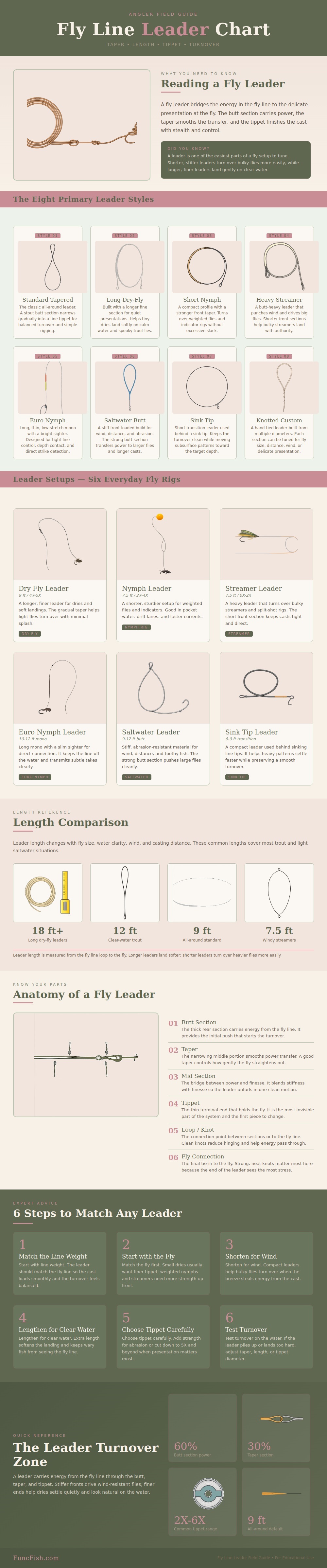
A fly fishing leader are teh length of line that connect a person’s fly line to the fly that they are attempting to fish. The fly fishing leader is responsable for effective transferring energy from the person’s fly line to the fly that is attached to the fishing leader. If the person uses a fishing leader that is incorrect for the conditions in which they are fishing, then the fishing leader will not turn over proper.
As a result of the fishing leader not turning over proper, the fishing leader may become entangled or the fly may hit the water too forceful. Thus, it is necessary for the person to use the correct kind of fishing leader for there specific fishing conditions, as the fishing leader will dictate the movement of the fly on the water surface. A fly fishing leader function by having a thick diameter for the portion of the fishing leader that is attached to the fly line, and having the remainder of the fishing leader (the portion that has the fly attached to it) have a thinner diameter.
What a Fly Fishing Leader Is and How to Choose One
The thick portion of the fishing leader help to absorb the energy of the heavy fly fishing line, and the thin portion of the fishing leader allow for the designated fly to travel through the water with minimal effort. If the fishing leader does not have the proper tapering of the thick to thin portion of the leader, then the energy from the fishing line will dissipate from the leader, and the lack of energy will cause for the line to fail. The different kind of flies, as well as the conditions of the water in which the flies are being cast, require different kinds of fishing leaders.
For instance, flies that are cast onto the surface of the water, such as dry flies, require fishing leaders that are long and thin to allow for the flies to land gentle upon the water surface. However, environments with alot of wind utilize short and stiff fishing leaders, or when heavy streamers are being used. Long fishing leaders are used in clear water environments to ensure that the flies do not land upon the water surface, but short fishing leaders are used to allow for more better control of heavy flies.
The construction of a fly fishing leader consist of several specific sections. The butt section of a fly fishing leader is the thickest part of the leader, and it is responsable for receiving the energy from the fly line. The midsection of the leader connect the butt section of the leader to the tippet of the leader, and it help to evenly distribute the energy from the fly line to the tippet.
Finally, the tippet of a fly fishing leader is the thinnest part of the leader, and it is the section of the leader that is tied to the fly that is being cast. Because the tippet is the thinnest part of the leader, it is the part of the leader that will break or wear out first; thus, the tippet must be replaced more frequent than the other sections of the leader. In order to select the proper fly fishing leader for the type of fly that is to be used, the water conditions, and the wind conditions, a person should consider a few factor.
For instance, if the flies that will be used are large and heavy, the fishing leader will have a thicker tippet. In contrast, if the flies that will be used are small and delicate, the fishing leader will have a thinner tippet to ensure the fly remain invisible to the fish. Furthermore, the length of the leader should be adjusted according to the clarity of the water in which the fly will be cast.
For example, if the water is very clear, a longer leader will allow for even more even distribution of the energy from the fly line to the fly. However, if the water is not as clear, or if there are heavy wind or heavy flies in the water, a shorter leader will allow for better control of the fly. Finally, if the leader cause the fly to coil or heap when being cast, that leader should of been adjusted to improve the turnover of the fly and the line.