🐟 Jerkbait Suspension Calculator
Find the exact ballast weight needed for perfect neutral buoyancy in any water condition
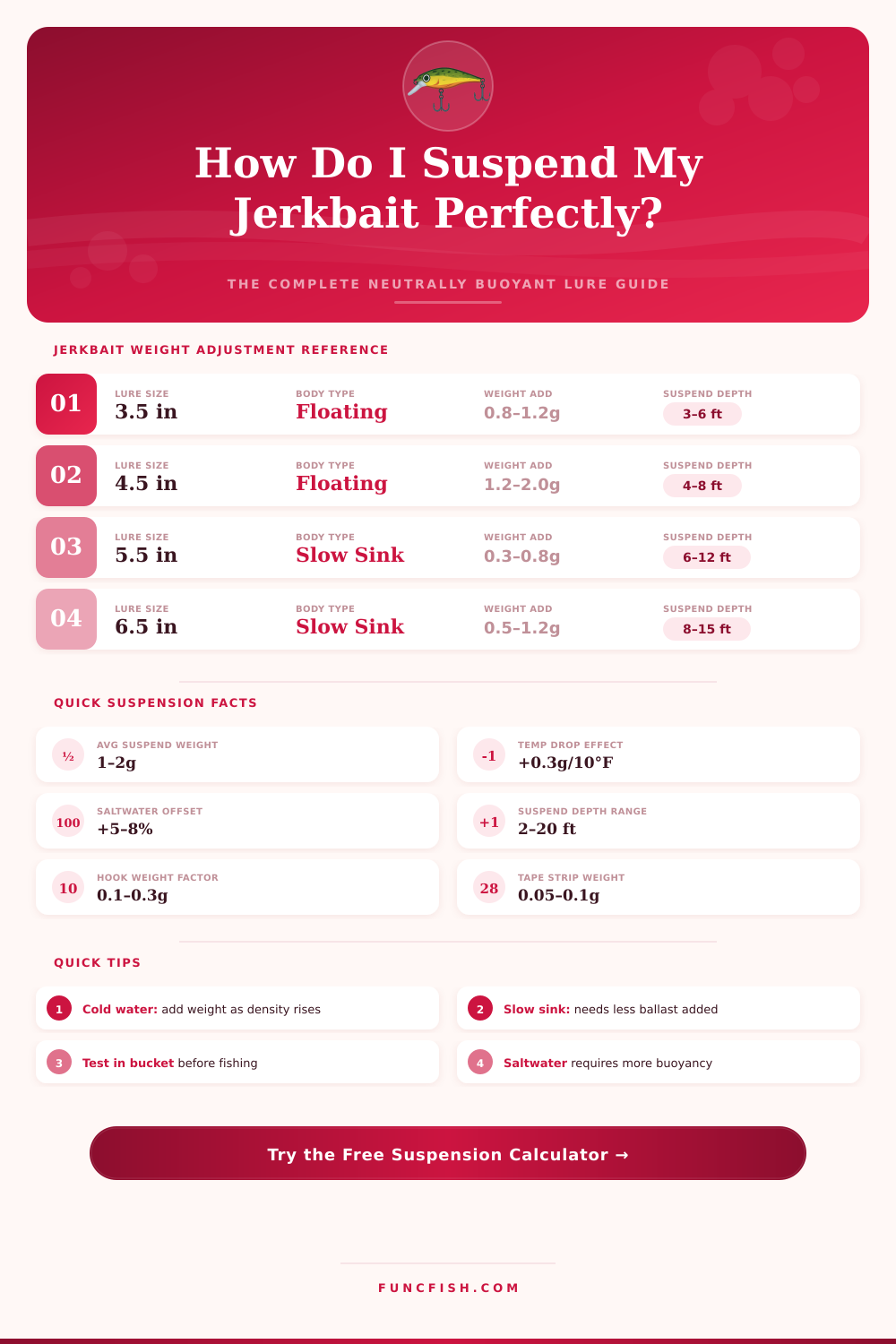
| Material | Buoyancy Class | Density (g/cm³) | Ballast Needed | Notes |
|---|---|---|---|---|
| Balsa Wood | High Positive | 0.12–0.20 | 1.5–3.0g | Most buoyant, needs most weight |
| Basswood / Cedar | Moderate Positive | 0.32–0.45 | 0.8–1.8g | Good balance, popular DIY choice |
| ABS Hard Plastic | Low Positive | 1.02–1.08 | 0.4–1.2g | Most factory jerkbaits |
| Polycarbonate | Near Neutral | 1.18–1.22 | 0.1–0.6g | Often already near neutral |
| Resin / Composite | Near Neutral | 1.10–1.20 | 0.2–0.8g | Dense, less ballast required |
| Foam Core Plastic | High Positive | 0.50–0.75 | 1.0–2.5g | Varies by core density |
| Solid Hard Plastic | Near Neutral | 1.05–1.15 | 0.2–0.9g | Denser than hollow ABS |
| Wood Laminate | Low Positive | 0.55–0.80 | 0.6–1.6g | Layered construction varies |
| Temp (°F) | Temp (°C) | Water Density (g/mL) | Adj. vs. 68°F | Recommendation |
|---|---|---|---|---|
| 32°F | 0°C | 0.9998 | +0.9g | Maximum ballast, ice fishing |
| 40°F | 4°C | 0.9998 | +0.7g | Heavy ballast, cold season |
| 50°F | 10°C | 0.9997 | +0.4g | Moderate ballast needed |
| 59°F | 15°C | 0.9991 | +0.2g | Slight extra weight |
| 68°F | 20°C | 0.9982 | Baseline | Factory tuned baseline |
| 77°F | 25°C | 0.9970 | –0.2g | Remove small weight |
| 86°F | 30°C | 0.9957 | –0.4g | Summer, reduce ballast |
| Target Species | Jerkbait Size | Suspend Depth | Ideal Water Temp | Ballast Range |
|---|---|---|---|---|
| Largemouth Bass | 3.5–5in / 9–13cm | 3–10 ft / 1–3m | 45–65°F / 7–18°C | 0.8–2.0g |
| Smallmouth Bass | 3–4.5in / 7.5–11cm | 4–12 ft / 1.2–3.7m | 48–68°F / 9–20°C | 0.6–1.6g |
| Walleye | 4–5.5in / 10–14cm | 6–18 ft / 1.8–5.5m | 45–60°F / 7–16°C | 1.0–2.2g |
| Northern Pike | 5–7in / 13–18cm | 4–15 ft / 1.2–4.6m | 40–60°F / 4–16°C | 1.5–3.5g |
| Muskie | 6–10in / 15–25cm | 6–20 ft / 1.8–6m | 55–70°F / 13–21°C | 2.0–5.0g |
| Trout (Lake) | 3–4.5in / 7.5–11cm | 5–15 ft / 1.5–4.6m | 42–56°F / 6–13°C | 0.5–1.5g |
| Striped Bass | 4.5–6in / 11–15cm | 6–20 ft / 1.8–6m | 55–68°F / 13–20°C | 1.2–2.8g |
| Yellow Perch | 2–3.5in / 5–9cm | 4–12 ft / 1.2–3.7m | 38–58°F / 3–14°C | 0.3–1.0g |
| Hook Size | Approx. Weight (g) | Best Lure Size | Wire Gauge |
|---|---|---|---|
| #6 Treble | 0.08–0.12g | 2–3in lures | Light wire |
| #4 Treble | 0.12–0.18g | 3–4in lures | Light–Med wire |
| #2 Treble | 0.18–0.25g | 3.5–5in lures | Medium wire |
| #1 Treble | 0.25–0.35g | 4.5–6in lures | Medium wire |
| #1/0 Treble | 0.35–0.50g | 5–7in lures | Heavy wire |
| #2/0 Treble | 0.50–0.70g | 6–10in lures | Heavy wire |
A jerkbait is an type of fishing lure that is designed to suspend in the water. Suspension is the state in which the jerkbait remain at a specific depth in the water column. Achieving suspension with a jerkbait allow the jerkbait to effectively mimic the movement of a dying fish to attract fish to the bait.
If the jerkbait do not achieve suspension, then the jerkbait will either float to the surface like a balloon or it will sink to the bottom of the water column like a brick, both of which can prevent the fishing effort from being succesful. Buoyancy is the physical principle that determine the action of a jerkbait when it is suspended in the water column. The jerkbait will displace a volume of water, and the weight of that volume of displaced water will determine the buoyancy of the jerkbait.
How to Make a Jerkbait Stay at the Right Depth
If the total mass of the jerkbait are equal to the weight of the volume of water that it displaces, the jerkbait will achieve neutral buoyancy. Achieving neutral buoyancy will cause the jerkbait to remain at a constant depth while paused. However, adding hardware to a jerkbait will increase its total mass.
Therefore, if the total mass of the jerkbait increase, it will sink faster to the bottom of the water column. The water temperature and salinity also affect the buoyancy of a jerkbait. Cold water is more dense than water that is warmed to the same temperature.
Dense water will create more lift on the jerkbait than less dense water. Therefore, a jerkbait that achieves neutral buoyancy in warm water will float in cold water. Additionally, saltwater is more dense than freshwater.
Therefore, a jerkbait that is neutral in freshwater will float in saltwater. You can determine the exact displacement of a jerkbait by placing it in a graduated cylinder to measure its volume. The hardware that is added to a jerkbait can change the total mass of the jerkbait and also change the action of the lure.
For instance, changing the size of the treble hook will change the total mass of the jerkbait. Using larger treble hooks will increase the total mass of the jerkbait, which will cause it to sink faster. Using saltwater split rings will also increase the total mass of the jerkbait because saltwater split rings is heavier than freshwater split rings.
Additionally, the use of snaps and leaders will create drag on the jerkbait, which will slow the descent rate of the jerkbait in the water column. Depending on the type of fish that a person intend to catch, there are different suspension styles for jerkbaits. For instance, level suspension is useful for catching smallmouth bass in winter.
Nose-down suspension will mimic an injured fish that is struggling to swim, which is helpful for catching walleye. Slow rise actions will allow a fisherman to avoid grass when fishing for largemouth bass. Slow sink actions is helpful when fishing in windy conditions.
A jerkbait calculator can be used to determine the correct weight of a jerkbait for a fishing application. The jerkbait calculator takes into account the density of the water, the salinity of the water, and the mass of the hardware components of the jerkbait to calculate the neutral mass of the jerkbait. This neutral mass will allow the jerkbait to achieve neutral buoyancy.
Additionally, the calculator will provide information regarding the current reserve of the jerkbait. The current reserve will indicate whether the jerkbait is rising or sinking in the water column. If the jerkbait is not suspending proper, the fisherman can use a tune change to correct the problem.
For instance, the fisherman can add lead dots to the belly of the jerkbait to adjust its mass to achieve a neutral state. In order to determine if a jerkbait is properly tuned, it is necessary for the fisherman to test the jerkbait. One way to test the jerkbait is to float the jerkbait in a bucket of water that has the same salinity and temperature as the fishing spot.
The fisherman can time the jerkbait to determine how long it take the jerkbait to drift or sink in a five second pause. If the time does not match the expected time, the fisherman should recheck the volume of the jerkbait or the total mass of the treble hooks on the jerkbait. One common mistake when adding weight to a jerkbait is placing the added weight on the nose of the jerkbait.
Placing the weight on the nose of a jerkbait will cause the jerkbait to pitch upward on its nose. To keep the jerkbait level in the water column, the weight should be placed in the center of the belly of the jerkbait. By making small adjustments to a jerkbait, a fisherman can improve their chance of success.
For instance, a fisherman uses lead dots to make small adjustments to a jerkbait. Tungsten weights are also helpful, but could potentially change the flash of the jerkbait in the water column. Therefore, a fisherman may prefer to use hook swaps to change the weight of a jerkbait instead of using tungsten weight.
By understanding the physics of jerkbaits (such as buoyancy), the density of the water, and the mass of the hardware components… A fisherman can ensure that the jerkbait will achieve the correct suspension for the target fish species.