🐟 Cobia Weight Calculator
Estimate cobia weight from length & girth measurements using the standard fish weight formula
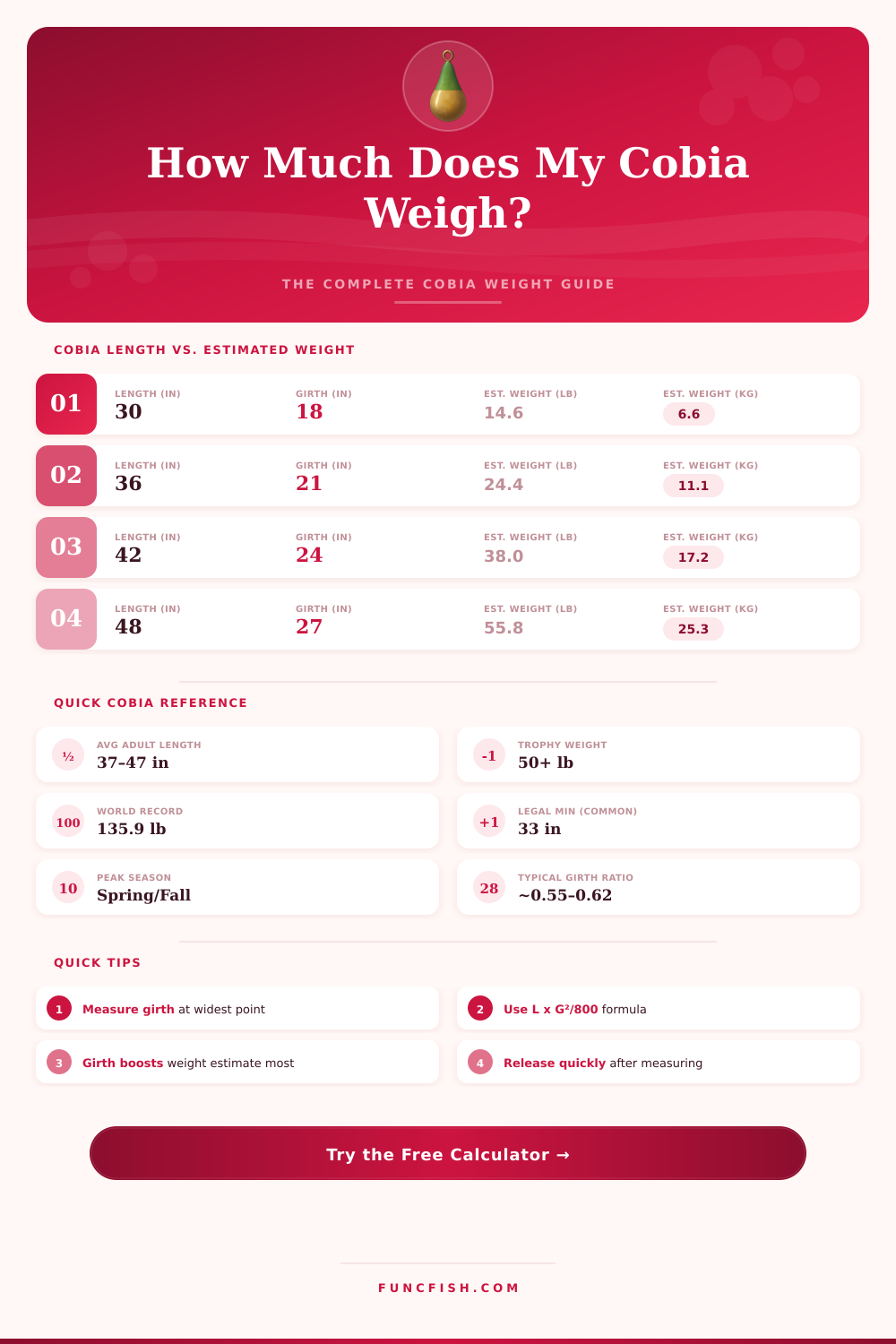
| Length (in) | Length (cm) | Est. Girth (in) | Est. Weight (lb) | Est. Weight (kg) | Classification |
|---|---|---|---|---|---|
| 28 | 71.1 | 16.2 | 9.2 | 4.2 | Juvenile |
| 30 | 76.2 | 17.4 | 11.3 | 5.1 | Sub-adult |
| 33 | 83.8 | 19.1 | 15.2 | 6.9 | Legal Min. (common) |
| 36 | 91.4 | 20.9 | 19.6 | 8.9 | Slot Size |
| 40 | 101.6 | 23.2 | 26.8 | 12.2 | Average Adult |
| 44 | 111.8 | 25.5 | 35.8 | 16.2 | Good Fish |
| 48 | 121.9 | 27.8 | 46.5 | 21.1 | Large Adult |
| 52 | 132.1 | 30.2 | 59.7 | 27.1 | Trophy Class |
| 56 | 142.2 | 32.5 | 74.1 | 33.6 | Bull Cobia |
| 60 | 152.4 | 34.8 | 90.1 | 40.9 | Elite Trophy |
| Species | Typical Wt (lb) | Formula Divisor | Girth Ratio |
|---|---|---|---|
| Cobia | 20–60 | 800 | ~0.58 |
| Striped Bass | 10–40 | 800 | ~0.52 |
| Red Drum | 10–40 | 900 | ~0.55 |
| Mahi-Mahi | 10–30 | 850 | ~0.50 |
| King Mackerel | 10–50 | 1000 | ~0.40 |
| Tarpon | 50–150 | 800 | ~0.60 |
| Formula | Inputs | Accuracy | Best Use |
|---|---|---|---|
| L x G² / 800 | L + G | Very High | Live fish |
| L³ / 1200 | L only | Moderate | Quick est. |
| L x G² / 850 | L + G | High | Fork length |
| NOAA L² x 0.00184 | L only | Low–Mod | Field survey |
In order to estimate the weights of a cobia, a person must measure both the length and the girth of the cobia. A person can measure the length of the cobia in two different ways: by measuring the fork length of the cobia (from the nose of the cobia to the tail notch) or by simply measuring the total lengths of the cobia. The fork length of a cobia is approximately 94 percent of the total length of the cobia.
Therefore, while the length of the cobia is one measurement of the cobia, the girth of the cobia is a more accurately measurement of the weight of the cobia. A person measures the girth of the cobia by taking the measurement of the cobias thickest part behind it head. If a person do not measure the girth of the cobia, there estimate of the cobias weight will be inaccuracy.
How to Estimate a Cobia’s Weight
The girth of the cobia is one of the measurement that indicates the weight of the cobias body. The weight of the cobia may also change depending on the time of year that the cobia is weighed and the body condition of the cobia. For instance, cobia is often migrating and eating more in the spring than during other times of the year.
Thus, cobia in the spring may have more weight then cobia in other seasons. Additionally, cobia that are full of eggs will have a larger girth than cobia that is not full of eggs. Therefore, the time of year and the body condition of the cobia must also be consider when estimating its weight.
As the body shape of cobia change with the year, the length of the cobia alone is not a reliable measurement of its weight. The method in which a person holds the cobia also has an impact on the weight that is estimated for the cobia. For instance, if a person holds the cobia in a sling, the cobia will tend to have a tighter girth measurement than if it was held in lip grippers, which may cause the cobia to twist.
If the cobia twists, the girth measurement will be less certain; thus, the confidence band for the weight of the cobia will be more wider. Additionally, if the cobia that is being weighed is exhausted (of its fight with the angler), it may weigh less than if the cobia was fresh. When cobia are exhausted after a fight, they may deflate in weight by two percents or more.
Thus, the cobia should always be weigh while it is fresh. The estimated weight of the cobia will allow a person to select the correct tackle and drag settings for the cobia. For instance, a 30-pound spinning rig is appropriate for cobia that weigh between 10 and 22 pounds, while a 65-pound spinning rig is appropriate for cobia that weigh between 40 and 70 pound.
Thus, by knowing the weight of the cobia, a person can set the drag on the cobias fishing gear to ensure that it will not break during its fight with the cobia. Finally, the weight estimate that is calculated for the cobia will provide a blended weight along with a confidence band. The multiplier of its season and body condition calculates the blended weight from the length and girth of the cobia.
The confidence band for the cobias weight indicates the range of possible weights for the cobia. A wide confidence band indicates that there is a high amount of uncertainty in the weight estimate, while a narrow confidence band indicates that there is a low amount of uncertainty in the weight estimate. Thus, by calculating the cobias length, girth, season, and body condition, angler can produce an estimate of the cobias weight.