🐟 Flounder Weight Calculator
Estimate flounder weight from length & girth — Imperial & Metric supported
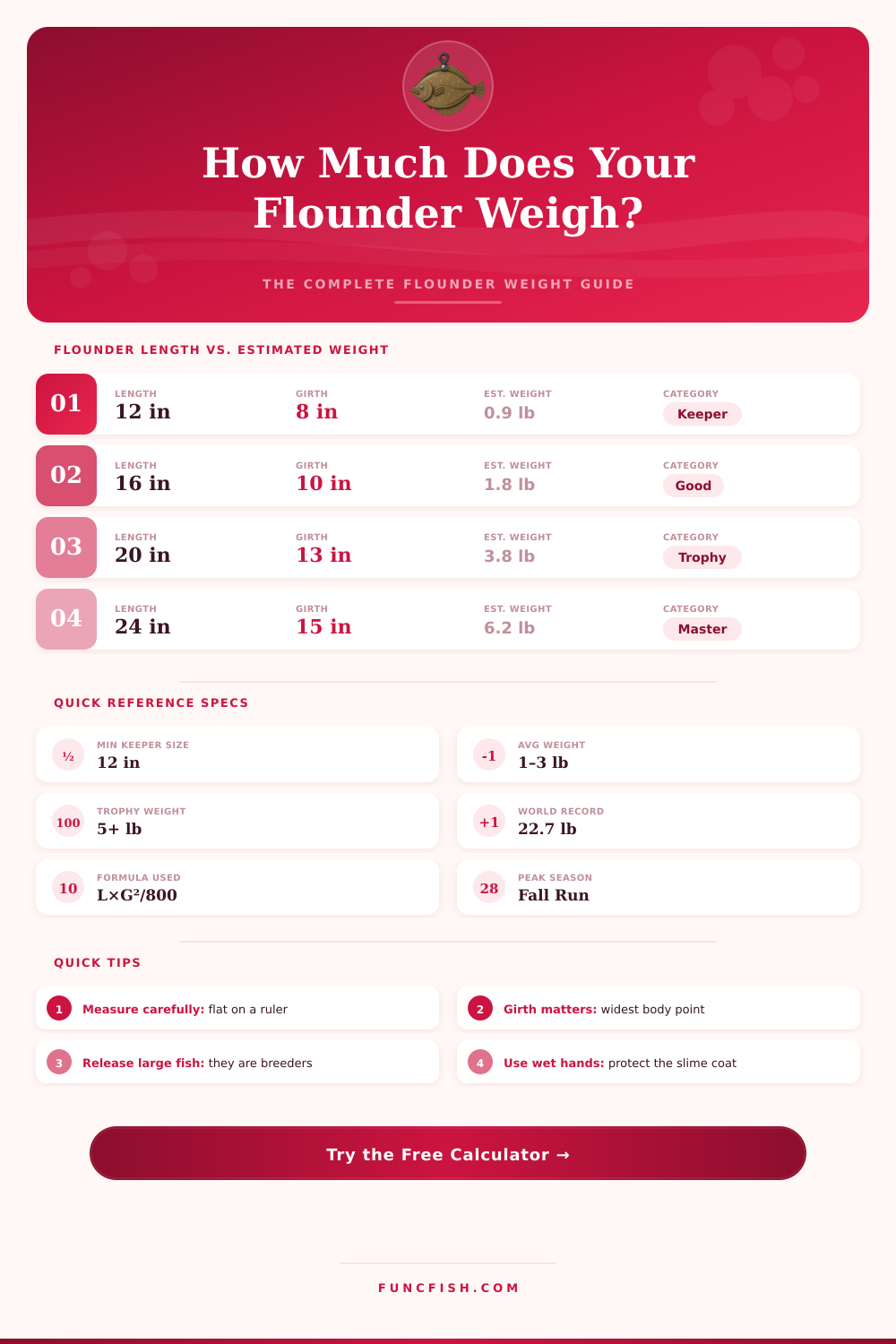
| Length (in) | Length (cm) | Est. Girth (in) | Est. Weight (lb) | Est. Weight (kg) | Category |
|---|---|---|---|---|---|
| 10 | 25.4 | 6.5 | 0.53 | 0.24 | Sub-Legal |
| 12 | 30.5 | 8.0 | 0.96 | 0.44 | Min Keeper |
| 14 | 35.6 | 9.0 | 1.42 | 0.64 | Keeper |
| 16 | 40.6 | 10.5 | 2.21 | 1.00 | Good Keeper |
| 18 | 45.7 | 11.5 | 2.98 | 1.35 | Above Average |
| 20 | 50.8 | 13.0 | 4.23 | 1.92 | Trophy Candidate |
| 22 | 55.9 | 14.0 | 5.39 | 2.44 | Trophy |
| 24 | 61.0 | 15.5 | 7.22 | 3.27 | Master Angler |
| 26 | 66.0 | 16.5 | 8.84 | 4.01 | Tournament Class |
| 28 | 71.1 | 18.0 | 11.34 | 5.14 | Doormat |
| Species | Avg Weight | Max Weight | Avg Length | Formula Divisor | Range |
|---|---|---|---|---|---|
| Southern Flounder | 1–3 lb | 22.7 lb | 12–20 in | 800 | SE USA Coast |
| Summer Flounder (Fluke) | 2–5 lb | 22.3 lb | 14–24 in | 780 | NE USA Atlantic |
| Gulf Flounder | 0.5–2 lb | 6 lb | 10–16 in | 820 | Gulf of Mexico |
| Starry Flounder | 1–4 lb | 20 lb | 12–22 in | 800 | Pacific Coast |
| Winter Flounder | 0.5–2 lb | 7 lb | 10–18 in | 830 | NE USA Atlantic |
| Pacific Halibut | 20–100 lb | 459 lb | 24–60 in | 750 | Pacific/Alaska |
| Fish Weight | Rod Power | Line (lb test) | Hook Size | Leader (lb) |
|---|---|---|---|---|
| Under 1 lb | Ultralight | 4–6 lb | #4 – #2 | 8 lb mono |
| 1–2 lb | Light | 8–10 lb | #2 – #1 | 12 lb mono |
| 2–4 lb | Medium-Light | 10–15 lb | #1 – 1/0 | 15–20 lb mono |
| 4–7 lb | Medium | 15–20 lb | 1/0 – 2/0 | 20–25 lb mono |
| 7–12 lb | Medium-Heavy | 20–30 lb | 2/0 – 3/0 | 30 lb mono/fluoro |
| 12+ lb | Heavy | 30–50 lb | 3/0 – 5/0 | 40–50 lb fluoro |
To fish for flounder successfuly, you have to use a proper weight for your fishing rig. If the weights for your fishing rig is too light for the current, your rig will drift over the flounder. Using too much weight will cause your rig to plow into sea floor or bury the bait in the sand sea floor sediment.
Flounder live on the sand sea floor, so your fishing rig should tap the sand without skip or dragging the bait too deep into the sea floor. The depth of the water and the speed of the current will determine the weight for your fishing rig. The depth of the water will determine the baseline weight for your fishing rig.
How to Pick the Right Weight for Flounder Fishing
However, the current in the water and the speed of the boat while drifting will increase the weight of your fishing rig. For example, a quarter ounce of weight will work for a small currents in ten feet of water. However, if the depth or the current is double, you will need three times the weight to allow your fishing rig to remain in the strike zone.
The type of bait you use will also affect the weight of your fishing rig. Bait that catches more water then other baits requires more weight to allow it to stay on the sea floor. The type of line you use for your fishing rig will also affect the weight you use.
Braided lines are thin and will cut through the current. This feature of braided lines allows fishermen to use less weight with braided lines than with monofilament line. The thicker monofilament lines will bow out in the current, acting like sail for the fishing rig.
Because monofilament lines have more drag than braided lines, you will need more weight to keep fishing rigs with monofilament lines on the sea floor. The type of sea floor you are fishing on will also change the weight of the fishing rigs. If the sea floor has firm sand, you can use lighter weight.
However, if the bottom type is mud, the mud will grip your fishing rig so more weight will be needed. The type of fishing rig you use will also change the weight requirement for your fishing rig. Bucktail jigs will remain high in the water because of the mass of the jig.
Therefore, bucktail jigs will need less lead than other types of fishing rig. For example, Carolina rig use a sliding sinker and a live minnow so the minnow will move creating more drag on the fishing rig. Stand-up jigs can stay off the snags on the sea floor while fishing near the bottom so they are ideal for areas with grass edge.
The type of bait you use, the depth, the current, the line type, the bottom type, and the type of fishing rig will all influence the weight of the fishing rigs you use. The different species of flounder require different type of weights for their fishing rigs. Summer flounder live in deeper structures in the sea so summer flounder allow for more weight choice for the fishermen targeting these species.
However, southern flounder live in shallower marsh area with mud flats so the weight required for these species is light. Winter flounder live in calmer waters and require the use of more gentle movement with their fishing rigs. Lastly, peacock flounder live in the same areas as the summer and southern flounder but require very light weights when fishing for them because the weight will plow through the sand.
Your drifting angle and your fishing goal will also change how much weight you use for your fishing rigs. If you are fishing vertically from a boat or pier, you do not have to consider the sink rate of your weights. If you drift at an angle to the current in the water, the current will stretch your line into a bow.
A bowed fishing line will require more weight to reach the sea floor. Your fishing goal will also change the weight you use. For example, if you are catching picky fish, you will want to use a lightweight fishing rig.
However, if you are establishing a position in a fast current, a heavy fishing rig may be better for your goal. If your fishing line bows away from the bottom, you must use more weight for your fishing rig. However, if your fishing rig is skipping on the sea floor, your weight is too light so you will have to use more weight.
Because you have to use different weights for different species of flounder, you can prepare preset for your weights. For example, if you know that you will be fishing for summer flounder in shallow waters, you can use a bucktail jig for your fishing rig. Additionally, if you are fishing for fish in an inlet with currents, you can use a minnow fishing rig.
You can also use reference table to determine your weights. For example, a fishing rig with a quarter ounce of weight will work for firm sand in a current. However, if you are fishing in mud, you will need a half ounce of weight to maintain the fishing rig on the sea floor.
Additionally, if you use braided lines instead of monofilament lines, you will need less weight for your fishing rig because braided lines will cut through the current with less drag than monofilament lines. If you use the proper weight for the species of flounder you are fishing for, your fishing rig will remain in the strike zone and you will be able to feel the flounder strike your bait.