🎣 Inline Planer Board Lead Length Calculator
Calculate the ideal lead length between your inline planer board and lure for maximum trolling effectiveness
Lead Bonus
Lead Bonus
Lead Bonus
Lead Adj.
Lead Bonus
Lead Bonus
Lead Adj.
Lead Bonus
| Line Type | Stretch | Visibility | Lead Adj. Factor | Best For |
|---|---|---|---|---|
| Monofilament | High (25–30%) | Medium | 1.00x (baseline) | General trolling, walleye |
| Fluorocarbon | Low (5–8%) | Low (near invisible) | 0.95x (slightly shorter) | Clear water, trout, bass |
| Braided Line | Very Low (<1%) | High | 0.85x (shorter lead) | Deep trolling, salmon |
| Lead Core | None | N/A | 0.70x (shorter lead) | Depth control, walleye |
| Single-Strand Wire | None | N/A | 0.65x (much shorter) | Muskie, large lures |
| Copper Wire | None | N/A | 0.68x (shorter lead) | Deep salmon, trout |
| Species | Typical Depth (ft) | Base Lead (ft) | Speed (mph) | Preferred Lure |
|---|---|---|---|---|
| Walleye (Shallow) | 4–12 | 30–50 | 1.3–1.8 | Crawler harness, crankbait |
| Walleye (Deep) | 15–30 | 20–35 | 1.5–2.0 | Bottom bouncer, crankbait |
| Chinook Salmon | 20–60 | 40–80 | 2.0–2.8 | Spoon, plug |
| Coho Salmon | 10–30 | 35–60 | 2.5–3.0 | Spoon, fly |
| Kokanee | 15–40 | 25–45 | 1.5–2.0 | Wedding ring, small spoon |
| Lake Trout | 30–80 | 20–40 | 2.0–2.5 | Stick bait, spoon |
| Striped Bass | 5–20 | 40–70 | 2.5–3.5 | Swimbait, crankbait |
| Northern Pike | 4–15 | 30–55 | 2.0–3.0 | Spoon, large crankbait |
| Muskie | 6–20 | 25–45 | 2.0–2.8 | Large crankbait, swimbait |
| Yellow Perch | 8–25 | 15–30 | 1.0–1.5 | Small spoon, jig |
| Speed (mph) | Speed (km/h) | Shallow Lead (ft/m) | Mid-Depth Lead (ft/m) | Deep Lead (ft/m) |
|---|---|---|---|---|
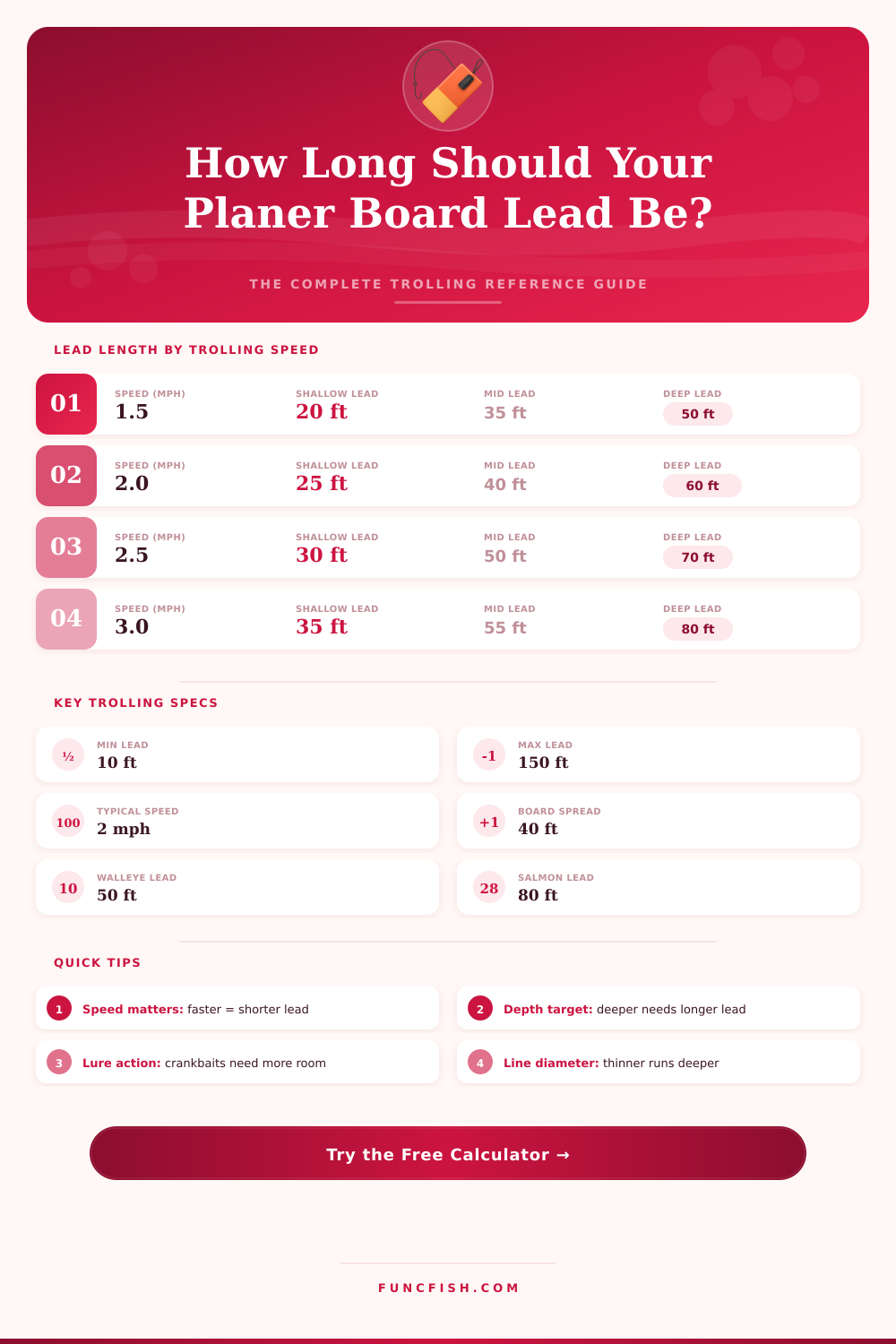
| 1.0 | 1.6 | 15 / 4.6 | 25 / 7.6 | 40 / 12.2 |
| 1.5 | 2.4 | 20 / 6.1 | 35 / 10.7 | 55 / 16.8 |
| 2.0 | 3.2 | 30 / 9.1 | 45 / 13.7 | 65 / 19.8 |
| 2.5 | 4.0 | 35 / 10.7 | 55 / 16.8 | 80 / 24.4 |
| 3.0 | 4.8 | 40 / 12.2 | 60 / 18.3 | 90 / 27.4 |
| 3.5 | 5.6 | 45 / 13.7 | 70 / 21.3 | 100 / 30.5 |
| 4.0 | 6.4 | 50 / 15.2 | 75 / 22.9 | 110 / 33.5 |
Lead length are the distance between the planer board clip and the lure. Lead length is vital to understand because lead length determine how far the lure is from the planer board and the boat. By understanding lead length, angler can control the distance between each of the lures that is being used.
By setting the correct lead length, the lure will remain in its designated lanes and will not become entangled with each other. Lead length can also have an impact on how much the boat affects the lure. If the lead length is more short, the lure will be closer to the boat.
How to Set Lead Length for Fishing Lures
However, because it is closer to the boat, the boat can affect the lure with the noise and the wake that it creates. If the lead length is longer, the lure will be further from the boat. However, this will help the lure to avoid the shadow that the boat create as well as the noise that the boat creates.
If the water is very clear, using a long lead length will help the lures to avoid being seen by the fish. However, if the water is murkily, the short lead length will keep the lures closer to the boat where the fish are less likely to see it. The type of lure that you use will require a specific lead length.
For example, crankbait require a moderate lead length because they have a specific dive curve to there lures. Spoons require a longer lead length because they require more line to allow them to move through the water free. Lastly, crawler harness require a shorter lead length because they produce heavy vibration that the fish can feel even if the lead length is shorter.
The speed of the boat will impact the lead length that is use. If the boat is moving at a faster speed, the fishing line will bow less. Therefore, the angler will have to increase the lead length to maintain the depth that the angler desire for the bait.
If the boat is moving at a slower speed, the fishing line will bow more. Therefore, the angler can decrease the lead length. Water conditions will also impact the lead length that is set for the fishing spread.
If the water has chop on the surface, the lead length will have to be shorter to compensate for the movement of the boat on the water. If the water is calm, the lead length can be longer. The position of the planer board will also impact the lead length of the spread.
If the planer boards are positioned in the inside of the spread, they will need to have the shortest lead length. This is because the planer boards should stay close to the boat to avoid getting into the weed. If the planer boards are in the outside of the spread, the lead length should be the longest.
This will help to create a spread of the lures. If the planer boards are in the middle of the spread, the lead length will be somewhere in the middle of the other two length. The type of fishing line that is use will have an effect upon the lead length.
If braided line is used, it will have no stretch. Therefore, the lead length will have to be longer. Monofilament line have some stretch so there will be a buffer if the fish begin to pull on the line.
Leadcore lines will sink more fast than the other lines so the lead length can be shorter. Snap weights are used to adjust for lead length and depth. Using snap weight allow anglers to clip the snap weight onto the fishing line to help the lure reach the desired depth.
This allows angler to adjust for depth without changing the entire fishing line. Placing the snap weight closer to the lure will create a more subtle change in depth. However, placing the snap weight further from the lure will create a more aggressive change in depth for the lures.
It is impossible to find the perfect number for lead length because a number of variable will impact this length. For instance, the current in the water will change the lead length that is required. Additionally, the wind will also change the lead length for the lures.
By observing the fishing line and using sonar to monitor the movement of the lures, the anglers can adjust the lead length. If the lures are too close together, the lead length should of been increased. If the lures are not reaching the proper depth, the lead length should be adjusted to account for this.