🐟 Drift Net Fishing Calculator
Calculate net length, coverage area, mesh size, buoy spacing, and total net weight for any drift net setup
lb/ft (dry)
lb/ft (dry)
lb/ft (dry)
lb/ft (dry)
lb/ft (dry)
lb/ft (dry)
lb/ft (dry)
lb/ft (dry)
| Species | Mesh Size (in) | Mesh Size (cm) | Rec. Net Depth (ft) | Rec. Net Depth (m) | Avg. Target Weight (lb) |
|---|---|---|---|---|---|
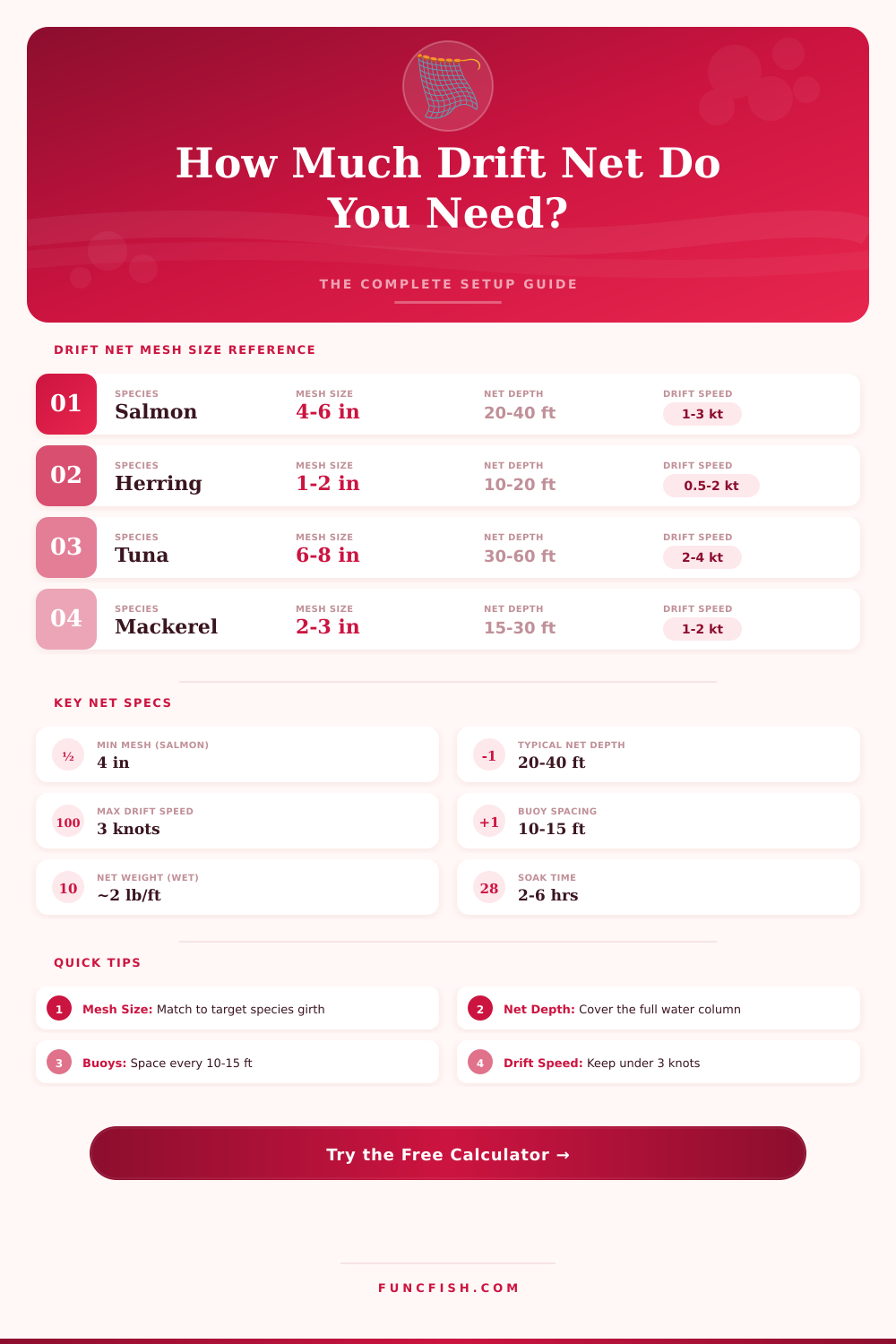
| Pacific Salmon | 4–6 | 10–15 | 20–40 | 6–12 | 8–30 |
| Atlantic Herring | 1–2 | 2.5–5 | 10–20 | 3–6 | 0.2–0.8 |
| Bluefin Tuna | 6–8 | 15–20 | 30–60 | 9–18 | 200–1000 |
| Atlantic Mackerel | 2–3 | 5–7.5 | 15–30 | 4.5–9 | 0.5–2.5 |
| Atlantic Cod | 3–5 | 7.5–12.5 | 20–40 | 6–12 | 5–50 |
| Sardine | 0.75–1.25 | 2–3 | 8–15 | 2.4–4.5 | 0.1–0.4 |
| Pacific Halibut | 5–7 | 12.5–18 | 25–50 | 7.5–15 | 20–200 |
| Striped Bass | 3–4.5 | 7.5–11.5 | 15–30 | 4.5–9 | 5–50 |
| Lake Trout | 2–3.5 | 5–9 | 10–25 | 3–7.5 | 2–20 |
| Striped Mullet | 1.5–2.5 | 4–6 | 10–20 | 3–6 | 0.5–4 |
| Material | Buoyancy | Strength Rating | Wet Weight Multiplier | UV Resistance | Best Use |
|---|---|---|---|---|---|
| Monofilament Nylon | Sinks | High | 1.15x | Moderate | Gill nets, clear water |
| Multifilament Nylon | Sinks | Very High | 1.20x | Moderate | General drift netting |
| Polyethylene (PE) | Slight sink | High | 1.05x | Good | Deep water, rough seas |
| Polyester (Dacron) | Sinks | Very High | 1.10x | Excellent | Long soak, offshore |
| Polypropylene | Floats | Medium | 0.95x | Poor | Surface drift, inshore |
| Dyneema / Spectra | Sinks | Exceptional | 1.02x | Excellent | High-strength, light nets |
| Cotton | Sinks | Low | 1.60x | Poor | Traditional, freshwater |
| Hemp | Sinks | Low-Medium | 1.80x | Poor | Traditional, subsistence |
| Net Length | Buoy Spacing | Buoys Needed | Coverage Area (sq ft) | Coverage Area (sq m) |
|---|---|---|---|---|
| 200 ft (61 m) | 10 ft (3 m) | 21 | 4,000 | 372 |
| 300 ft (91 m) | 12 ft (3.7 m) | 26 | 7,500 | 697 |
| 500 ft (152 m) | 12 ft (3.7 m) | 43 | 12,500 | 1,161 |
| 750 ft (229 m) | 15 ft (4.6 m) | 51 | 22,500 | 2,090 |
| 1000 ft (305 m) | 15 ft (4.6 m) | 68 | 35,000 | 3,252 |
| 1500 ft (457 m) | 20 ft (6.1 m) | 76 | 60,000 | 5,574 |
Drift netting require that a person manage several physical variable to ensure that the drift net performs correctly. For instance, the leader of the drift net not being balance against the lift of the floatline can decrease drift net efficiency. The floatline and the leadline create vertical force on the drift net; if the net isnt vertical, the shape of the mesh of the drift net will change.
A change in the shape of the mesh will reduce the efficiency of the drift net. Another physical variable to manage is the hanging ratio of the drift net. If the drift net is too tightly hung, the diamond of the mesh will open too wide, allowing fish to pass through the mesh.
Things That Affect Drift Nets
If a drift net is too loosely hung, it will form deep pockets in the mesh that is likely to become entangled in the fishing operation. Another physical variable to manage is the size of the mesh in the drift net. You should choose the size of the mesh to match the girth of the fish that you are attempting to catch with the drift net.
If the mesh is too large relative to the size of the fish, the fish will be unable to push their heads into the mesh but will be unable to pull their entire body through the mesh. For example, if the fish that you are targeting are herring, which have small girts, you will need to use a small mesh size in the drift net. On the other hand, if the targeted species have larger girts, like tuna, the mesh size will need to be larger.
Another choice that you must make is between using monofilament twine or multifilament nylon twine in the mesh of the drift net. If the water that you are fishing in is clear, the monofilament twine will be nearly invisible to the fish. If the water is not clear, multifilament nylon twine will be more supple so that it will bend different than the current in the water.
Additionally, multifilament nylon twine will create more drag on the drift net when moving through the water; therefore, you will need more float lift to ensure that the multifilament nylon twine does not collapse within the current. The soak time of the drift net also have to be controlled. For drift nets, there is a specific period in which the drift net will be most efficient at catching fish.
If the soak time is too great, however, the rate at which fish are being caught will decline. If the soak time is too long, predators that have become intrigued by the fish that is being held in the drift net may cause the drift net to be lost. Additionally, the quality of the fish may decline if the soak time is too great.
Tools can be used to estimate the catch effort index of the drift net. The catch effort index use variables like the fishing area, soak time, and the selectivity score of the drift net to indicate whether the drift net is optimally set up for the species of fish that live in that area. Visibility of the water in which the drift net is being deployed can also affect the interaction between the fish and the drift net.
In water that is turbid or green with algae growth, the fish will not be likely to see the drift net. Thus, the turbid water will increase the encounter rate of the fish to the drift net. In clear water, however, the fish will be likely to see the drift net; in this case, you should use thin and transparent twine for the drift net.
Thus, visibility of the water affect the drift net in that the visibility will affect how the fish perceive the drift net. The speed of the current in which the drift net will be cast can affect both the drift track of the drift net and the drag of the drift net. At high speeds, the drift net will cover more distance.
Additionally, high speeds in the current will increase the drag on the webbing of the drift net. The increased drag on the webbing will increase the stress on the rigging of the drift net. Thus, you must weight the drift net with a heavy leadline to keep the drift net on the bottom of the ocean floor; additionally, more buoyancy will be necessary to ensure that the drift net does not dip below the surface of the water.
If the leadline is not heavy enough for the current speed, the drift net may bow; this bowing will distort the shape of the mesh of the drift net. Thus, if the current speed is too great, the drift net may bow and the mesh may distort, decreasing the efficiency of the drift net.