🎣 Landing Net Size Calculator
Find the ideal hoop diameter, net depth & handle length for your target species
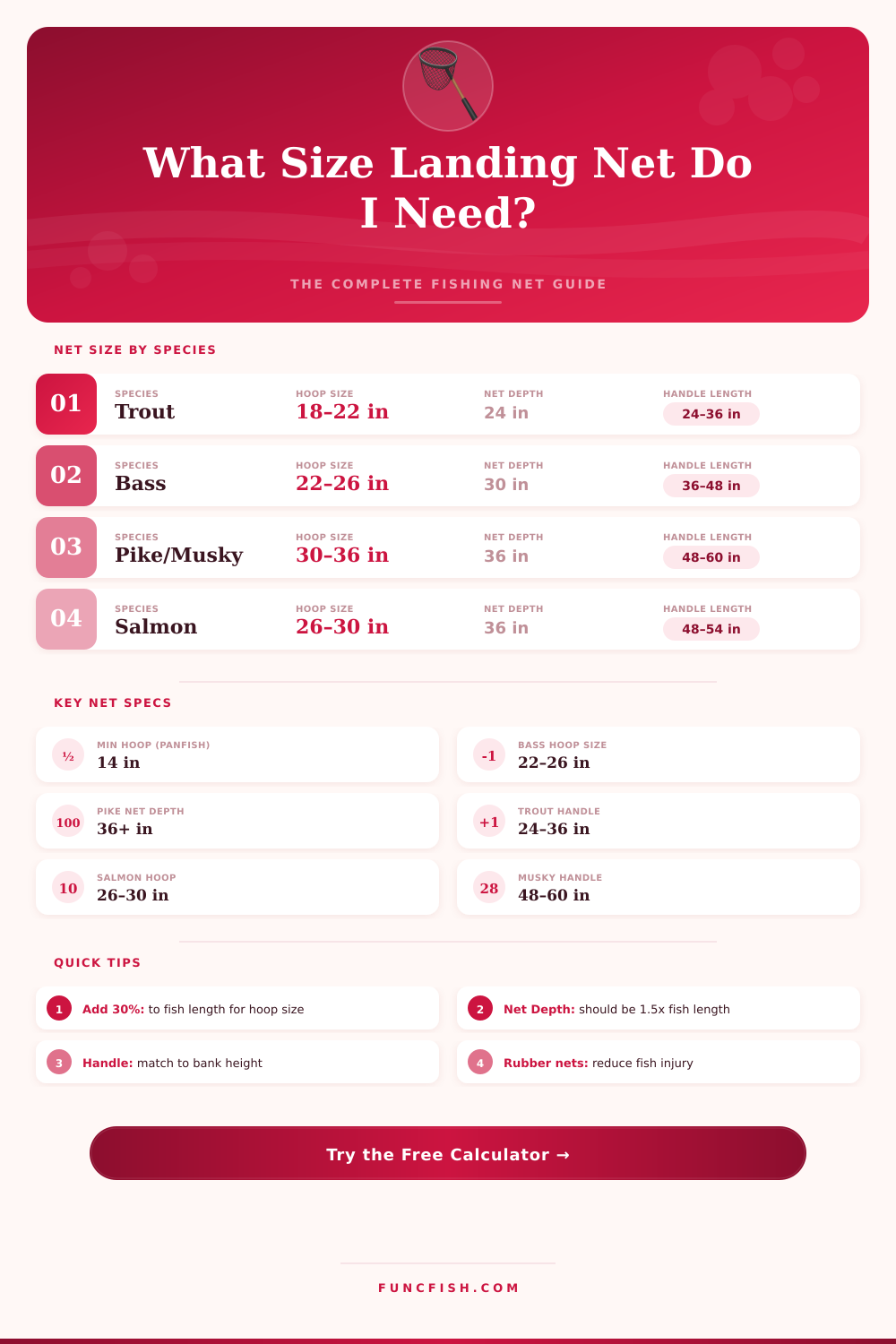
| Species | Avg Length | Hoop Diameter | Net Depth | Handle Length | Rec. Material |
|---|---|---|---|---|---|
| Panfish / Bluegill | 6–10 in (15–25 cm) | 14–16 in (36–41 cm) | 18–20 in (46–51 cm) | 18–24 in (46–61 cm) | Fine Mesh / Rubber |
| Rainbow Trout | 12–22 in (30–56 cm) | 18–22 in (46–56 cm) | 24–28 in (61–71 cm) | 24–36 in (61–91 cm) | Rubber / Knotless |
| Largemouth Bass | 14–22 in (36–56 cm) | 22–26 in (56–66 cm) | 28–32 in (71–81 cm) | 36–48 in (91–122 cm) | Rubber / Coated |
| Walleye | 16–26 in (41–66 cm) | 22–28 in (56–71 cm) | 28–36 in (71–91 cm) | 36–48 in (91–122 cm) | Rubber / Coated |
| Salmon / Steelhead | 24–36 in (61–91 cm) | 26–32 in (66–81 cm) | 32–40 in (81–102 cm) | 48–60 in (122–152 cm) | Rubber / Knotless |
| Northern Pike | 24–40 in (61–102 cm) | 30–36 in (76–91 cm) | 36–42 in (91–107 cm) | 48–60 in (122–152 cm) | Coated / Poly |
| Musky | 36–54 in (91–137 cm) | 36–48 in (91–122 cm) | 42–54 in (107–137 cm) | 54–72 in (137–183 cm) | Rubber / Coated |
| Common Carp | 18–36 in (46–91 cm) | 28–36 in (71–91 cm) | 36–48 in (91–122 cm) | 48–60 in (122–152 cm) | Rubber / Knotless |
| Striped Bass | 20–36 in (51–91 cm) | 28–36 in (71–91 cm) | 32–42 in (81–107 cm) | 42–60 in (107–152 cm) | Nylon / Poly |
| Catfish (Channel) | 16–30 in (41–76 cm) | 24–32 in (61–81 cm) | 30–40 in (76–102 cm) | 36–54 in (91–137 cm) | Poly / Nylon |
| Fish Length | Min Hoop (1.25x) | Std Hoop (1.35x) | Comf Hoop (1.5x) | Hoop (cm) |
|---|---|---|---|---|
| 8 in (20 cm) | 10 in | 11 in | 12 in | 28–30 cm |
| 12 in (30 cm) | 15 in | 16 in | 18 in | 38–46 cm |
| 16 in (41 cm) | 20 in | 22 in | 24 in | 51–61 cm |
| 20 in (51 cm) | 25 in | 27 in | 30 in | 64–76 cm |
| 24 in (61 cm) | 30 in | 32 in | 36 in | 76–91 cm |
| 30 in (76 cm) | 38 in | 41 in | 45 in | 97–114 cm |
| 36 in (91 cm) | 45 in | 49 in | 54 in | 114–137 cm |
| 42 in (107 cm) | 53 in | 57 in | 63 in | 135–160 cm |
| Location | Bank Height | Min Handle | Rec. Handle | Handle (cm) |
|---|---|---|---|---|
| Wading (Stream) | 0 ft (water level) | 18 in | 24–30 in | 61–76 cm |
| Bank / Low Shore | 1–2 ft (0.3–0.6 m) | 24 in | 30–36 in | 76–91 cm |
| Kayak / Canoe | 1–2 ft (0.3–0.6 m) | 20 in | 24–36 in | 61–91 cm |
| Bass Boat / Deck | 2–3 ft (0.6–0.9 m) | 36 in | 48–54 in | 122–137 cm |
| Bank / High Shore | 3–5 ft (0.9–1.5 m) | 48 in | 54–72 in | 137–183 cm |
| Pier / Dock | 5–8 ft (1.5–2.4 m) | 60 in | 72–96 in | 183–244 cm |
| Surf / Jetty | 4–6 ft (1.2–1.8 m) | 54 in | 60–84 in | 152–213 cm |
When selecting a landing net for a fishing operation, a fish farmer must consider the size of the fishes that will be caught, the environment where the fish will be caught, and the type of mesh that can be used on the landing net. A landing net is a tool that are used to secure the caught fish. For these reasons, the farmer must size the landing net correctly so that he can effectively move the fish from the catching environment into the landing net.
Should the landing net be too small for the fish, the fish will escape the landing net. However, if the landing net is too large, the farmer will have issues handling the landing net with the fish within it. The width of the landing net hoop is one of the primary factor to consider when selecting a landing net.
How to Choose the Right Landing Net
The width of the hoop should be based off the girth of the fish that will be landed rather than the length of the fish. The girth of the fish is the measurement of the fish from side to side at its widest point, and the landing net hoop should be wide enough to allow for the girth of the fish and the width of the fish fin. For example, a fish with a 14-inch girth will require a landing net hoop that is at least 22 inch in diameter to allow the fish to completely slide into the net.
Additionally, the farmer should consider the depth of the landing net bag. Bags with a deeper mesh are appropriate for species that will move within the bag, while bags with a shallower mesh is used for situations in which the fish will be quickly lift out of the water. The length of the handle of the landing net is another factor that should be considered when selecting a landing net.
This length will determine the distance between the fish farmer and the fish. For example, if a farmer is fishing from a bank or pier, a longer handle will allow the fisherman to reach the fish. However, if the fisherman is fishing from a boat, a shorter handle will be of more benefit to the fisherman.
For instance, a fisherman on a kayak may want a shorter landing net handle to make it more easy to store the landing net on the kayak, but a fisherman fishing from a pier may require a longer handle to reach the fish from the pier. The material of the mesh of the landing net can impact the way in which a person handles the caught fish and manages the fishing lines. Rubber mesh is one of the materials that is commonly used to construct the landing nets, since rubber mesh allow for the hooks to slide out of the net easily, and sheds any water or slime that comes from the caught fish.
Knotless mesh is another material that can be used for the landing net, as people consider the knotless mesh to be gentler on the scales of the fish if the goal is to catch and release the fish. Fishermen who need to drain the water from their landing net quickly may use coated nylon mesh, though the coating on the mesh may not be as gentle on the fish as the knotless mesh option. Depending on the environment in which a person is fishing, the configuration of the landing net may need to be different.
For instance, if a person is fishing from a boat, the fish may be landed with a compact landing net and one that has a short handle, as the boat will provide a stable platform from which to fish. In contrast, a person who is fishing from the surf or a pier will require a landing net whose handle is 18 inches or longer, as these location tend to create a gap between the fisherman and the land. Similarly, a person who is wade fishing may require a landing net whose bag is relatively shallow, so that the current does not pull the net to a position that is difficult for the fisherman to control.
Many fishermen make mistake when they select their landing net. For instance, many people dont consider the girth of the fish that they are catching in addition to the length of the fish. Additionally, many people select landing nets whose handles are too short to effectively land their fish.
Finally, another mistake that many people make is to select a landing net whose bag is too shallow for the type of fish that are being landed; the fish will flop out of the net. To avoid these mistake, round the size of the landing net hoop up to the next largest size if the fins of the fish are tight. You should of checked the fishes size before buying.
It can be alot of work to find the right one, but your going to want the right equipment for the job. Dont let the fish escape because of a moddern mistake.