🐟 Bighead Carp Weight Calculator
Estimate bighead carp weight from length & girth — imperial and metric supported
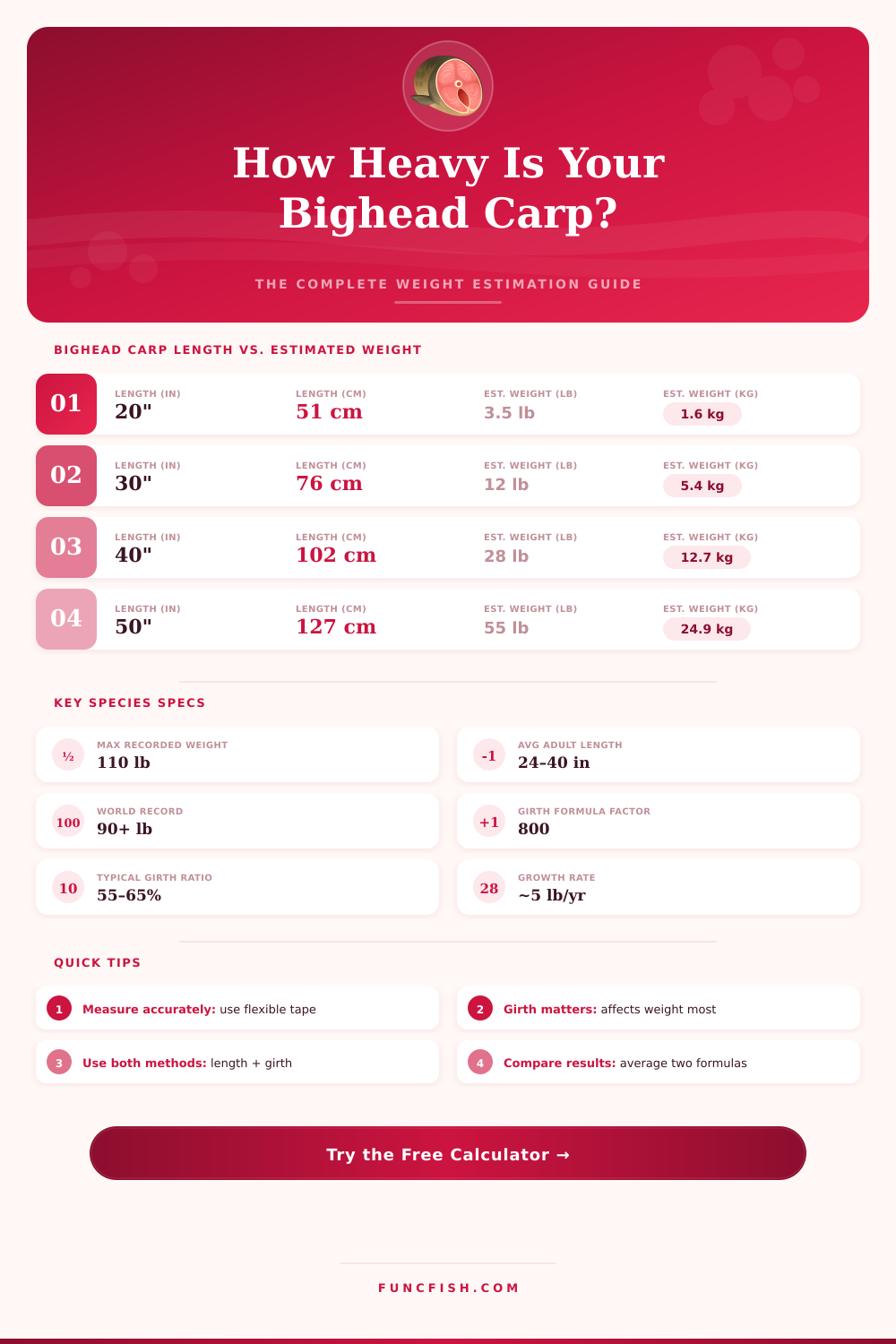
| Length (in) | Length (cm) | Est. Weight (lb) | Est. Weight (kg) | Typical Girth (in) |
|---|---|---|---|---|
| 12" | 30 cm | 0.8 lb | 0.36 kg | 7 in |
| 16" | 41 cm | 2.0 lb | 0.91 kg | 9 in |
| 20" | 51 cm | 3.5 lb | 1.59 kg | 11 in |
| 24" | 61 cm | 6.0 lb | 2.72 kg | 13 in |
| 28" | 71 cm | 9.5 lb | 4.31 kg | 16 in |
| 32" | 81 cm | 14 lb | 6.35 kg | 18 in |
| 36" | 91 cm | 20 lb | 9.07 kg | 21 in |
| 40" | 102 cm | 28 lb | 12.7 kg | 24 in |
| 44" | 112 cm | 38 lb | 17.2 kg | 26 in |
| 48" | 122 cm | 50 lb | 22.7 kg | 29 in |
| 52" | 132 cm | 64 lb | 29.0 kg | 31 in |
| 56" | 142 cm | 80 lb | 36.3 kg | 34 in |
| Species | Avg Weight | Max Weight | Avg Length | Formula Factor |
|---|---|---|---|---|
| Bighead Carp | 20–40 lb | 110 lb | 24–40 in | 800 |
| Silver Carp | 15–30 lb | 60 lb | 20–36 in | 820 |
| Grass Carp | 15–35 lb | 100 lb | 24–48 in | 810 |
| Black Carp | 25–50 lb | 150 lb | 30–48 in | 790 |
| Common Carp | 5–20 lb | 90 lb | 14–32 in | 800 |
| Fish Weight | Line Weight | Hook Size | Rod Power | Drag Setting |
|---|---|---|---|---|
| Under 10 lb | 10–15 lb | #2 – 1/0 | Medium | 3–5 lb |
| 10–20 lb | 17–25 lb | 1/0 – 3/0 | Med-Heavy | 5–8 lb |
| 20–40 lb | 25–40 lb | 3/0 – 5/0 | Heavy | 8–12 lb |
| 40–60 lb | 40–65 lb | 5/0 – 7/0 | X-Heavy | 12–18 lb |
| 60+ lb | 65–100 lb | 7/0 – 9/0 | XX-Heavy | 18–25 lb |
The length-girth formula (Length × Girth² ÷ 800) is significantly more accurate than length-only estimates. A bighead carp's deep, rounded body shape means girth contributes more to weight than length alone. Always measure girth at the widest point — just behind the pectoral fins.
Bighead carp in plankton-rich reservoirs tend to be 10–20% heavier than river fish of the same length. Use the "Good Condition" or "Excellent" multiplier for fish from nutrient-rich environments. River fish fighting strong current are often leaner — use "Lean" or "Average" for more realistic estimates.
To accurately estimate the weight of a bighead carp, individuals must gather more then an length of the bighead carp. Many individuals will attempt to estimate the weight of the bighead carp by measuring the length of the bighead carp alone. However, this is an insufficient measurement to determine the weight of the bighead carp.
The weight of a bighead carp can vary based off the body shape of that bighead carp. For example, a bighead carp with a lean body and torpedo shape will weigh less than a bighead carp with a bulky and deep bodied shape. To obtain an accurate estimation of the weight of a bighead carp, individuals should measure the length and the girth of the bighead carp.
How to Estimate the Weight of a Bighead Carp
The girth of a bighead carp is a critical measurement to understand the weight of the fish. The girth are used to measure the volume of a bighead carp at its deepest part of the body. By using a weight calculator for bighead carp, that calculator will use the girth of the bighead carp to determine the weight of that fish.
By measuring the girth of the bighead carp at the deepest part of its belly, individuals can gain further information about the physical condition of that bighead carp. For example, if the girth of the bighead carp is large, it likely contains alot of food and the bighead carp is well fed. In contrast, a bighead carp with a small girth may have little food and be thin.
Thus, measuring the girth of a bighead carp will change the weight estimation because the girth will reflect the actual mass of that bighead carp. One factor that affects the weight of a bighead carp is the habitat where that bighead carp live. For example, bighead carp that live in areas with a strong current in the river will have a lean body to allow the bighead carp to move through the water more efficient.
However, bighead carp that live in a reservoir with abundant plankton will eat more food and gain more weight. The weight calculator takes into account the habitat where the bighead carp lives. Another measurement that can impact the weight of a bighead carp is the head of the bighead carp.
Bighead carp have specific proportions of head to body. However, the proportions can differ between bighead carp. For example, bighead carp with a broader head and deep shoulders will have a more robust body.
Thus, bighead carp with a large head will weigh more than bighead carp with a smaller head. By measuring the width and depth of the head, individuals can calculate the head-body index of that bighead carp. This measurement can provide a second estimation of the bulk of the bighead carp.
It is often difficult for an individual to obtain accurate measurements of a bighead carp. For example, it is difficult for an individual to hold the bighead carp still on the bank of a river. Additionally, if an individual measures the bighead carp using a tape measure that slips on the bighead carps body or if the length of the bighead carp is estimated from a photograph, there will be a margin of error in that measurement.
To account for this margin for error, the bighead carp weight calculator will provide an individual with a range of possible weight for the bighead carp instead of a specific weight. A range of weights is more accurate for a bighead carp in the field than a specific weight for that bighead carp. The gear used to handle the bighead carp may also relate to the weight of that bighead carp.
For example, if an individual catches a bighead carp with small gear, the gear may stress the bighead carp. Additionally, small gear may not be able to contain the bighead carp, making it difficult to get an accurate measurement of the bighead carp’s weight. Gear such as a boat cradle or a two person lift may be needed to safely handle the bighead carp.
Additionally, the gear that an individual selects should relates to the weight of the bighead carp that is being handled. Overall, the purpose of measuring a bighead carp is to determine its condition. A high score for the condition of the bighead carp indicates that the water where the bighead carp lives is healthy and contains abundant food for that bighead carp.
For example, if an individual sees a bighead carp with a bulky body and containing roe, they can determine that the bighead carp has gained alot of weight during the fishing season. Thus, to gain an informed estimation of the weight of a bighead carp, individuals should measure the length, girth, and the head of that bighead carp. Through measuring these specific features of the bighead carp, individuals will have a better understanding of the weight of the bighead carp.