🐟 Bullhead Catfish Weight Calculator
Estimate bullhead catfish weight from length & girth — Black, Yellow & Brown Bullhead species supported
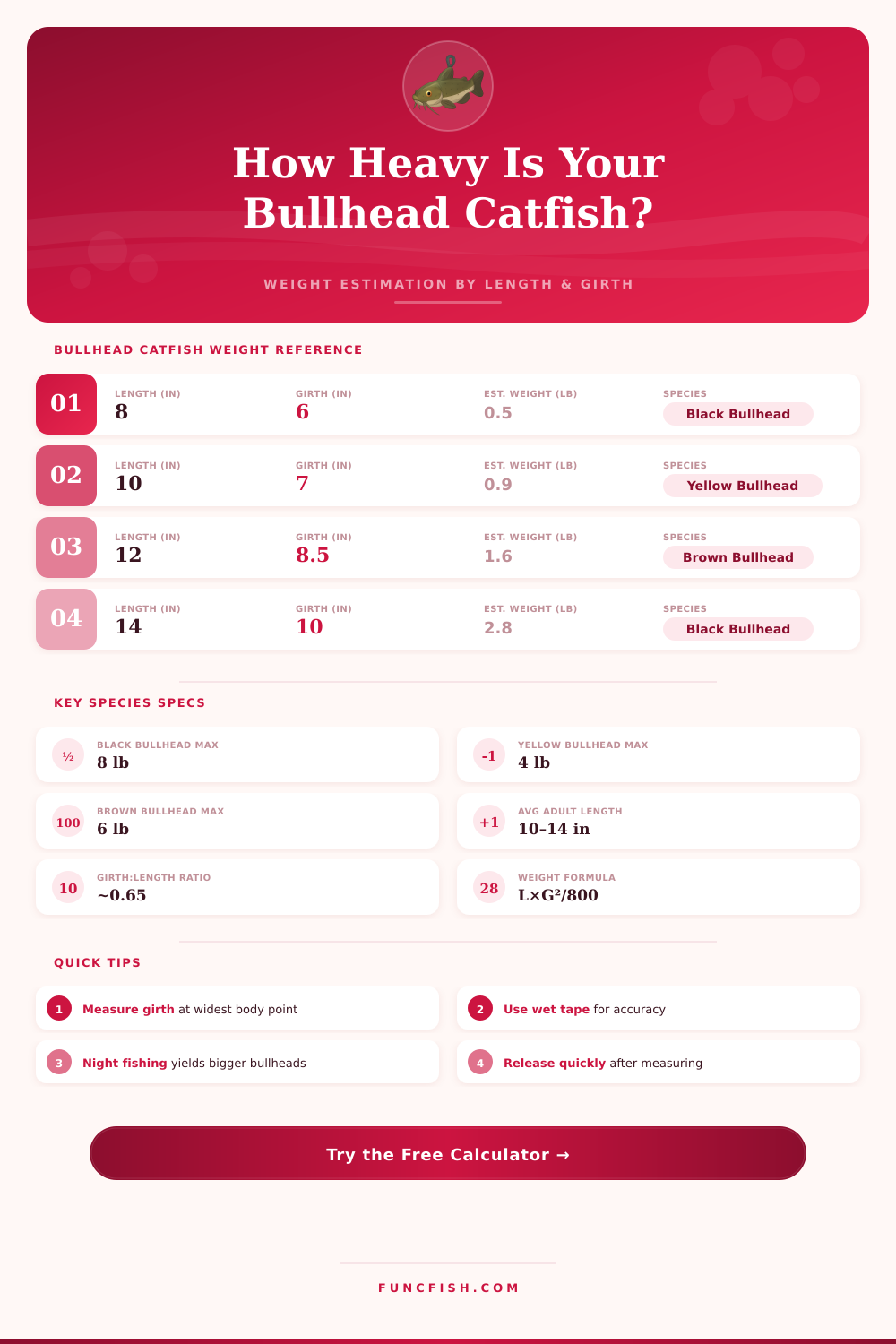
| Length (in) / (cm) | Est. Girth (in) | Black Bullhead (lb/kg) | Yellow Bullhead (lb/kg) | Brown Bullhead (lb/kg) |
|---|---|---|---|---|
| 6" / 15.2 cm | 4.5" | 0.2 / 0.09 kg | 0.2 / 0.09 kg | 0.2 / 0.09 kg |
| 8" / 20.3 cm | 6.0" | 0.5 / 0.23 kg | 0.4 / 0.18 kg | 0.4 / 0.18 kg |
| 10" / 25.4 cm | 7.0" | 0.9 / 0.41 kg | 0.8 / 0.36 kg | 0.8 / 0.36 kg |
| 12" / 30.5 cm | 8.5" | 1.6 / 0.73 kg | 1.4 / 0.64 kg | 1.5 / 0.68 kg |
| 14" / 35.6 cm | 10.0" | 2.8 / 1.27 kg | 2.5 / 1.13 kg | 2.6 / 1.18 kg |
| 16" / 40.6 cm | 11.5" | 4.2 / 1.91 kg | 3.8 / 1.72 kg | 4.0 / 1.81 kg |
| 18" / 45.7 cm | 13.0" | 6.1 / 2.77 kg | — | 5.5 / 2.49 kg |
| 20" / 50.8 cm | 14.5" | 8.0 / 3.63 kg | — | 6.0 / 2.72 kg |
| Species | Typical Length | Weight Range | Habitat | Formula Factor | Condition Factor K |
|---|---|---|---|---|---|
| Black Bullhead | 8–18 in (20–46 cm) | 0.5–8 lb (0.2–3.6 kg) | Ponds, slow rivers | 800 | 1.0 baseline |
| Yellow Bullhead | 8–15 in (20–38 cm) | 0.3–4 lb (0.1–1.8 kg) | Weedy ponds, streams | 850 | 0.92 (slimmer) |
| Brown Bullhead | 8–18 in (20–46 cm) | 0.4–6 lb (0.2–2.7 kg) | Lakes, ponds, reservoirs | 820 | 0.96 (mid-range) |
| Condition | Season | Weight Multiplier | Notes |
|---|---|---|---|
| Excellent | Summer | 1.08 | Peaked feeding, maximum fat stores |
| Excellent | Fall | 1.04 | Still fattening before winter |
| Good | Summer | 1.00 | Baseline estimate |
| Good | Spring | 0.97 | Pre-spawn, slightly lighter |
| Fair | Spring | 0.91 | Post-spawn recovery |
| Fair | Winter | 0.88 | Reduced metabolism |
| Poor | Winter | 0.82 | Extended cold, minimal feeding |
| Poor | Any | 0.80 | Disease, stress, or spawned out |
To estimate the weight of a bullhead, individuals will need to consider more than the length of the bullhead. Bullheads of different species will have different body shape and sizes, so estimating the weight of bullheads based off length alone is inaccurate. Instead, individuals can use the girth of the bullhead as a more important metric for estimating the weight of bullheads.
Additionally, individuals can use a calculator to process these dimension for estimating the weight of bullheads, as it can handle the math calculation for individuals instead of having to memorize the growth coefficient of each species of bullhead. Bullhead species will also need to be identified, as there are several species of bullheads. For instance, brown bullheads will be heavier than other species of bullheads of the same length.
How to Estimate Bullhead Weight
Black bullheads will have weight in the middle of other bullhead species. Yellow bullhead will be the slimmest of bullhead species, so the weight of a yellow bullhead will be less than a brown bullhead of the same length. If individuals attempts to estimate the weight of a yellow bullhead by measuring the length and applying the coefficients for brown bullheads, they will overestimate the weight of the bullhead.
Each species has different body proportion to allow them to survive in there different environment. The weight of bullheads can also change based upon the condition of their belly. Bullheads who have eaten food will weigh more than bullheads who have not eaten food.
Additionally, female bullheads who are carrying egg will weigh more than female bullheads who have already spawned their eggs. Thus, individuals must remember that the weight of bullheads can change, so it isnt a static number. Bullheads live in specific environment that can affect their weight.
Bullheads who live in ponds that contain many nutrient may have more body fat and weigh more than bullheads who live in drainage ditches. The nutrient rich ponds contain more calories for bullheads. Additionally, water temperature can affect the weight of the bullheads in that water.
Bullheads that live in cold water may weigh less than bullheads that live in warmer water, as bullheads in warm water are the bulkiest due to the breeding season for bullheads. Other factor to consider are the accuracy of the measurements of the bullhead. For instance, if individuals are using a professional measuring board and a tape measure, the measurement will be accurate.
However, using a photo or memory to measure the bullhead will result in less accurate measurement. Thus, the confidence in measuring the bullhead allows individuals to account for inaccuracy in the measurement of bullheads. Bullheads will need to be matched to the correct fishing gear based upon their weight.
Using gear that is too heavy than the bullheads weight is unnecessary, while gear that is too light may result in the loss of the bullhead. Thus, reference table allow individuals to select the proper size of the hook and the line strength for bullheads of certain weight. Finally, knowing the weight of bullheads allows individuals to document the bullhead as a fact.
Additionally, knowing the weight of bullheads will allow individuals to understand the health of the bullhead ecosystem.