
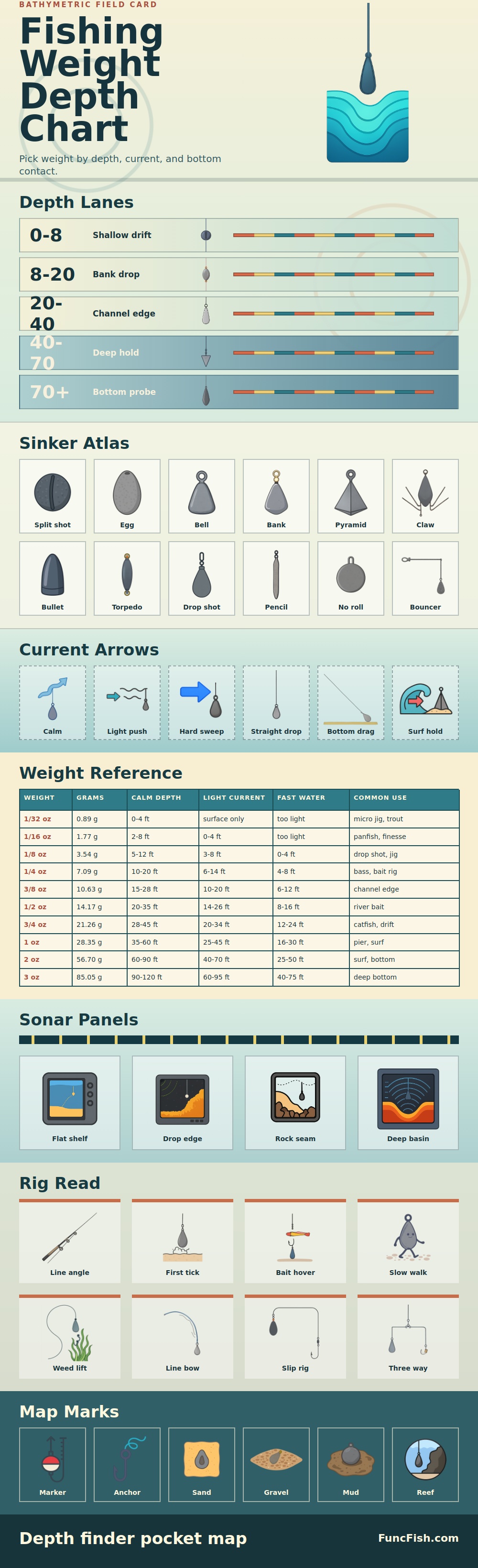
Bottom fishing require you to choose a sinker weight that match the depth of the water and the speed of the current moving through it. If the sinker is too light for the strength of the current, the current will move the sinker and the bait away from bottom of the water. If the sinker is too heavy for the depth of the water, the sinker will bury itself in the bottom or prevent the fisherman from feeling the fish.
Using the correct weight of sinker will allow the bait to remain near the bottom where the fish live. The fisherman should use which types of sinker weight the depth of the water will determine. If the depth of the water is less than eight feet, then the fisherman can use small split shot sinkers because they dont easily move in shallow water.
How to Pick the Right Sinker Weight
For depths of around twenty feet, an egg sinker will allow the bait to move along the bottom of the water where fish live rather than get caught on the bottoms decoration. For depths of seventy feet or more, heavy torpedo sinkers and pyramid sinkers can reach deep into the water and remain in place on the bottom. The speed of the current in the water will also determine the type of sinker the fisherman should use.
In calm water, a light sinker will allow the bait to easy reach the bottom. In fast moving currents, however, the light sinker will cause the fishing line to bow when the current moves through the water. This will cause the bait to move away from the bottom where the fish lives.
In these cases, a heavy sinker will help to keep the bait in place in fast moving currents. Pyramid sinkers will work well in these situation because their shape allow them to dig into sand on the bottom of lakes and rivers and remain vertical. Finally, the composition of the bottom of the lake or river will also determine the type of sinker the fisherman should use.
If the bottom is compose of sand, pyramid sinkers will remain in place. However, if the lake or river bed is made of gravel or rocks, bullet or pencil sinkers can be use because they are less likely to get stuck on rocks. If the bottom of the fishing location is made of mud, then you must be careful with the weight that you use for your sinkers.
If the sinker is too heavy, it will sink into the mud and hide your bait from the fish. One of the best ways to determine the proper sinker weight is with the use of sonar. Using sonar, you can determine the depth of the water and the type of bottom that you are about to fish.
If the bottom of the water is flat, use a light sinker weight to avoid moving the mud on the bottom. If the bottom of the water is an deep basin, use a heavy sinker weight to ensure that it lands on the bottom. By using these two tool, you can determine the perfect sinker weight for the environment in which you plan to fish.
Common sinker weights come in a scale that is based off the depth and current of the water that you plan to fish. For very shallow and calm water, use sinkers that weigh one ounce or less. Between depths of ten and twenty feet, use sinkers that weigh a quarter-ounce to hold a fish in a light current.
Between twenty and thirty-five feet depth, use half-ounce sinkers to fish in river currents. For deep and fast moving water, use sinkers that weigh two or three ounce. Additionally, the shape of the sinker may be more important than the total weight of the sinker; pyramid sinkers hold better in a current than egg-shaped sinkers of the same weight.
To ensure that the sinker weight that you are using is the correct one, monitor your fishing line. If the line is tight and the angle of the fishing line is straight, the sinker weight is appropriate for the fishing location. If the fishing line is bow significantly, the sinker weight is too light for the fishing current.
If the sinker weight does not feel touching the bottom of the lake or river, the sinker weight may be too light or it may be stuck to the bottom material. By monitoring the fishing line and the fishing rod tip, a fisherman can easly recognize if he need to change the weight of his sinkers.