🎣 Lindy Rig Calculator
Calculate sinker weight, leader length, hook size & line strength for the perfect slip-sinker rig
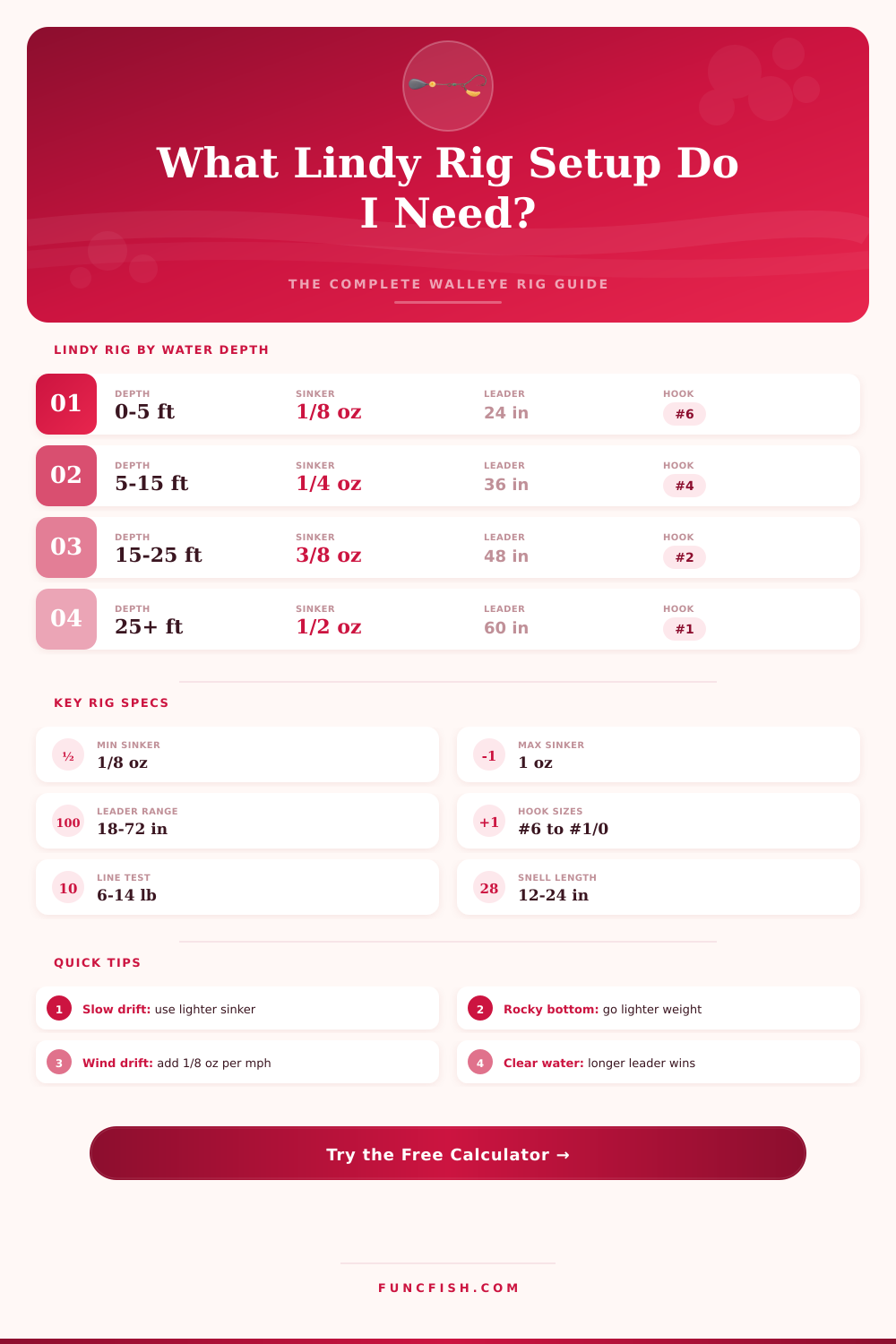
| Depth (ft) | Depth (m) | Still Water Sinker | Light Current Sinker | Heavy Current Sinker |
|---|---|---|---|---|
| 1–5 ft | 0.3–1.5 m | 1/16–1/8 oz | 1/8 oz | 1/4 oz |
| 6–10 ft | 1.8–3 m | 1/8–1/4 oz | 1/4 oz | 3/8 oz |
| 11–15 ft | 3.4–4.6 m | 1/4 oz | 3/8 oz | 1/2 oz |
| 16–20 ft | 4.9–6.1 m | 3/8 oz | 1/2 oz | 5/8 oz |
| 21–28 ft | 6.4–8.5 m | 1/2 oz | 5/8 oz | 3/4 oz |
| 29–35 ft | 8.8–10.7 m | 5/8–3/4 oz | 3/4 oz | 1 oz |
| 36+ ft | 11+ m | 3/4–1 oz | 1 oz | 1–1.5 oz |
| Species | Typical Weight | Leader Length | Hook Size | Line Test |
|---|---|---|---|---|
| Walleye | 1–8 lb (0.5–3.6 kg) | 24–60 in (61–152 cm) | #4 to #1 | 6–10 lb |
| Yellow Perch | 0.25–1.5 lb (0.1–0.7 kg) | 12–24 in (30–61 cm) | #6 to #4 | 4–6 lb |
| Northern Pike | 5–20 lb (2.3–9 kg) | 18–36 in (46–91 cm) | #2 to #1/0 | 12–17 lb |
| Largemouth Bass | 1–6 lb (0.5–2.7 kg) | 18–36 in (46–91 cm) | #2 to #1/0 | 8–12 lb |
| Sauger | 0.5–3 lb (0.2–1.4 kg) | 24–48 in (61–122 cm) | #4 to #2 | 6–8 lb |
| Catfish | 2–20 lb (0.9–9 kg) | 12–24 in (30–61 cm) | #2 to #2/0 | 14–20 lb |
| Lake Trout | 3–15 lb (1.4–6.8 kg) | 24–48 in (61–122 cm) | #2 to #1 | 10–14 lb |
| Crappie | 0.25–2 lb (0.1–0.9 kg) | 12–20 in (30–51 cm) | #6 to #4 | 4–6 lb |
| Line Type | Diameter (in) | Diameter (mm) | Visibility | Best Use |
|---|---|---|---|---|
| Mono 6 lb | 0.009 in | 0.23 mm | Medium | General walleye, perch |
| Mono 8 lb | 0.010 in | 0.26 mm | Medium | Standard walleye |
| Mono 10 lb | 0.011 in | 0.28 mm | Medium-High | Pike, bass |
| Fluoro 6 lb | 0.009 in | 0.23 mm | Very Low | Clear water walleye |
| Fluoro 8 lb | 0.010 in | 0.25 mm | Very Low | Clear water, pressured fish |
| Braid 10 lb | 0.006 in | 0.15 mm | High | Sensitivity, deep water |
| Braid 20 lb | 0.009 in | 0.23 mm | High | Heavy cover, large species |
| Wire 14 lb | 0.011 in | 0.28 mm | Medium | Pike, toothy species |
The Lindy rig is a fishing setup that are designed to allow the live bait that is attached to the rig to move above the bottom of the body of water in which the fish is to be caught. The Lindy rig accomplishes this goal through the use of a sliding sinker. The sinker is allowed to move along the fishing line attached to the bait, thus allowing the bait to move in its natural movement.
Because the bait is allowed to move in these natural movements, the fish are more likely to bite upon the bait. The Lindy rig is often used to catch walleye, but it can also be used to catch other fish species as well, such as sauger, perch, or pike. The clarity of the water in which the fish live can play a crucial role in the way in which the Lindy rig should be set up.
How to Set Up a Lindy Rig
In water that is clear, fish is less likely to become spooked by large objects. In this case, using a lighter sinker with a longer leader will allow the bait to move free and look more natural to the fish in the clear water. In muddy water, however, the use of a short leader will allow for a more compact presentation to the fish.
Thus, depending upon the clarity of the water, the fish should be adjusted to use either a lighter or heavier sinker, and with either a long or short leader. Another of the factors to consider when setting up a Lindy rig is the current of the water in which the fish live. In areas in which the current is gentle, the use of an egg sinker will allow the egg to roll smooth over the bottom of the fishing area.
In areas, like rivers, in which there is a strong current, however, the use of a banana sinker or a bell sinker will allow the sinker to grip the bottom. If the sinker does not grip the bottom of the lake, river, or other body of water, the current will move the sinker sideways along the bottom. Thus, the use of a sinker that will grip the bottom will ensure that the Lindy rig remains in the correct position.
The type of bottom on which the fish live on the floor of the water can also impact the way in which the Lindy rig should be used. If the bottom is composed of mud, then the use of light tackle will allow the bait to hover naturaly above the bottom. If, however, the bottom of the water floor consists of rocks, a no-snag design with a shorter leader will prevent the Lindy rig from becoming snagged on these rocks.
The type of bait that is to be used can impact the weight that the Lindy rig should have, as well as the style of the Lindy rig that is used. If large nightcrawler bait is to be used, a heavier sinker and a baitholder hook will help to offset the drag that the nightcrawler will create while swimming. If, however, small bait such as a shiner or a plastic worm is to be used, a lighter Lindy rig with a finesse hook will allow the bait to move more natural.
In either case, however, the size of the hook should be matched to the size of the bait. Otherwise, the bait will create a stiff appearance when moving in the water. In addition to the factors mentioned above, the way in which the anglers handle the boat can impact the way in which the Lindy rig should be used.
If the anglers are fishing from a boat that is anchored over a weedline, a very light sinker and long leader will allow the bait to move free. In situations, however, in which trolling is performed, or the boat is drifting due to the wind, a heavier sinker and shorter leader will allow the anglers to maintain better control of the fishing line. The drift speed of the boat can have the same impact; if the boat is moving slowly, the use of light tackle will allow the bait to move natural in the water.
However, if the boat is drifting quickly, the Lindy rig will begin to balloon in the water, so a heavier sinker should be used to keep the Lindy rig from moving too quick. In addition to boat drift, other factors in the water can also impact the way in which the Lindy rig should be used. For instance, if the water in which the fish live is exposed to cold temperatures, the leeches may become stiff.
In these instances, a shorter leader will allow for the bait to remain more flexible. Additionally, sudden gusts of wind can also impact the way in which the Lindy rig performs. In these instances, the weight of the sinker may need to be adjusted to account for the additional load that the wind may place upon the fishing line.
To test the Lindy rig, however, the anglers can drop the Lindy rig into the water. Depending upon the angle of the line in the air, adjustments can be made to the weight of the sinker or the length of the leader until the Lindy rig is functioning in the water in the manner in which the anglers wishes to use it.