Fish Jerky Yield Calculator
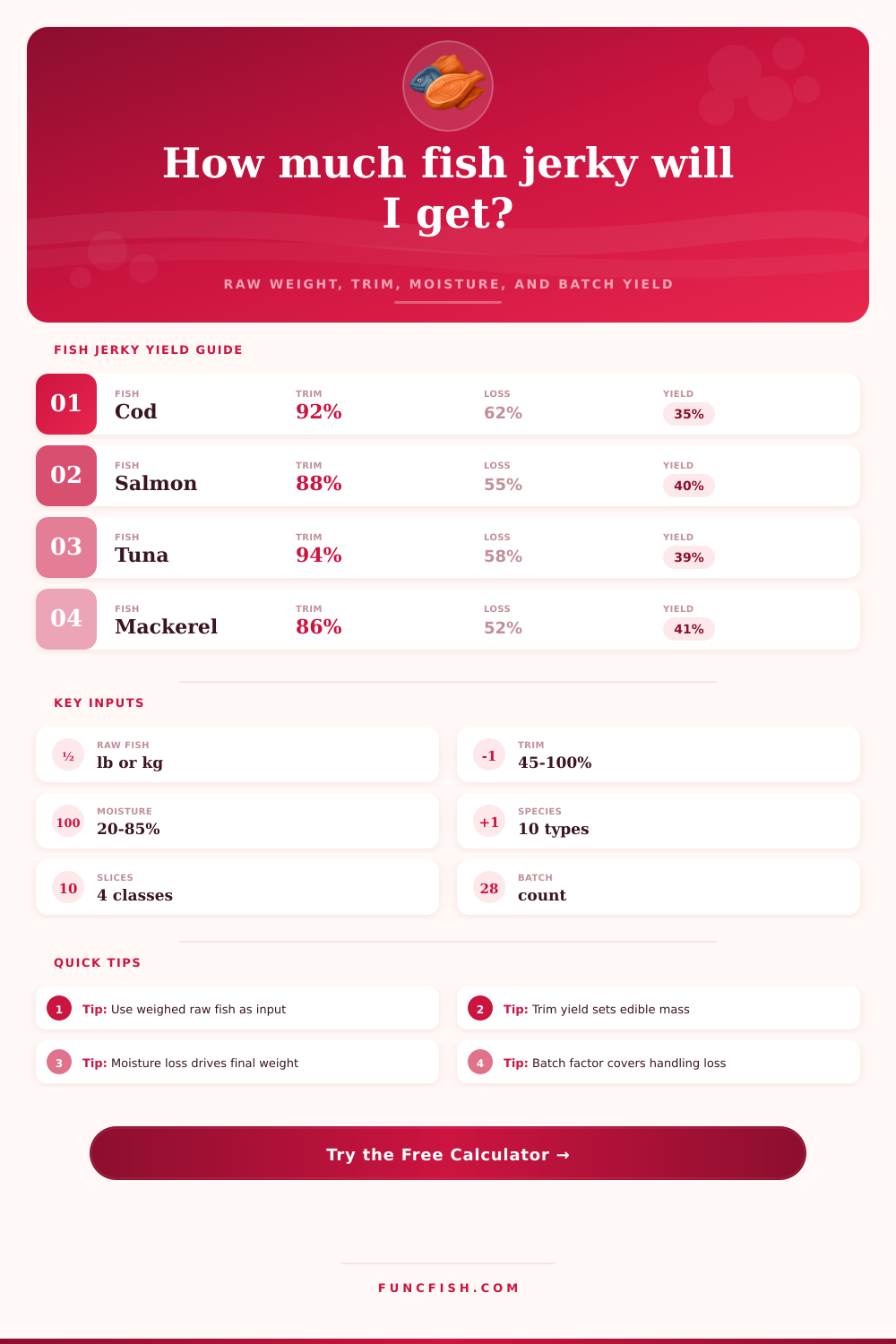
Estimate finished fish jerky yield from raw fish weight, trimmed yield, moisture loss, species fatness, slice thickness, finished-moisture category, batch loss, and unit system.
📌 Fish Yield Presets
⚙ Yield Inputs
Fish jerky yield estimate
Calculation breakdown
📊 Yield Factor Cards
Trim Yield
Moisture Loss
Species Class
Batch Units
📋 Reference Tables
| Starting fish form | Typical trim yield | Trim loss share | Calculator use |
|---|---|---|---|
| Boneless skinless fillets | 94-100% | 0-6% | Use when raw weight is already trimmed fish |
| Skin-on fillets | 86-94% | 6-14% | Use for skin and edge removal math |
| Loins or large portions | 90-98% | 2-10% | Use for dense cut yield estimates |
| Headed dressed fish | 62-78% | 22-38% | Use when frame and skin are included |
| Whole round fish | 45-62% | 38-55% | Use when raw weight includes full fish mass |
| Finished moisture category | Adjustment points | Example base loss | Yield effect |
|---|---|---|---|
| Higher finished moisture | -5 pct pt | 60% becomes 55% | Higher finished weight |
| Medium finished moisture | 0 pct pt | 60% stays 60% | Baseline finished weight |
| Low finished moisture | +6 pct pt | 60% becomes 66% | Lower finished weight |
| Custom target adjustment | User value | 60% plus custom | Scenario-specific output |
| Slice thickness category | Moisture-loss adjustment | Relative area factor | Calculator effect |
|---|---|---|---|
| Thin slices | +4 pct pt | High surface area | More loss from trimmed fish |
| Standard strips | 0 pct pt | Baseline surface area | Uses base moisture loss |
| Thick strips | -3 pct pt | Lower surface area | Less loss from trimmed fish |
| Chunk-style pieces | -5 pct pt | Lowest surface area | Highest retained finished weight |
| Raw fish weight | Trim yield | Adjusted moisture loss | Finished yield before batch factor |
|---|---|---|---|
| 5 lb / 2.27 kg | 92% | 58% | 1.93 lb / 0.88 kg |
| 10 lb / 4.54 kg | 90% | 60% | 3.60 lb / 1.63 kg |
| 20 lb / 9.07 kg | 86% | 55% | 7.74 lb / 3.51 kg |
| 25 lb / 11.34 kg | 94% | 63% | 8.70 lb / 3.95 kg |
Reference rows are yield-math data points only. They do not describe preparation methods, processing steps, or safety standards.
🐟 Species Yield Comparison Grid
Cod
Very lean white fish reference with high trim yield and higher moisture-loss adjustment.
Tilapia
Lean fillet reference for common small-to-medium batch calculations.
Tuna
Dense lean loin reference with strong trimmed yield and moderate moisture loss.
Mahi-mahi
Lean firm fish class used for medium and large portion yield scenarios.
Halibut
Thick lean cut reference with high trim yield and mild class adjustment.
Catfish
Medium-fat fillet class with baseline-to-slightly-lower moisture-loss math.
Salmon
Oily fish reference that retains more finished weight after moisture math.
Mackerel
Very oily class with lower trim reference and strongest retention adjustment.
💡 Calculator Tips
Yield tip: Enter the raw fish weight that matches your trim-yield basis. If the fish is already boneless and trimmed, use a high trim-yield percentage.
Scenario tip: Change one factor at a time to compare trim yield, moisture loss, species class, slice category, and batch-unit count.
When you prepare fish jerky, the final weight of the jerky will be significantly lower than the initial weight of the raw fish that you start with. This is due to a high amount of water that is present in fish. As the fish jerky is dehydrated, the water are removed from the raw fish.
Because water is removed from the raw fish, the weight of the raw fish will decrease. In order to correctly calculate how much raw fish to purchase for your desired quantity of fish jerky, it is important to account for a loss of the weight of the raw fish due to dehydration. The type of fish that you use will impact the dehydration process of the raw fish.
How Much Fish Jerky Will You Get?
Lean fish, such as cod, will have very little fat in there flesh. Fish that are lean have a fast loss of water during dehydration. Oily fish, such as mackerel, will have more fat in there flesh.
This fat will act as an barrier to the dehydration process. Fish jerky made from oily fish will have a higher final weight than jerky made from lean fish. Additionally, the amount of fat in the fish will also impact the texture of the jerky and the length of time that the jerky will last once prepared.
The amount of weight that the raw fish lose can also be impacted by the trimming of the raw fish. The skin, bones, and belly fat of the raw fish must be removed prior to the dehydration process. Removing the skin and bones from the raw fish decrease the amount of fish jerky that can be obtained from the raw fish that you start with.
If you start with a whole fish, you can lose up to fifty percent of the weight of the raw fish through the trimming process. If, however, you use pre-filleted loins of raw fish, you will lose less of the raw fish weight during trimming. The thickness of the slices of raw fish that you use will impact the weight of the resulting fish jerky.
Thin slices will have a higher surface area in contact with the air than thick slices of raw fish. Because water will evaporate more faster from the thin fish jerky slices, there will be less final weight of fish jerky made from thin fish jerky slices. Thick slices will retain the water in the raw fish better, resulting in a higher final weight of jerky made from thick fish jerky slices.
However, those who prepare the jerky must completely dehydrate the thick fish jerky slices prior to being considered safly to eat. The level of moisture that you want in your finished fish jerky will also have an impact on the final weight of the jerky. If you want your finished jerky to have a very low moisture level, it will lose most of its moisture during the dehydration process.
If you want your jerky to be chewier when eaten, it will not need to lose as much moisture during the dehydration process. Jerky that is chewy will have a higher final weight than jerky that is bone-dry. Many people who prepare jerky want the dehydration process to result in a moisture level of twenty percent in the jerky.
During the dehydration process, it is possible for some of the prepared jerky to lose its weight due to sticking to the dehydration trays or break during the unmolding process of the jerky. This loss of weight is known as batch loss and usually ranges between four and six percent of the total weight of the jerky that is made. This batch loss should of been accounted for in the total weight of the jerky that will be made during the dehydration process.
It is important to accurately weigh the raw fish that is to be dehydrated to make the jerky. The cook should obtain the weight of the raw fish with a scale and should not be estimated. If the raw fish is not accurately weighed before dehydration, it is impossible to accurately calculate the weight of the jerky that will be made.
If the raw fish is accurately weighed, the cook can accurately calculate the weight of the jerky that will be made. By considering each of these factors, the species of the fish that will be used, the trimming of the raw fish, the thickness of the jerky slices, the desired moisture level of the jerky, and the potential for batch loss during dehydration, it is possible to accurately calculate the yield that can be made in the dehydration process to produce fish jerky. Actualy, you should of considered all these things to avoid errors.
If you dont consider them, your results might be different than you expect. This is a moddern way to do it.