
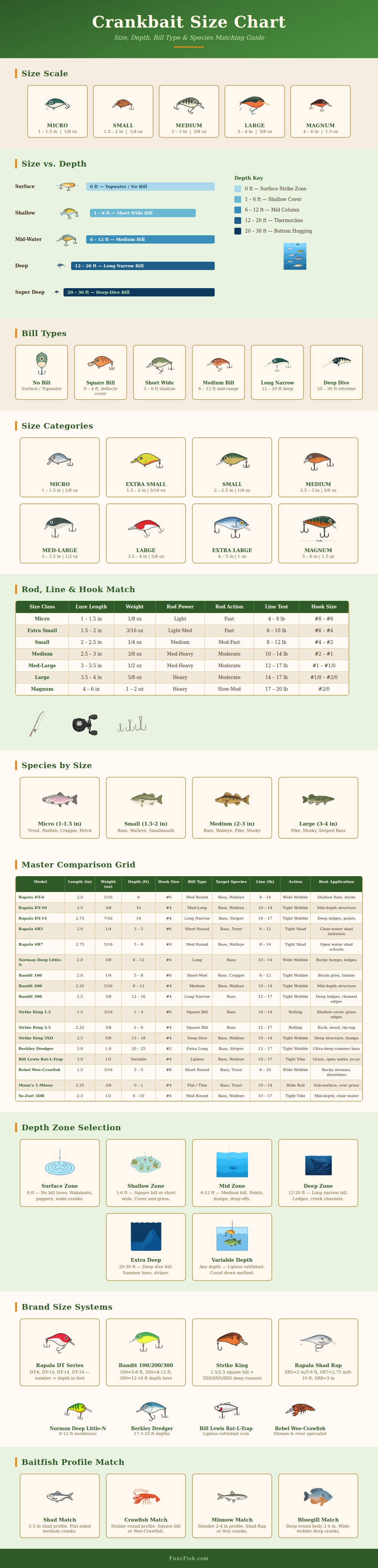
Crankbaits are artificial lures that is used to catch fish. Crankbaits work because they mimic the appearance of a baitfish. The size of the crankbait that is used depends on the size of the fish that is being target.
Using a crankbait that is too small or too large for the fish that is being targeted may cause the target fish to not bite on the bait. Therefore, the fisherman must match the size of the crankbait to the forage in an area and the water column. The length and the weight of the bait can determine the size of the crankbait.
How to Choose the Right Crankbait
Tiny crankbaits are used to mimic small amount of prey such as insects or threadfin shad. Tiny crankbaits are used to target panfish in areas of shallow water. Medium sized crankbaits is used to target bass because medium sized crankbaits will trigger a reaction strike from bass.
Large and magnum sized crankbaits is used to target species like pike and musky. If the baitfish in the lake are three inch in length, then a three inch long crankbait should be used because the fish can tell the difference in the size of the bait. The bill of the crankbait is the plastic lip on the front of the bait.
Short and wide bills are used for fishing in areas of shallow water because they will bounce off the grass at the bottom of the water column without snagging on the weeds. Square bills are also used for shallow water because they will deflect off rocks in the water. These bills are usually used in waters under four feet deep.
Medium bills are used for depths between six and twelve feet of water. These depths are where walleye lives. Therefore, using a crankbait with medium bills will allow the bait to reach the fish that are targeted.
Long bills are used for deep water because they can reach depths of twenty feet or more to target larger fish such as stripers and largemouth bass. The bill of the crankbait will determine the angle of the bait so that it can maintain a precise depth in the water column. The fishing rod and the fishing line must also match the size of the crankbait that is being used.
Light rods and fine fishing line are used for micro crankbaits so that the tiny bait can move natural in the water. Heavy rods and thick fishing line are used for magnum sized crankbaits because the strong fishing rod and thick line will help to pull the large fish out of the water. If the rod and line that is being used do not match the size of the crankbait that is being used, then the crankbait will not move correctly in the water, or the fishing line may snap.
Different species of fish prefers different sizes of crankbaits. Panfish and perch will generally ignore any crankbaits that are larger than one and a half inches in size. Bass will eat either small or medium sized crankbaits, depending upon the temperature of the water and the size of the forage fish in the water.
Pike, on the other hand, will only eat large crankbaits, as they trigger the pike to pursue the lure. Finally, large fish will eat large crankbaits for large meals, but small fish will eat small crankbaits and be suspicious of those that are too large for them to consume. Crankbaits come from a variety of brands, and each brand may categorize their products in different ways.
For example, some brands will number their crankbaits according to the depth that the crankbaits will reach when being cast into the water and reeled in, while other brands may make series of crankbaits for different purposes. Additionally, lipless crankbaits dont have a bill projecting from the bait, and will sink in the water to target other areas of the water different than those where the bait is first cast. In addition to the type of crankbaits that is being used, other factors in the water may impact the type of crankbaits that should be used.
For example, square bills with crankbaits are used in the spring to target shallow areas of the water where fish are spawning, but deep divers are used in the summer months when the water is much deeper and fish can be targeted in those deeper areas of the water. Additionally, if the water is clear, crankbaits that have tight wiggles will be required, but crankbaits with wide rolls are used in murky water. Fast retrieves of the crankbaits will trigger some fish to eat the bait, but slow retrieves will attract the interest of fish that will follow the bait.
Finally, natural colors are used in clear water, but bright colors like firetiger are used in dirty water where visibility is reduced for the fish. A size chart can help a person to correctly match the rod, the line, the hook, and the type of crankbaits. Such a size chart will allow a person to avoid trial and error in selecting each of these fishing components, but will instead allow the person to easily find the correct matching components for the different sized crankbaits, from micro finesse to magnum sizes.
Additionally, the shape of the crankbaits should also match the type of baitfish that is in the water. For example, flat-sided crankbaits mimic the movements of shad, but crankbaits with stubby square bills mimic the movement of crawfish. Additionally, slender crankbaits mimic the movement of minnows, and round deep divers will attract fish to mimic bluegills.
Each of these options is based off the ecology of the water and the types of fish that is evolved to recognize those specific silhouettes of the crankbaits.