Hook Size for Bass Calculator
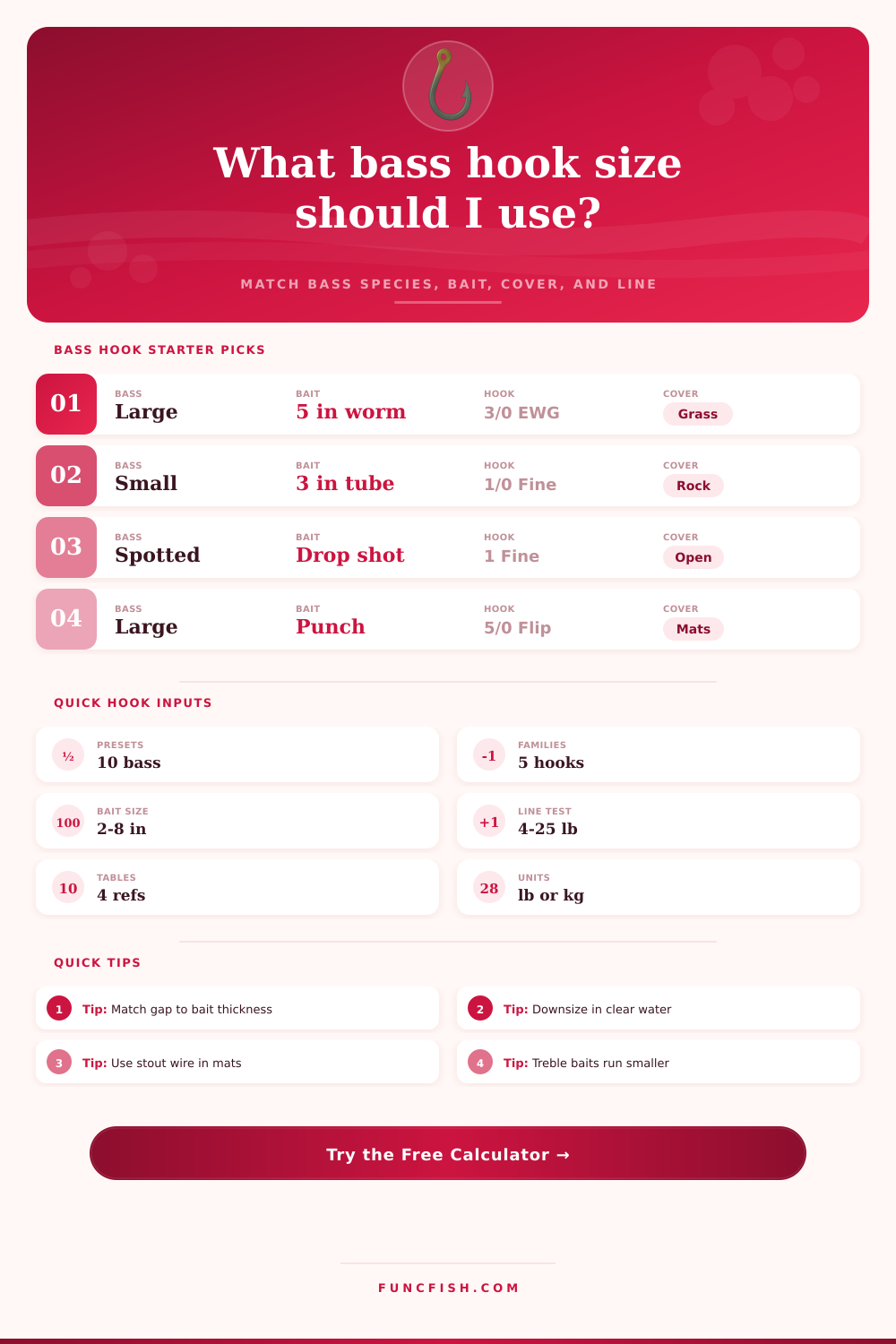
Match largemouth, smallmouth, or spotted bass hooks to soft-plastic length, bait thickness, hook family, line test, cover, and water clarity.
📌Bass hook presets
⚙Bass hook inputs
Bass hook recommendation
Full breakdown
📋Bass bait and hook comparison grid
Stick Worm
Finesse Worm
Craw
Tube
Fluke
Paddle Tail
Hard Bait
Punch Bait
🧰Hook family quick match
EWG
Best for thick worms, craws, flukes, and swimbaits that need wide bite clearance.
Offset Worm
Best for slimmer Texas rigs when a straight body should stay centered.
Finesse
Best for drop shot, wacky, tubes, and pressured smallmouth or spotted bass.
Flipping
Best for stout line, buried points, matted grass, wood, and close-quarters hooksets.
Treble
Best for hard bait replacement sizing where smaller numbered hooks are larger.
📚Bass hook reference tables
| Bass species | Typical bait window | Starter hook range | Common note |
|---|---|---|---|
| Largemouth bass | 4 to 7 in / 10 to 18 cm | 2/0 to 5/0 | Thicker plastics and heavier cover |
| Smallmouth bass | 2.5 to 4.5 in / 6 to 11 cm | 2 to 2/0 | Compact baits and clear water |
| Spotted bass | 3 to 5 in / 8 to 13 cm | 1 to 3/0 | Finesse to mid-size baitfish profiles |
| Pressured bass | 2 to 4 in / 5 to 10 cm | 6 to 1/0 | Downsize hook and line first |
| Soft-plastic length | Slim bait | Thick bait | Best hook family |
|---|---|---|---|
| 2 to 3 in / 5 to 8 cm | 6 to 2 | 2 to 1 | Finesse |
| 3 to 4 in / 8 to 10 cm | 1 to 1/0 | 1/0 to 2/0 | Finesse or offset |
| 4 to 5 in / 10 to 13 cm | 2/0 to 3/0 | 3/0 to 4/0 | Offset or EWG |
| 5 to 7 in / 13 to 18 cm | 3/0 to 4/0 | 4/0 to 6/0 | EWG or flipping |
| Cover type | Line test guide | Wire guide | Hook choice cue |
|---|---|---|---|
| Open water | 4 to 10 lb / 1.8 to 4.5 kg | Light to medium | Finesse hooks stay natural |
| Rock or gravel | 6 to 12 lb / 2.7 to 5.4 kg | Medium | Compact hook, good point exposure |
| Docks and wood | 12 to 20 lb / 5.4 to 9.1 kg | Medium-heavy | Offset, EWG, or flipping hook |
| Matted grass | 17 to 65 lb / 7.7 to 29.5 kg | Heavy | Flipping hook with buried point |
| Hook family | Size ladder used | Gap behavior | Best bass role |
|---|---|---|---|
| EWG worm hook | 1/0 to 6/0 | Widest plastic clearance | Texas rigs, flukes, thick craws |
| Offset worm hook | 1 to 5/0 | Slimmer than EWG | Ribbon worms and straight worms |
| Finesse hook | 6 to 2/0 | Small, open bite | Drop shot, wacky, tubes |
| Flipping hook | 3/0 to 6/0 | Strong gap and keeper | Heavy cover and punching |
| Treble hook | 8 to 1 | Short shank, multi-point | Hard bait replacement |
💡Hook fit checks
Gap check: A soft plastic should compress without fully filling the hook gap. If the bait body is bulky, the calculator pushes toward EWG or flipping hooks.
Stealth check: In gin-clear water, a hook that is one size smaller often lands more bites, but heavy cover can override that choice.
Choosing the correct hook for bass requires you to consider the species of bass, the bait you are using, and the cover where you are bass fishing. If you dont choose the correct hook for these different variable, you run the risk of either the hook failing to set into the bass, or the bass feeling the hook to quick. The calculator included in this article will allow you to enter each of these different variables so that the calculator can perform the calculations necessary to determine the best hook size for the bass fishing condition you are creating.
Bass species are all different from each other. For instance, largemouth bass have wide mouth, and tend to eat thick plastic baits in areas of heavy cover. Smallmouth bass live in clear water and tend to use smaller hooks and smaller baits.
How to Choose the Right Hook for Bass
Finally, spotted bass are different than both largemouth and smallmouth bass in that spotted bass live in the middle area of complexity in their environment, so they require a middle level of finesse with their fishing bait and hooks. The calculator include a variable for the mouth size of the bass being targeted and the power of the bass species so that the anglor does not have to guess at the proper species to target. The dimensions of the bait you use will impact the gap that you require in your hook.
For instance, thick creature baits will require a wider gap in the hook than slim finesse worms. The calculator consider the dimensions of the bait being used so that the hook can adequately open to the flesh of the bass while minimizing the likelihood that the bait will fall out of the hook. Additionally, the type of point on the hook impacts the hook gap recommendation made by the calculator; skin hooked points will require a different gap than open points on the hook.
The type of cover in which you are fishing also alter the requirements of the hook you use. For instance, open water will allow for the use of smaller hooks than matted grass or wooden cover, where the bass may encounter folding wire on the hook. The calculator considers the cover type and line test to create a recommendation for the bass angler that accounts for the strength of the hook and the type of cover.
While many anglors use a stout flipping hook in all types of fishing conditions, using such a hook may prevent the angler from successfully catching bass in clear water. Thus, the calculator can adjust for these types of differences in cover type. The clarity of the water in which you are fishing for bass is a variable that must be considered in the hook selection process.
For instance, if the water is very clear, the bass may be able to see the hook hardware prior to being able to see the bait. In muddy water, however, the reverse of this scenario is true; the bass use their sense of feel to find the bait instead of their sight. Thus, if the water is muddy, the angler can utilize an advantage of a larger, stronger hook.
The calculation consider this variable in its determination of hook size. One of the main considerations of hook size for bass fishing is the balance of line test and hook wire. For instance, if the line test is light, the hook wire should also be fine in order to allow the hook to easily penetrate the bass.
In contrast, if the line test is heavy, stout hook wire can be used to avoid creating a leverage problem with the bass. This factor is incorporated into the calculation of the recommended hook size. Finally, the rigging style and the mood of the bass will impact the hook size requirements.
For instance, tex-posed points will hide the hook from the fish, but will require a sufficient hook gap to allow the bait to compress against the fish. Open points will penetrate the fish faster but may not offer the same protection of the hook from weeds. Additionally, finicky bass may be caught with smaller hooks than aggressive fish.
These variable are factored into the final recommendation of hook size. The tables provided on this page provide common pairings of the different variables. These tables will help to narrow the parameters of the type of bass hook you should use; you can use the calculator to further narrow it to the exact size and family of hook you should purchase.
Understanding why a certain hook works in one location but fails in another will allow you to make better decisions in your fishing effort. Many anglors make mistakes with bass fishing hooks because they use the same hook in all types of conditions. Using 4/0 EWG hooks, for instance, may prevent an angler from successfully catching smallmouth and spotted bass that require the finesse of other bait type.
Anglers that use small hooks may find that their hook wires fold when they attempt to catch bass in matted grass area. The calculator prevents these types of mistake. The biggest value of the calculator becomes apparent in varying fishing conditions.
If an angler changes from clear rock areas to stained grass, for instance, the recommendation of the calculator will change accordingly. Simply updating the variables in the calculator will show the angler how the recommendation for hook size change. Thus, the calculator will allow the angler to learn about bass hook size faster so that their fishing experience can increase at a more rapid rate.
To select the proper hook for bass fishing, the angler must consider the type of cover in which they are fishing for bass, the type of bait to use, and the size of the hook that will best accommodate the condition. When these variables are considered and matched with the proper hook size, the hook will not become a weak link in the anglers effort to catch the bass.