🎣 Tenkara Line Length Calculator
Calculate the ideal line length for your tenkara setup based on rod length, water type, and technique
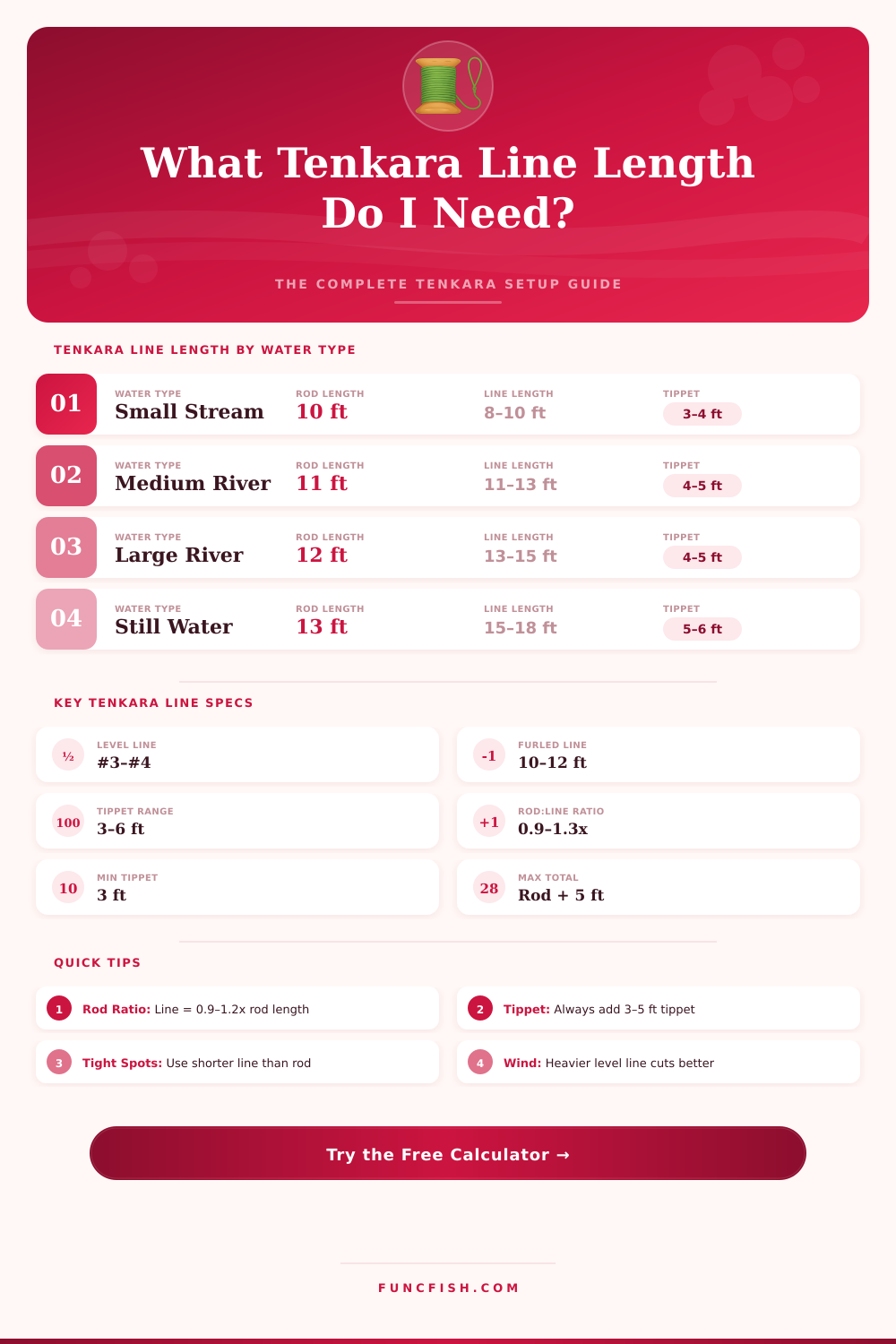
| Water Type | Rod Length | Recommended Line | Line (Metric) | Tippet | Ratio |
|---|---|---|---|---|---|
| Tiny Creek | 9–10 ft | 7–9 ft | 2.1–2.7 m | 3 ft | 0.8x |
| Small Stream | 10–11 ft | 9–11 ft | 2.7–3.4 m | 3–4 ft | 0.9x |
| Medium River | 11–12 ft | 11–13 ft | 3.4–4.0 m | 4–5 ft | 1.0x–1.1x |
| Large River | 12–13 ft | 13–15 ft | 4.0–4.6 m | 4–5 ft | 1.1x–1.2x |
| Still Water | 12–13 ft | 14–18 ft | 4.3–5.5 m | 5–6 ft | 1.2x–1.3x |
| Overhung Banks | 10–11 ft | 8–10 ft | 2.4–3.0 m | 3 ft | 0.8x–0.9x |
| Species | Typical Size | Line Type | Rec. Line Length | Tippet Size | Fly Size |
|---|---|---|---|---|---|
| Brook Trout | 6–14 in | Level #3 | 9–11 ft | 6X–7X | #14–#18 |
| Brown Trout | 10–20 in | Level #3.5 | 11–13 ft | 5X–6X | #12–#16 |
| Rainbow Trout | 8–18 in | Furled | 11–14 ft | 5X–6X | #12–#16 |
| Cutthroat Trout | 10–18 in | Level #3 | 10–13 ft | 5X–6X | #12–#16 |
| Iwana (Char) | 6–12 in | Horsehair | 8–10 ft | 6X–7X | #14–#18 |
| Yamame | 6–12 in | Level #3 | 9–11 ft | 6X–7X | #14–#18 |
| Bluegill / Panfish | 5–10 in | Furled | 10–13 ft | 4X–5X | #10–#14 |
| Smallmouth Bass | 10–18 in | Level #4 | 12–15 ft | 3X–4X | #8–#10 |
| Line Size | Diameter (mm) | Weight (g/m) | Best Use | Wind Rating |
|---|---|---|---|---|
| #2 | 0.235 mm | 0.043 g/m | Tiny flies, calm days | Poor |
| #2.5 | 0.260 mm | 0.053 g/m | Small streams, light wind | Fair |
| #3 | 0.285 mm | 0.063 g/m | All-purpose, most conditions | Good |
| #3.5 | 0.310 mm | 0.075 g/m | Larger flies, windy days | Good |
| #4 | 0.330 mm | 0.085 g/m | Big rivers, strong wind | Very Good |
| #4.5 | 0.355 mm | 0.098 g/m | Streamer fishing, rough water | Excellent |
To properly tenkara fish, a person must manages the length of their tenkara line in order to both reach the fish, as well as to maintain control of the tenkara line and the movement of their fly. The length of the tenkara line are an important factor in tenkara fishing. The length of the tenkara line will impact the distance that the line can reach the fish, as well as the control that a tenkara fisher will have over the movement of the fly.
If the tenkara line is too short, the fish will not be able to be reached. However, if the line is too long, the line may sag due to the weight of the line and the movement of the wind, which will make the drift of the fly look unnatrual to the fish. A person must calculate the length of their tenkara line according to the length of their tenkara rod.
Pick the Right Tenkara Line Length
Most commonly, the length of the tenkara line should be between 0.6 and 1.5 times the length of the tenkara rod. If a line is shorter than the rod, a person will have more control over the line but lesser reach. If a line is longer than the rod, a person will have more reach but have less control over the line.
For instance, a person using a tenkara rod that is 9 feet in length may use a tenkara line that is 6 feet in length if there are many branch in the water. However, a person using a tenkara rod that is 13 feet in length may use a tenkara line that is 15 feet in length if they are fishing in an open meadow where there are no branches. In addition to the length of the tenkara rod and line, there are a variety of environmental factor that will have an impact upon the length of the tenkara line that a person uses.
Factors like the wind, the water current, the overhead branches, and even the weight of the tenkara line will impact the length of the tenkara line. The wind can push tenkara lines, so shorter lines may be used with higher wind. The current in the water will cause the tenkara line to bow, so a fisher must take this into account when setting there line length.
If there are branches overhead in the water, the tenkara line will be limited in its ability to reach the fish, so shorter line should be used in these instances. Finally, the weight of the fly will impact the tenkara line; heavier flies will help to keep the tenkara line from sag. The type of tenkara line that a person uses will also impact how the line moves in the water.
For instance, level fluorocarbon lines are strong and dense line that will slice through the wind, so these lines will be useful for fishing in areas with high wind. Tapered nylon lines will land more soft on the water, making them useful when fishing near cover where the fish may become spooked by a line that lands heavy on the water. Furled lines will exhibit a pulsing movement in the water, which makes these lines useful when fishing upstream for nymph.
Because tenkara lines can range in their weights and the strength of their densities, a fisher must choose a line that is appropriate for the water where they will fish, as well as the weight of the fly that they will use. By knowing these factor, a tenkara fisher can adjust their tenkara line length according to the situation in which they are fishing. For instance, if the tippet of the tenkara line is very long, a person should shorten the main line.
Additionally, if the water is very fast in certain section, the ratio of the length of the tenkara line to the length of the tenkara rod may have to be adjusted to account for the lift that the fast-moving water will create. Additionally, the type of fish in the water should be considered; some fish are more easily spooked than others. By using the correct length of tenkara line and the correct type of tenkara line, a tenkara fisher will experience a clean drift of the fly, as well as better control over their tenkara fishing effort.