Tuna Lifespan Calculator
Estimate tuna age, maturity stage, remaining lifespan, and confidence range from species, fork length, weight estimate, ocean zone, growth class, body condition, and units.
📌Tuna presets
⚙Tuna growth inputs
Tuna lifespan estimate
Estimated age, lifespan stage, maturity, and confidence range will appear here.
Calculation breakdown
📊Tuna species comparison grid
Yellowfin Tuna
Bluefin Tuna
Bigeye Tuna
Albacore Tuna
Blackfin Tuna
Skipjack Tuna
📘Tuna reference tables
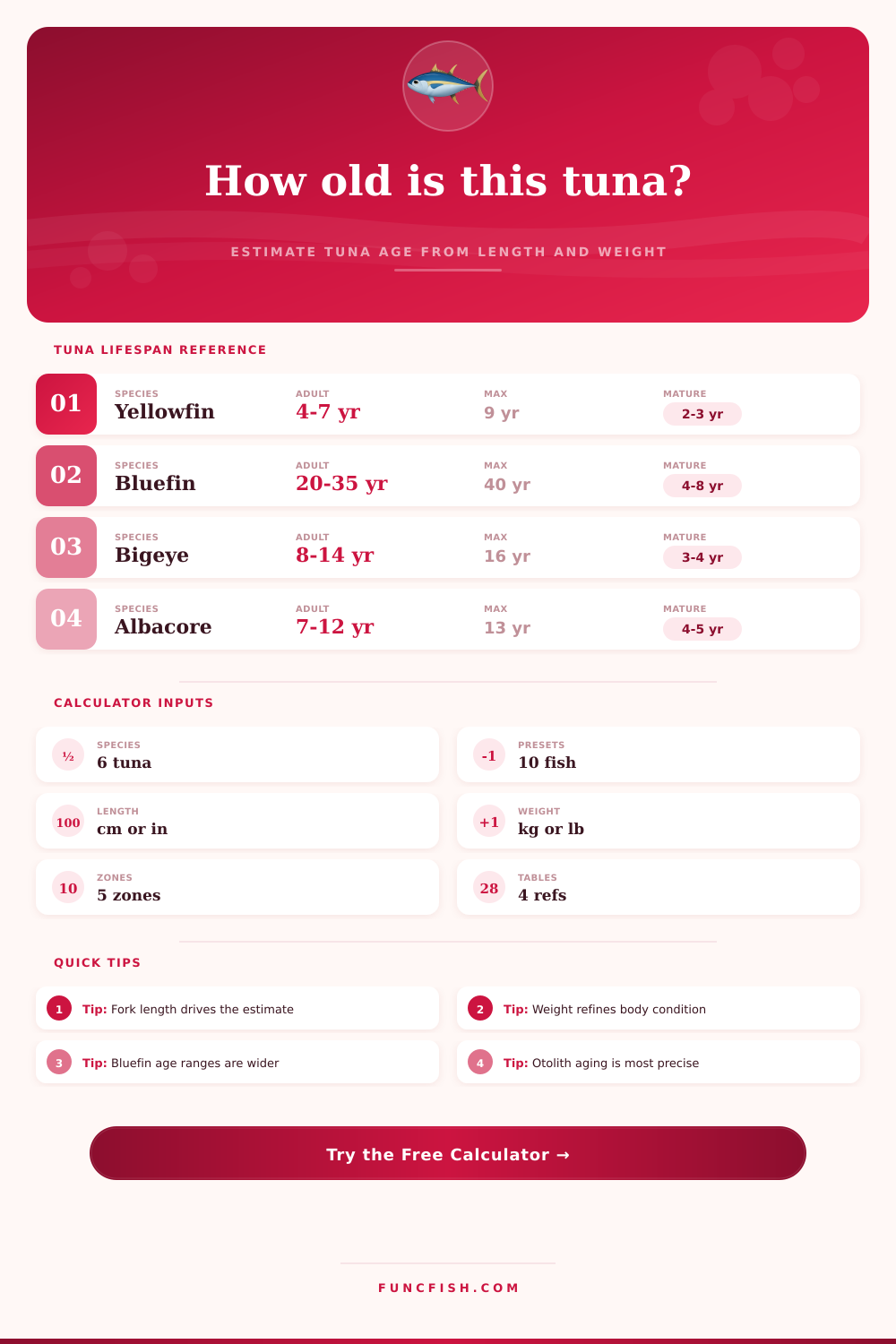
| Species | Common adult age | Reference max age | Typical maturity cue |
|---|---|---|---|
| Yellowfin tuna | 4 to 7 years | About 8 to 9 years | Often mature near 2 to 3 years and around 100 cm fork length. |
| Bluefin tuna | 20 to 35 years | About 35 to 40 years | Long-lived fish; maturity timing varies by stock and size. |
| Bigeye tuna | 8 to 14 years | About 15 to 16 years | Deep habitat and slower growth can push adult age higher. |
| Albacore tuna | 7 to 12 years | About 12 to 13 years | Many mature around mid-size adult fork lengths. |
| Blackfin tuna | 3 to 6 years | About 6 to 7 years | Small tuna with quick maturity and shorter lifespan. |
| Skipjack tuna | 3 to 6 years | About 7 to 8 years | Early maturity and fast tropical growth are common. |
| Fork length band | Yellowfin / skipjack | Bluefin / bigeye | Calculator use |
|---|---|---|---|
| Under 50 cm / 20 in | Juvenile to young subadult | Juvenile | Age band is sensitive because early growth is rapid. |
| 50 to 100 cm / 20 to 39 in | Subadult to mature in small species | Juvenile to subadult | Maturity selection strongly affects the interpretation. |
| 100 to 160 cm / 39 to 63 in | Large adult for many tunas | Adult for bigeye and young bluefin | Weight condition helps refine age from the length curve. |
| Over 160 cm / 63 in | Very large yellowfin or bigeye | Mature bluefin range | Bluefin can keep growing slowly for many years. |
| Ocean zone | Age tendency | Lifespan effect | Reason used in model |
|---|---|---|---|
| Tropical epipelagic | Slightly younger at length | Neutral to lower | Warm water and forage can support faster growth. |
| Temperate offshore | Slightly older at length | Slightly higher | Cooler water often slows length gain. |
| Deep scattering layer | Older at length | Higher for bigeye | Deep foraging is tied to slower growth assumptions. |
| Open-ocean migratory | Baseline | Baseline | Matches broad offshore movement and mixed feeding. |
| Spawning area sample | Adult-biased | Baseline | Maturity evidence can raise the minimum age estimate. |
| Input cue | Low confidence | Medium confidence | High confidence |
|---|---|---|---|
| Fork length | Photo or rough deck mark | Tape measure or landing record | Measured fork length with straight board |
| Weight estimate | Visual estimate only | Scale or dressed-weight conversion | Whole weight on calibrated scale |
| Maturity stage | Unknown or guessed | Size-based field call | Sampled maturity evidence |
| Age validation | Calculator only | Calculator plus catch record | Otolith, spine, or tagging reference |
💡Tuna age estimate tips
Tuna age estimates depend heavily on fork length because most reference growth curves are length-at-age curves. Total length or curved body measurements can shift the result.
A tuna that is unusually heavy or lean for its fork length may not be older or younger by that amount; weight mainly adjusts condition and confidence.
As tuna dont possess any indicators of their age (like tree rings), the length of the tuna must be used to estimate the age of the fish. The age of the tuna is used to determine aspects of the tuna itself, aspects of the fishery, and to plan future fishing trips for those tuna. In order to determine the length of tuna, a tuna lifespan calculator is used to determine the age of the fish from its various measurements.
The calculator uses each measurement in different ways to determine the age of the tuna to create an age range for that particular fish. One of the most important measurements of tuna is the fork length of the tuna. The lifespan calculator create growth curves using the length of the tunas fork.
How the Tuna Age Calculator Works
Thus, the fish has passed through growth stages to determine the age of the tuna according to its current length. The weight of the tuna can be used to determine the health of the tuna; however, the weight does not create a second clock for measuring the age of the tuna. Similarly, if the weight of the tuna is too heavy or too lean for its species’ typical length, it may indicate that the tuna has had a well-fed diet or that it has just spawned.
However, these factors will not lead to a great change in the age estimate. The calculator uses the weight of the tuna to make small adjustments to the age estimate and to the width of the confidence band created by the calculator. The ocean zone where the tuna was spotted is another important factor that the calculator utilizes.
Depending on whether the tuna was spotted in warm (tropical) waters or cooler (offshore) waters, the growth rate for the fish will change. Tuna will reach the same length in fewer years in warm tropical waters than in the cooler offshore waters. Thus, the calculator calculates the age and the remaining lifespan of the tuna according to the ocean zone from which the tuna was spotted.
The growth class and the maturity stage of the tuna work together to ensure that the age of the tuna remains within the limits of the biological maturity age of the species. For instance, if the tuna is determined to be a juvenile, it cannot have an age that is older than the maturity age for that species. Similarly, if the tuna is known to be a large adult, it is unlikely that the fish is juvenile.
These two categories are used to create age estimates for the tuna that are within the limits of the maturity age for that species. Thus, it is possible for two tuna of the same length to have different age estimates based off these factors. The body condition and confidence levels for the tuna will impact the width of the confidence band for the age estimate.
For example, if the body condition of the tuna is lean or if the length of the tunas fork is not accurately measured, there will be a wide confidence band for the age estimate. However, if the observer confirms the age of the tuna through the observation of its otoliths or through the measurement of its fork length, the confidence in the age estimate will lead to a much narrower confidence band for the age. The lifespan calculator is most useful when compared to the age of other tuna in that same fishery.
For instance, if the age estimate of a yellowfin tuna is four years, but yellowfin tuna in that region are typically harvested between three and five years of age, the age estimate is within the expected range for the species. However, if the same length of tuna creates an age estimate that is older when that tuna was spotted in another ocean zone, it is likely that the slow growth rate of that species is responsible for the older age estimate. Rather than providing a single age for tuna, the tool instead creates both an age estimate and a confidence band around that estimate.
This is used to reflect the variability within the species; tuna continue to grow after they reach maturity, and the growth rates of tuna vary according to the species of tuna. Thus, the calculator creates an age estimate and confidence band to account for these biological differences in tuna age. Through the age estimate, it is also possible to compare the fish according to different factors.
For instance, if the same tuna is calculated using two different growth class assumptions, the age estimate may shift in response. While the shift in the estimate may be small, it can indicate which factors is the most important for calculating the age of the tuna. For instance, if the shift in age occurs when altering the growth class factor, but not ocean zone or body condition, it is likely that the length of the tunas fork is the most important factor in calculating the age of the tuna.
However, if shifting the age shift according to ocean zone and body condition factors, those are the most important factors in calculating the age of the tuna. In addition to the age estimate, the maturity age of the tuna can also be determined with the tool. The maturity index for the tuna is determined from the ratio of the length of the tuna to its age; however, this value is only useful if you know the length for which that species normaly matures.
Thus, if the maturity index times the length of the tuna returns the age of the tuna according to the calculator, the age estimate is credible. However, if there is a discrepancy between the maturity index times the length and the age according to the calculator, it is possible that the tuna was spotted in a spawning area or that its growth class isnt accurate. There are some limits to the tuna lifespan calculator that is available.
For instance, the tool cannot determine the age of the tuna through the observation of its otoliths, which are the most accurate means of determining the true age of the tuna. Additionally, factors like feeding and spawning rates can have a great impact upon the growth of the tuna; however, the calculator does not account for these variables. Instead, the calculator uses the same variables that scientists use to calculate the age of tuna, but with the addition of other information specific to the location in which the tuna is observed.
Through the use of other knowledge of the fishery and the tuna according to the catch records for those individual tuna, it is possible to determine a more accurate age to that specific tuna. Thus, one of the most useful age estimates that is calculated with the tool will be the age that you could of verified according to other information about that specific tuna.