Crappie Lifespan Calculator
Estimate black or white crappie age, likely lifespan range, maturity stage, remaining growth window, and confidence from length, weight, habitat, productivity, growth rate, forage, pressure, and measurement quality.
📌Crappie lifespan presets
⚙Species, size, habitat, and pressure inputs
Estimated crappie age and lifespan
Choose a preset or enter measurements to calculate crappie age, maturity, lifespan, and confidence.
Calculation breakdown
📊Crappie growth comparison grid
Clear Reservoir
Fertile Reservoir
Crowded Pond
River Backwater
🧬Black and white crappie lifespan baselines
| Species model | Typical lifespan | Length ceiling used | Calculator effect |
|---|---|---|---|
| Black crappie | 7-10 years, 12+ exceptional | 15.5 in / 39 cm | Slightly slower curve and stronger clear-water lifespan |
| White crappie | 6-9 years, 11+ exceptional | 16.2 in / 41 cm | Faster curve in fertile or stained reservoirs |
| Hybrid estimate | 6-10 years | 16.0 in / 41 cm | Blends black and white crappie growth traits |
| Northern lake crappie | 8-12 years | 14.8 in / 38 cm | Older for length when seasons are shorter |
| Southern fertile crappie | 5-9 years | 16.5 in / 42 cm | Younger for length when food and warmth drive fast growth |
📏Crappie length, weight, and age reference
| Length class | Common weight | Typical age signal | Life stage clue |
|---|---|---|---|
| 5-7 in / 13-18 cm | 0.05-0.18 lb / 0.02-0.08 kg | Age 1-2 in many waters | Juvenile or first-year class fish |
| 8-9 in / 20-23 cm | 0.25-0.45 lb / 0.11-0.20 kg | Age 2-4 depending on growth | Often maturing or young adult |
| 10-11 in / 25-28 cm | 0.55-0.90 lb / 0.25-0.41 kg | Age 2-5 by habitat | Prime adult in average waters |
| 12-13 in / 30-33 cm | 1.0-1.5 lb / 0.45-0.68 kg | Age 3-7 in many fisheries | Quality adult or slab class |
| 14-16 in / 36-41 cm | 1.7-3.0 lb / 0.77-1.36 kg | Age 4-10+ depending on productivity | Trophy adult, usually strong year class |
🌊Habitat and productivity modifiers
| Setting | Age signal | Lifespan signal | Best calculator use |
|---|---|---|---|
| Clear reservoir | Moderate growth, older slabs | Raises upper lifespan slightly | Use for clear impoundments with stable forage |
| Fertile stained reservoir | Fast early growth | Average to slightly shorter | Use for productive shad or plankton systems |
| Balanced pond | Average if harvest and forage are balanced | Moderate lifespan range | Use for managed ponds and small lakes |
| Crowded pond | Older for short length | Lower old-fish odds | Use for slow, thin, overabundant populations |
| River backwater | Variable by flood pulse | Moderate, pressure sensitive | Use for oxbows, sloughs, and current edges |
🔎Maturity, forage, pressure, and confidence reference
| Input clue | Low setting | Middle setting | High setting | Calculator effect |
|---|---|---|---|---|
| Maturity stage | Immature | First spawn | Mature or post-spawn | Prevents the age model from over-aging small fish |
| Forage / pressure index | 0-3 | 4-6 | 7-10 | Rich forage lowers age at length; pressure lowers lifespan ceiling |
| Growth rate | Slow | Average | Fast or trophy | Same length reads older in slow populations and younger in fast ones |
| Measurement confidence | Visual estimate | Length only | Length plus weight | Controls the width of the age and lifespan bands |
| Known or tagged age | 0 years | Partial clue | Confirmed age | Blends independent age with the size-based estimate |
💡Crappie age estimate notes
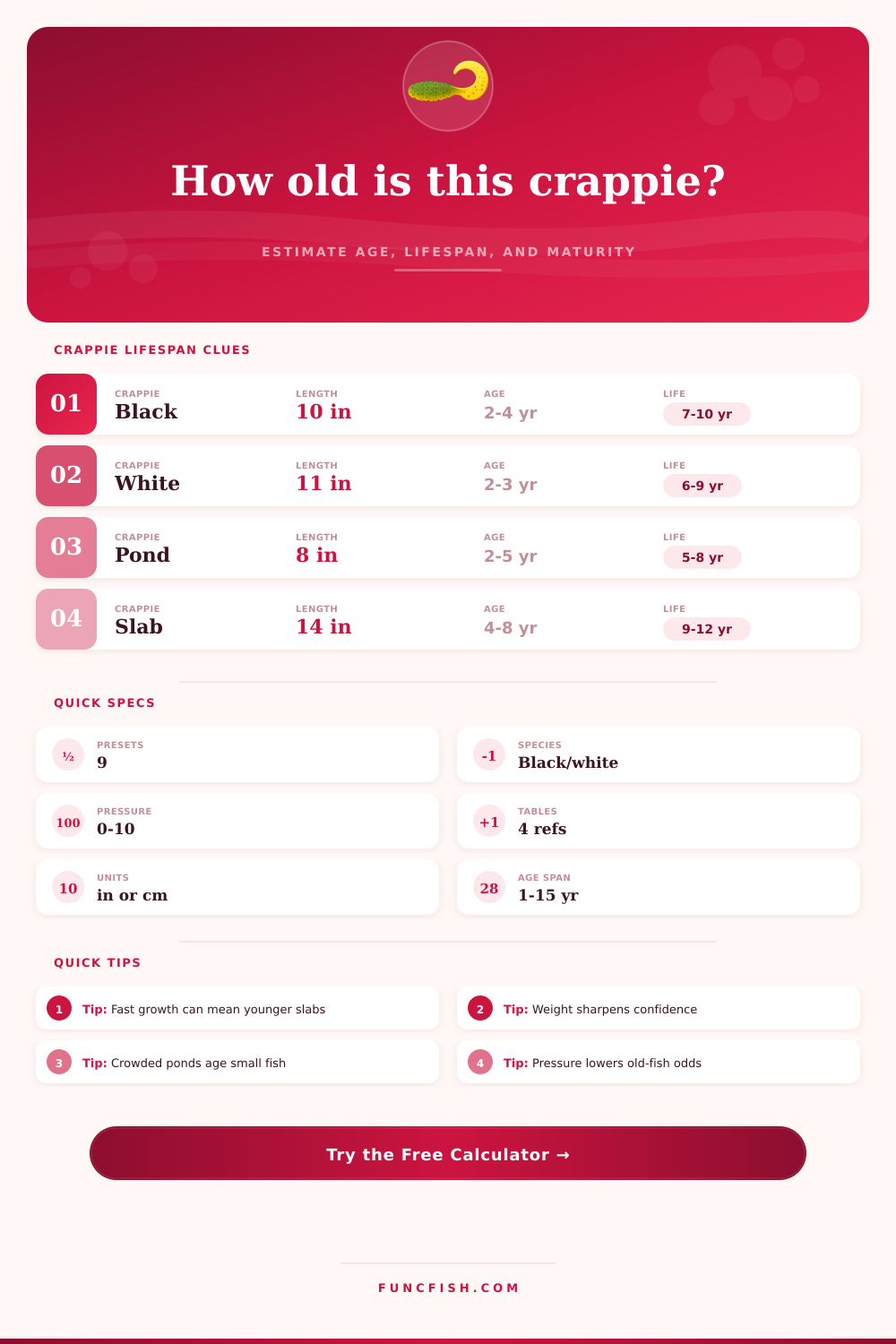
Growth note: A 12 inch crappie can be young in a fertile reservoir and much older in a crowded pond or low-productivity lake, so habitat and growth rate matter as much as length.
Confidence note: Length and weight tighten the estimate by separating a plump fast-growing slab from a thin slow-growing fish. Otolith or scale aging is still the biological confirmation.
To estimate the age of an crappie, several different variable must be considered because the size of a crappie dont always indicate the age of the crappie. A crappie may be of a large size, but that does not necesarily mean that it is an old crappie. The age of a crappie depends on several factors, including the type of water in which the crappie lives, the amount of food available to the crappie, and how often fishing pressure features the crappie.
To estimate the age of a crappie, you can enter the length, weight, and type of water in which the crappie was caught into the calculator. The calculator will mathematicaly calculate the age of the crappie for you. The growth rate of a crappie is one of the primary variable in age determination.
How to Estimate the Age of a Crappie
In lakes or reservoirs containing plenty of food for crappies, such as shad or plankton, crappies can reach a length of ten inches in only two season. In farm ponds or lakes with limited food for crappies, it may take a crappie four or five year to reach the same length. The growth rate of a crappie change based off the amount of food that it can find in its habitat.
The growth rate determines how long it may take for the crappie to reach a specific length. To determine the age of a crappie, these two variable must be considered. Fishing pressure on the crappie population and the amount of forage for crappie food in a specific location also impact the age of the crappies.
If people heavily fish a population of crappies, the oldest crappies are removed from the population. In these cases, there will be fewer old crappies in the population. With light fishing pressure and plenty of forage for food for crappies, the crappies will live longer in there habitat, reaching a greater age.
This factor is also accounted for in the forage and pressure index in the age calculator. If the crappie score a low forage and pressure index, it means that its age will be higher. If the crappie scores a high forage and pressure index, its age will be lower than crappies caught in habitats with lower forage and fishing pressure.
Another variable to consider in estimating the age of a crappie is the maturity stage of the crappie. Crappies that have spawned at least once are likely of an older age than crappies of the same length that has not yet spawned. To determine the age of the crappie, the calculator asks if the crappie indicated is a first-spawn adult or a post-spawn adult.
Providing this information provides the crappie age calculator with information to provide an accurate age estimate for the crappie. An accurate age estimate is essential because providing inaccurate information to the crappie age calculator may result in an inaccurate age estimate for the crappie. The weight of the crappie is another crucial factor to consider when estimating the age of a crappie.
Crappies that are heavy and plump for their length has likely experienced a quick growth rate, meaning they are likely of a younger age. Crappies that are thin for their length have likely experienced a slower growth rate as they age. The condition factor calculate the actual weight of the crappie and compares that to the expected weight of the crappie of that length.
If you dont provide this value in the crappie age calculator, the age estimate that is provided will not be as precise as it could of been. Both the length and weight of the crappie provide a more precise age estimate than length alone. The reference tables located on the page provide crucial information regarding crappie age, specifically black crappie and white crappie age.
These tables provide information on how the age of the crappie changes with the type of water in which it live. A crappie that is 12 inches in length in one lake might be four years old, but the same length of crappie in another lake might be seven years old. These tables also provide information on how the age of the crappie changes in lakes in the northern regions of the United States to crappie populations in the southern reservoirs.
Matching the type of water in which the crappie lives with the reference tables will provide the best estimate of the crappies age. Finally, it is important to understand that the information that this crappie age calculator calculates is only an estimate. The definitive measurement of the age of a crappie requires examining the scale of the crappie to read the growth rings that indicate the age of the crappie.
However, most people are unlikely to be able to examine the crappie scales while fishing for them. Therefore, the crappie age calculator provide an estimate of the age of the crappie. The age of a crappie is determined by the effects of temperature, food supply, competition for resources, and the rate at which crappies are fished from their habitats.
By considering each of these factors when estimating the age of a crappie, individuals can gain an understanding of the age of the crappie that they have caught while fishing.